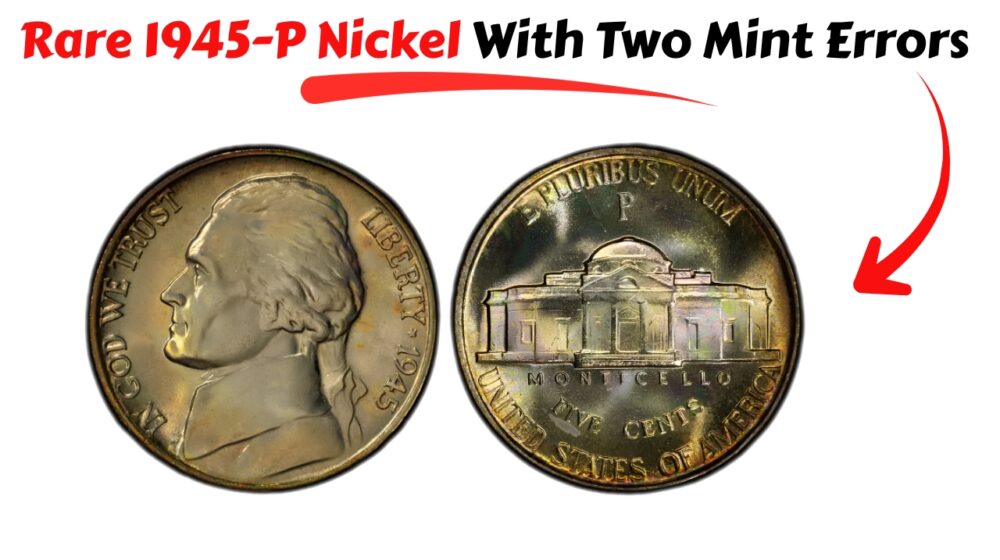
Most error and variety coins earn their reputation on the strength of a single flaw. A doubled die, a broadstrike, an off-center strike, a clipped planchet collectors typically hunt for one dramatic anomaly per coin. A 1945-P Jefferson Nickel now certified by CAC Grading breaks that pattern entirely. It carries one of the most celebrated doubled dies in the entire Jefferson Nickel series on its reverse, and it was struck on a planchet that was already incomplete before it ever reached the coining press.
CAC Grading has certified the coin as MS63, recording an actual weight of 4.75 grams against a standard weight of 5.00 grams the missing quarter-gram accounted for by a curved clip along the edge of the planchet. The certification number is 98359027. Struck in the wartime silver alloy adopted to conserve nickel for the military, this coin folds three separate storylines a national metal shortage, a die-hubbing mistake, and a blanking-press malfunction into one small piece of circulating 1945 currency.
Coin Specifications
| Attribute | Detail |
|---|---|
| Country | United States |
| Denomination | Five Cents (Jefferson Nickel) |
| Year | 1945 |
| Mint | Philadelphia |
| Designer | Felix Schlag |
| Major Variety | Doubled Die Reverse |
| Attribution Numbers | FS-801; CONECA DDR-001; NGC VarietyPlus VP-001 (formerly cataloged as FS-030) |
| Planchet Error | 5% curved clip |
| Total 1945-P Mintage | 119,408,100 (all varieties combined) |
| FS-801 Mintage | Not separately recorded by the Mint |
| Composition | 56% copper, 35% silver, 9% manganese (wartime “silver nickel” alloy) |
| Standard Weight | 5.00 grams |
| Actual Weight of This Coin | 4.75 grams |
| Diameter | 21.2 mm |
| Edge | Plain |
| Grade | MS63 |
| Grading Service | CAC Grading |
| Certification Number | 98359027 |
Specifications drawn from CAC Grading, PCGS CoinFacts, and NGC VarietyPlus references for the 1945-P issue.
How a Collector Actually Acquires a Coin Like This
Unlike a modern commemorative or a numismatic product sold directly by a mint, a certified 1945-P FS-801 with a documented clip is a one-of-a-kind survivor from circulation. There is no fixed retail price, no mintage cap set by an issuing authority, and no scheduled “order window,” because the coin was never sold as a product in the first place it was struck for commerce in 1945 and only decades later identified, attributed, and certified. Anyone interested in owning this specific coin, or one like it, should expect to work through the channels error and variety specialists actually use:
- Confirm the certification independently. CAC Grading’s online verification tool lets a buyer enter certification number 98359027 to confirm the coin’s grade, weight, and attributes match what a seller represents.
- Work through a recognized dealer. Members of professional bodies such as the Professional Numismatists Guild (PNG) or dealers active in major coin clubs (ANA, CONECA for variety specialists) are the standard route for high-end error and variety material.
- Watch major auction houses. Doubled-die and mint-error specialists regularly consign pieces like this to auction platforms such as Heritage Auctions, Stack’s Bowers, and GreatCollections, where bidding not a fixed list price determines final value.
- Compare against recent sales. Because the coin combines a major doubled die with an independent planchet error, pricing guides for a “plain” 1945-P FS-801 will understate its value; recent auction results for combination-error Jefferson Nickels are a better benchmark.
- Verify authenticity of any raw (uncertified) example separately. A raw coin claiming the same combination of errors should be sent to CAC, PCGS, or NGC for attribution before any purchase, since doubled dies and clips both have well-known counterfeits and look-alikes (machine doubling and straight clips, respectively).
There is no purchase limit, no set release date, and no publicly listed price for this certification buyers should treat any specific number quoted by a seller as a negotiable market price, not an official one, and confirm it against recent comparable auction results.
Historical Background: The Coi
Metal for a Nation at War
The story of the 1945-P FS-801 nickel begins away from the mint entirely, with the demands of wartime industry. Before 1942, the Jefferson Nickel introduced in 1938 was struck in a standard alloy of 75% copper and 25% nickel. Once the United States entered World War II, nickel metal became critical to manufacturing armor plate and other military hardware, and Congress authorized the Treasury to remove nickel from the five-cent coin entirely for the duration of the emergency.
After testing alternatives, the Mint settled on an unusual substitute alloy: 56% copper, 35% silver, and 9% manganese. The manganese content was specifically chosen so the new coins would still register correctly in vending machines calibrated for the older copper-nickel pieces. Production of the new alloy began late in 1942, meaning collectors have to be careful with that transitional year Philadelphia and Denver struck ordinary copper-nickel nickels early in 1942, while Philadelphia and San Francisco began producing the new wartime composition only in the year’s closing months. From 1943 through the end of 1945, all three operating mints Philadelphia, Denver, and San Francisco struck the emergency silver alloy exclusively.
The composition change also created a numismatic milestone. To make the temporary alloy coins easy to distinguish at a glance, the Mint enlarged the mintmark and relocated it above the dome of Monticello on the reverse. Philadelphia coins, which had never before carried a mintmark of any kind, received a large “P” the first time a Philadelphia mintmark had ever appeared on United States coinage. That oversized P on the 1945 issue is therefore more than a mint identifier; it is a visible artifact of wartime metallurgy.
The Designer
The Jefferson Nickel design itself was the work of Felix Schlag, a German-born sculptor who won a 1938 public design competition sponsored by the Treasury Department to replace the Indian Head “Buffalo” Nickel. Schlag’s design paired a left-facing portrait of Thomas Jefferson on the obverse with a rendering of Jefferson’s Virginia home, Monticello, on the reverse a pairing that, aside from the wartime mintmark change and a later reverse modification, would remain in production for decades.
The FS-801 Doubled Die Reverse
Of the doubled dies known across the classic Jefferson Nickel series, three are generally regarded as the most significant: the 1939 Doubled Die Reverse, the 1943 Doubled Die Obverse, and the 1945 Doubled Die Reverse discussed here. The Philadelphia Mint’s total 1945 nickel production came to 119,408,100 coins, but that figure covers the entire year’s output across all working dies Mint records do not break out how many coins any single doubled die, including FS-801, actually produced.
A doubled die is not a flaw introduced at the moment of striking a coin. It originates earlier, during the manufacture of the working die itself. In the 1940s, bringing a complete design into a working die typically required more than one impression from a master hub, with the die annealed (softened) and returned to the hubbing press between impressions. If the die and hub were not perfectly aligned on a later hubbing, the working die could pick up two slightly offset versions of the design. Once that doubled die entered service at the Mint, every coin it struck carried the same doubling the FS-801 nickel was not damaged after leaving the press; it was born doubled.
Collectors identify the FS-801 primarily through the lettering beneath the Monticello image. Strong doubling is visible on the words MONTICELLO and FIVE CENTS, with additional doubling running through portions of UNITED STATES OF AMERICA. The separation between the doubled elements grows more pronounced toward the right side of the lower reverse, with the closing letters of MONTICELLO and CENTS showing particularly wide spread. NGC catalogs this variety under three parallel systems FS-801, CONECA DDR-001, and VarietyPlus VP-001 while older references list the same variety as FS-030.
The Curved Clip
The coin’s second error has nothing to do with the doubled die and originated at an entirely different stage of production. Coin blanks begin life as long strips of planchet metal, which pass beneath a blanking press that punches out circular discs in sequence. In normal operation, the strip advances a fixed distance between punches so each blank is cut cleanly. When that advance falls short, a punch can overlap the hole left by the previous punch, and the resulting blank is cut with a crescent-shaped bite already missing from its edge what error specialists call a curved clip.
On this coin, CAC Grading measured the missing material at 5% of the planchet, consistent with the quarter-gram shortfall between the coin’s actual 4.75-gram weight and the standard 5.00-gram specification for a wartime nickel. The clipped blank was not caught or rejected; it continued through the production process and eventually reached a coining press one that happened to be equipped with the FS-801 doubled reverse die. The doubled die and the clipped planchet therefore share no common cause. One is a die-manufacturing error; the other is a blanking-press malfunction. They became part of the same coin only by chance, at the instant of striking.
Obverse and Reverse Design Details
Obverse: Thomas Jefferson
The obverse carries Felix Schlag’s left-facing portrait of Thomas Jefferson, the nation’s third president and author of the Declaration of Independence. Jefferson’s profile occupies the center-left of the field, with LIBERTY inscribed to the right along the coin’s edge, followed by an asterisk-flanked motto, IN GOD WE TRUST, curving beneath his chin, and the date positioned at the lower right. On wartime silver nickels, the obverse layout is unchanged from the standard copper-nickel Jefferson design the visible clue to the special alloy sits on the reverse, not here.
Reverse: Monticello, the Oversized Mintmark, and the Doubling
The reverse depicts Monticello, Jefferson’s neoclassical home near Charlottesville, Virginia, rendered in three-quarter perspective with its distinctive dome. MONTICELLO is lettered directly beneath the building, with FIVE CENTS below that and UNITED STATES OF AMERICA arcing around the upper rim. E PLURIBUS UNUM appears above the building itself.
On this coin, two features distinguish the reverse from an ordinary 1945-P nickel. First, the large “P” mintmark sits above Monticello’s dome the wartime-era mark unique to 1942–1945 silver nickels, and the first Philadelphia mintmark ever used on U.S. coinage. Second, and far more consequential for variety collectors, the lettering below the building shows unmistakable doubling: MONTICELLO and FIVE CENTS each display separated, doubled outlines, with the effect strongest on the right-hand letters, and partial doubling extends into UNITED STATES OF AMERICA along the upper rim. Around the coin’s edge, a curved bite is missing from the planchet the visible signature of the clip error, distinct from the doubling and unrelated to it in cause.
Why This Matters for Collectors
It satisfies two collecting specialties at once. Jefferson Nickel variety specialists chase the FS-801 for its bold, well-documented hub doubling a die-making error captured permanently in the design. Mint-error collectors, working an entirely separate branch of numismatics, chase clipped planchets because the coin’s physical shape documents a mechanical breakdown during blank production. A single coin that legitimately belongs in both reference catalogs is unusual.
The two errors are provably independent. Because a doubled die originates in die preparation and a curved clip originates in blank punching, their combination on one coin is not a single production fluke it is two separate, uncorrelated mistakes that happened to converge at the moment of striking. That independence is part of what makes the combination noteworthy rather than coincidental-looking.
It carries genuine wartime history. The coin’s silver-manganese alloy, its oversized Philadelphia mintmark, and its 1945 date all tie it directly to the final year of World War II and the national effort to conserve strategic nickel metal. Collectors of historical U.S. coinage, not only error and variety specialists, have reason to be interested.
Third-party certification reduces authentication risk. Doubled dies are frequently confused with ordinary strike or machine doubling, and clipped planchets have straight-clip and curved-clip look-alikes that require careful measurement to distinguish from damage. A CAC-certified example with a matching, independently verifiable certification number (98359027) removes much of that guesswork for a buyer.
Ordinary 1945-P nickels remain common this combination is not. Wartime nickels were widely saved by the public because of their silver content, so Mint State examples of the plain date are not scarce. The value proposition here rests entirely on the intersection of the major doubled die, the documented planchet error, and an uncirculated grade not on the base date or mint being rare in general.
Quick-Reference Buying Guide
- Verify the certification. Before discussing price with any seller, look up certification number 98359027 through CAC Grading’s official verification tool to confirm the coin’s grade, weight, and described errors match.
- Confirm both errors independently. Cross-check the doubled-die attribution (FS-801 / CONECA DDR-001 / NGC VP-001) and the curved-clip description against the coin’s certification label and, where possible, high-resolution photos of the actual piece.
- Identify the seller’s credentials. Favor dealers who are members of recognized professional organizations (PNG, ANA) or major consignment auction houses with a track record in error and variety coins.
- Research comparable sales. Search recent auction archives (Heritage Auctions, Stack’s Bowers, GreatCollections) for other combination-error Jefferson Nickels to gauge a fair market range, rather than relying on price guides written for single-error examples.
- Ask for full provenance where available. A documented chain of ownership, prior auction appearances, or dealer history adds confidence, particularly for a piece this specialized.
- Complete the purchase through a secure, traceable method. Use payment and shipping methods that offer buyer protection, especially for a certified coin of this value and specificity.
- Store and insure appropriately. Once acquired, keep the coin in its certified holder, avoid handling the coin itself, and consider scheduling it on a collectibles insurance policy given its dual-error significance.