Most countries and their currencies rise and fall together. The Federal Republic of Central America broke that pattern in dramatic fashion. Formed in 1823 out of five former Spanish colonial provinces, the young republic collapsed into civil war and dissolution within less than two decades yet the striking silver coin it introduced to declare its independence kept being struck, in essentially the same design, for years after the government behind it had ceased to exist.
That coin is the Central American Republic 8 Reales, and its inaugural 1824 issue from the Nueva Guatemala mint stands as one of the most historically loaded coins in Latin American numismatics. Rather than a monarch’s portrait, it carries a rising sun over five volcanoes and a Ceiba tree inscribed with a motto celebrating liberty imagery chosen specifically to erase every trace of Spanish royal authority from Central American money. This guide covers the coin’s full specifications, how it came to exist, what its design actually depicts, how collectors acquire examples today, and why it remains such a compelling piece of political and monetary history to own.
Specifications at a Glance
| Detail | Information |
|---|---|
| Issuer | Central American Republic (Federal Republic of Central America) |
| Denomination | 8 Reales (equivalent to 1 Peso) |
| Date | 1824 |
| Mint | Nueva Guatemala (Guatemala City) |
| Mintmark | NG |
| Assayer mark | M Manuel Eusebio Sánchez |
| Catalog number | KM-4 (Krause-Mishler world coin reference) |
| Composition | Silver |
| Fineness | .903 |
| Weight | Approx. 27.07 grams |
| Actual silver weight (ASW) | Approx. 0.7859 troy oz |
| Diameter | Approx. 39 mm |
| Edge / manufacture | Milled coinage, coin alignment |
| Obverse legend | REPUBLICA DEL CENTRO DE AMERICA |
| Reverse legend/motto | LIBRE CREZCA FECUNDO (“Grow free and fruitful”) |
| Series span | Nueva Guatemala 8 Reales type struck 1824–1847 |
| Typical circulated market value | Roughly under $100–$200 for Fine to Extremely Fine grades |
| Mint State market value | Can exceed $5,000 depending on grade and eye appeal |
| Proof/pattern rarities | Documented estimates in the $12,500–$15,000+ range for exceptional Proof or pattern examples |
Because this is a 19th-century world coin traded on the open collector market rather than a currently issued product, there is no single fixed “price” value depends heavily on grade, strike quality, originality of surfaces, and whether the piece carries a later circulation countermark.

How Collectors Acquire This Coin Today
There is, of course, no active order window for a coin struck two centuries ago Central America’s federal government that authorized this design no longer exists, and the coin itself hasn’t been struck since 1847. Collectors instead find examples through the established world-coin and Latin American numismatics market. Here’s what that process typically looks like.
Availability by grade. Despite the short life of the political union it commemorates, the 8 Reales was produced in substantial volume during its run, and worn circulated examples remain genuinely common. Well-worn pieces in Fine to Extremely Fine condition regularly trade for well under $200, with some lower-grade examples selling for under $100 making this a surprisingly accessible entry point into a coin with major historical weight. Mint State and Proof-quality examples are a different story entirely: they’re scarce, prized for their luster and sharp strike, and can command prices from several thousand dollars into five figures depending on grade and eye appeal.
Where to buy. Major auction houses with strong world and Latin American coin departments Heritage Auctions, Stack’s Bowers Galleries, and GreatCollections among them regularly handle 8 Reales examples across the full 1824–1847 date range, along with dealers specializing in Latin American colonial and early republican coinage.
Certification matters. Because strike quality on this type is often irregular and cleaning or light circulation wear is common, buying a coin certified by PCGS or NGC gives collectors a documented, third-party grade and an authenticity guarantee valuable given how much price can swing between adjacent grades on this series.
Watch for later countermarks. Some surviving 8 Reales pieces carry countermarks applied after the federation’s 1838–1841 collapse, often featuring a sun-behind-a-mountain motif, reflecting the coin’s continued use in commerce even after the political union that created it had disbanded. These countermarked pieces are a distinct collecting sub-category in their own right.
Bidding mechanics. As with any certified-coin auction, prospective bidders generally need to register with the auction house in advance, and should confirm each house’s specific buyer’s premium (commonly in the 15–20% range across major U.S. auction houses, though this varies by venue and payment method) and any applicable sales tax or shipping costs before bidding.
No purchase limits. Unlike a modern Mint product, there’s no cap on how many examples a collector can acquire availability is simply a function of what’s consigned to auction or held by dealers at any given time, which for the more common circulated grades of this type is fairly steady.
Historical Background
The Political Story: A Federation Born and Lost
Central America broke from Spanish colonial rule in 1821, but independence did not immediately produce the separate nations that exist in the region today. The territory first joined the short-lived Mexican Empire under Agustín de Iturbide; when that government collapsed, Central American representatives declared independence from Mexico on July 1, 1823. Guatemala, El Salvador, Honduras, Nicaragua, and Costa Rica then banded together as the United Provinces of Central America, formalized as the Federal Republic of Central America under a constitution that took effect on November 22, 1824.
The new federation needed institutions that visibly broke with its colonial past, and money was one of the most public ways to make that statement. On March 19, 1824, the National Constituent Assembly passed a coinage law explicitly banning any depiction of the Spanish monarch’s bust, coat of arms, or other royal symbols on the republic’s new coinage. In their place, lawmakers specified a landscape: five volcanoes beneath a rising sun for the silver coinage, and a tree symbolizing liberty on the reverse. That legislative choice produced one of the standout designs in 19th-century Latin American numismatics.
The union it commemorated did not last. Liberal and conservative factions clashed over the shape and direction of the government throughout the 1820s and 1830s, compounded by regional rivalries that steadily eroded federal authority. Civil war followed, member states began withdrawing from the federation by 1838, and the union effectively dissolved around 1840, with El Salvador remaining its last legal successor until 1841. What had been envisioned as a lasting political experiment survived barely a generation.
The Coin’s Own Story: Surviving Its Government
What makes this issue remarkable is that the coin outlived the political entity it was minted to represent. The Nueva Guatemala mint kept striking the same basic 8 Reales design the same volcanoes, the same rising sun, the same Ceiba tree and liberty motto well after the federal republic had stopped functioning as a unified government. Modern references, including PCGS’s own type set structure, catalog Guatemala-mint examples of this design dated all the way through 1847, roughly seven years past the federation’s practical collapse.
That continuity says something important about the difference between political authority and monetary trust. Borders shifted, alliances broke apart, and the government that had legislated this design out of a rejection of monarchy disappeared yet merchants and the public kept recognizing, accepting, and using the coin itself. The 1824 date holds particular importance within that longer run because it marks the series’ inaugural year, cataloged by major world-coin references as KM-4.
An International Dimension: Recognition in the United States
The coin’s significance wasn’t confined to Central America. On June 25, 1834, the United States Congress passed legislation regulating the value of specified foreign silver coins circulating domestically, explicitly naming the silver dollars of Mexico, Peru, Chile, and Central America among those qualified to pass as legal money in the U.S. at 100 cents to the dollar, provided they met the law’s weight and fineness standards. That gave the Central American Republic 8 Reales a genuine foothold in American commerce during the era evidence that this wasn’t simply a regional curiosity, but a recognized unit of international silver-dollar trade alongside its better-known Spanish-American counterparts.
Design Continuity With the Spanish-American Dollar Tradition
While the imagery broke completely from Spanish colonial symbolism, the underlying monetary framework did not. The 8 Reales denomination descended directly from the long-established Spanish-American silver peso system, in which eight reales equaled one peso a standard that had already circulated internationally for generations by 1824. By keeping the familiar denomination, weight, and fineness while replacing only the imagery, the new republic managed a genuine political break from the Spanish crown without disrupting the monetary framework merchants already trusted.
Obverse and Reverse: Reading the Design
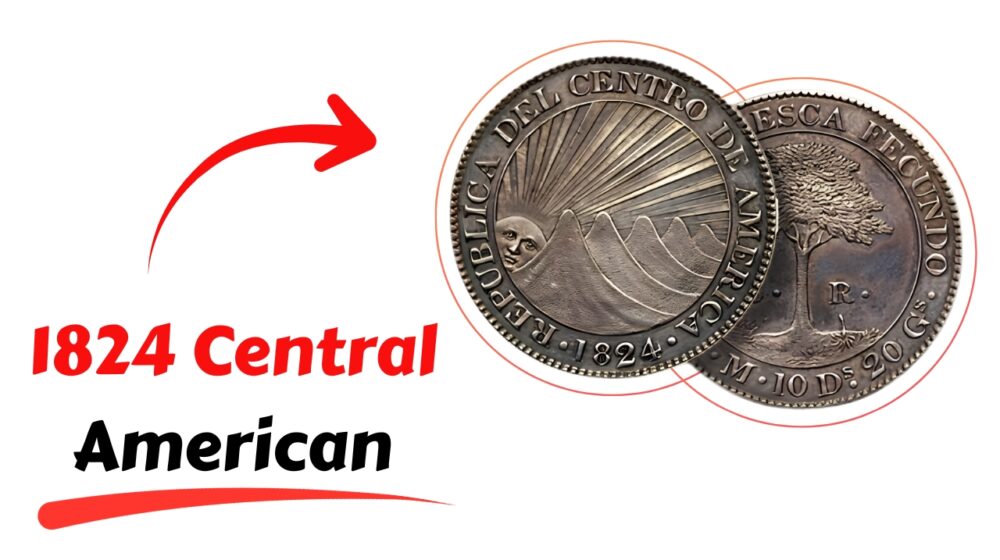
Obverse. The design centers on a dramatic landscape rather than a portrait: five volcanic peaks rise across the coin’s field, with a radiant sun climbing above the horizon behind them. Collectors traditionally read the five volcanoes as representing the federation’s five member states Guatemala, El Salvador, Honduras, Nicaragua, and Costa Rica while the rising sun signals the dawn of a new political era free from colonial rule. The legend REPUBLICA DEL CENTRO DE AMERICA arcs around the design. Notably absent is anything resembling a monarch’s bust, a crown, or a royal coat of arms a deliberate, legislated omission that gives the coin much of its visual and symbolic force.
Reverse. A large Ceiba tree dominates the field, explicitly identified in the 1824 coinage decree as an emblem of liberty. The motto LIBRE CREZCA FECUNDO (“Grow free and fruitful”) circles the design, directly tying the tree’s imagery to the republic’s aspirations for the future. The denomination appears as 8 R beside the tree, while the NG mintmark (Nueva Guatemala) and M assayer initial (for Manuel Eusebio Sánchez, who served the mint across both the late Spanish colonial period and the early republican era) appear below.
Condition notes. Strike quality on this type is often irregular, a byproduct of period minting technology working with a large, high-relief design; strong, fully struck examples that clearly show the sun’s rays, distinct volcanic contours, and fine branch detail on the Ceiba are more desirable and command real premiums. Large silver surfaces on well-preserved examples can also develop attractive natural toning, adding further to a coin’s eye appeal and value.
Why This Matters for Collectors
A genuine political manifesto in silver. Few world coins encode a specific legislative act as directly as this one. The 1824 coinage law didn’t just update a design it legally prohibited royal imagery and mandated new republican symbolism, and this coin is the direct physical result of that decree.
A rare “coin outlives country” story. Most numismatic history involves coinage changing because governments changed. This series inverts that pattern: the government fell apart, but the mint kept striking essentially the same design for years afterward, making the coin a tangible record of monetary continuity surviving political collapse.
Real accessibility at the entry level. Despite carrying this much history, worn circulated examples are genuinely affordable often under $200, sometimes under $100 making the type an unusually approachable way to own a piece of early Latin American republican history without a five-figure budget.
Meaningful upside for condition-focused collectors. For those chasing higher grades, Mint State and Proof-quality examples are legitimately scarce and can bring prices into the thousands or, for exceptional pattern or Proof pieces, well into five figures giving the series real depth for collectors who want to specialize.
A documented connection to U.S. monetary history. The 1834 congressional act recognizing Central American silver dollars as legal tender in the United States adds a concrete American numismatic angle to a coin that might otherwise be seen as purely a Latin American specialty.
A first-year type coin. As the inaugural 1824 issue of the KM-4 series, this date carries particular significance for type collectors and specialists in the broader 1824–1847 Central American Republic 8 Reales run, distinguishing it from the many later-dated examples that share the same basic design.
Quick-Reference Buying Guide
- Decide what you’re collecting for — a representative circulated example for historical interest, or a high-grade Mint State/Proof piece as a condition rarity since the price difference between these goals is enormous.
- Confirm the date and catalog number. Look specifically for the 1824-NG M, KM-4 issue if the inaugural year matters to you, since the design was struck with only modest changes through 1847.
- Favor certified examples. A PCGS- or NGC-graded coin gives you a documented grade and authenticity guarantee, which matters given how common cleaning, adjustment marks, and irregular strikes are on this type.
- Shop major auction houses and Latin American specialists — Heritage Auctions, Stack’s Bowers Galleries, and GreatCollections regularly handle this series, alongside dealers who focus on colonial and early republican Latin American coinage.
- Compare recent sold prices for the same date, grade, and certification service before bidding, since values can vary significantly based on strike quality and eye appeal even within the same numeric grade.
- Consider a countermarked example if you’re interested in the coin’s post-federation circulation history these carry an added, documented layer of the story beyond the original 1824 striking.
- Register with your chosen auction house in advance and confirm the buyer’s premium, payment methods, and any applicable sales tax or shipping costs before you bid.
- Budget realistically by grade — plan on roughly $100–$200 for a solid circulated example, low thousands for choice Mint State, and five figures for exceptional Proof or pattern rarities.
This article covers a historical world coin traded on the secondary collector market. There is no current issuing authority, order window, or fixed retail price for this series; figures above reflect general auction-market ranges and can vary by grade, strike quality, and originality.