Modern U.S. coins rarely earn legendary status the moment they’re released. The 2020-W End of World War II 75th Anniversary $50 Proof American Gold Eagle came about as close as any coin in recent memory. The U.S. Mint capped production at exactly 1,945 pieces a deliberate nod to 1945, the year World War II ended making it, by a wide margin, the lowest-mintage American Gold Eagle ever issued.
When ordering opened at noon Eastern Time on November 5, 2020, the response was immediate and overwhelming. Within seven minutes, the coin had sold out, and record-breaking web traffic left thousands of would-be buyers staring at error messages instead of checkout confirmations. A $2,600 Mint product instantly became one of the most sought-after modern coins in the country, and its story didn’t end there the coin’s design pedigree, its symbolic privy mark, and its position at the close of an entire design era have kept collector interest strong for more than five years since.
At a Glance: Specifications
| Detail | Description |
|---|---|
| Official name | End of World War II 75th Anniversary American Eagle Gold Proof Coin |
| Year | 2020 |
| Denomination | $50 |
| Mint facility | West Point |
| Mintmark | W |
| Finish | Proof |
| Product code | 20XE |
| Product limit | 1,945 |
| Later reported Mint sales figure | 1,939 |
| Composition | 91.67% gold, 3% silver, 5.33% copper |
| Gold content | 1.000 troy ounce |
| Weight | 33.931 grams |
| Diameter | 32.70 mm |
| Edge | Reeded |
| Obverse designer | Augustus Saint-Gaudens |
| Reverse designer | Miley Busiek Frost |
| Privy mark | “V75” set within an outline of the Rainbow Pool at the National WWII Memorial |
| Original Mint price | $2,600 |
| Notable auction result | $43,200 (Heritage Auctions, April 6, 2025, PCGS PR70 Deep Cameo, Trump signature holder 55/75) |
| Typical PR70 secondary-market range (2023–2026) | Roughly $19,500–$24,000 |
The Ordering Process: Seven Minutes That Overwhelmed the Mint
The 2020-W V75 Gold Eagle’s release stands as one of the most dramatic ordering events in recent U.S. Mint history:

- Launch date and time. Ordering opened at noon Eastern Time on November 5, 2020, under product code 20XE.
- Household limit. The Mint imposed a strict limit of one coin per household, a common restriction for high-demand numismatic releases.
- Original price. Each coin was priced at $2,600 at the time of release.
- Immediate sellout. By 12:07 p.m. just seven minutes after the sale began the coin had become unavailable.
- Site instability. The Mint later confirmed the release generated the highest website traffic it had ever recorded, exceeding system capacity and producing widespread error messages and failed transactions for customers attempting to order.
- Order reconciliation. First-day orders totaled 1,737 coins. As the Mint reconciled failed and duplicate transactions, additional inventory periodically returned to the site, pushing cumulative sales to 1,923 coins by November 13, 2020.
- Final sales figures. U.S. Mint data published in 2022 placed cumulative sales at 1,939 coins, though major grading services and auction houses continue to catalog the issue by its announced 1,945-piece limit.
For collectors trying to understand the discrepancy between figures, the distinction is straightforward: 1,945 represents the Mint’s announced production limit, while 1,939 reflects the final number of coins actually sold according to later reported Mint data. Either figure places the V75 far below any other American Gold Eagle mintage in the program’s history.
Historical Background
The American Gold Eagle Program
The American Gold Eagle series launched in 1986, giving the United States its first officially sanctioned gold bullion and proof coin program in decades. From its debut, the series paired a revived version of one of America’s most celebrated coin designs with a brand-new reverse, creating a program that balanced classic artistry with a fresh national symbol. The one-ounce $50 denomination has remained the flagship weight in the series since its introduction.
Augustus Saint-Gaudens and the Striding Liberty
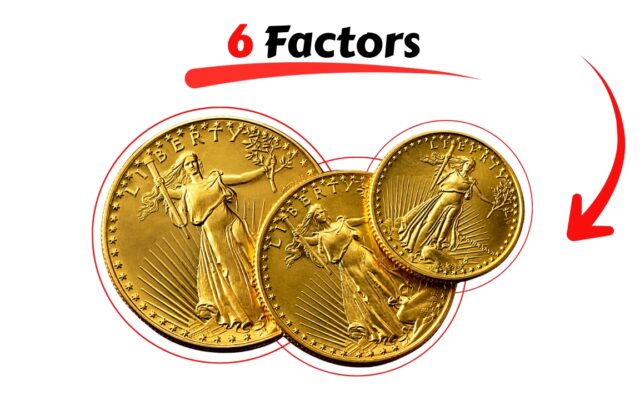
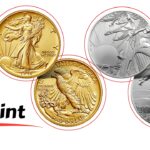
The obverse design used on every American Gold Eagle traces back to Augustus Saint-Gaudens, one of the most influential sculptors in American coinage history. Saint-Gaudens originally created this full-length striding Liberty for the 1907 Double Eagle, a $20 gold piece commissioned by President Theodore Roosevelt as part of his effort to elevate the artistic quality of American coinage an era often referred to as the “Renaissance of American Coinage.” When the Mint launched the American Gold Eagle program in 1986, it adapted Saint-Gaudens’ Liberty for the new series, giving the modern bullion coin a direct visual link to one of the most admired coin designs of the early 20th century.
Miley Busiek Frost and the Family of Eagles
The reverse design used on Gold Eagles from 1986 through 2021 came from artist Miley Busiek Frost, whose “Family of Eagles” composition depicts a male eagle descending toward a nest where a female eagle shelters young eaglets. This design gave the American Gold Eagle program its own distinct identity from the moment of its launch, separate from the historic obverse. Notably, the Mint retired this reverse after 2021, introducing a new design by Jennie Norris for the program’s 35th anniversary in 2022 meaning the 2020-W V75 Gold Eagle was struck during the final full calendar year of the original 1986 reverse design, adding an additional layer of historical significance beyond its already record-low mintage.
The V75 Privy Mark and the National WWII Memorial
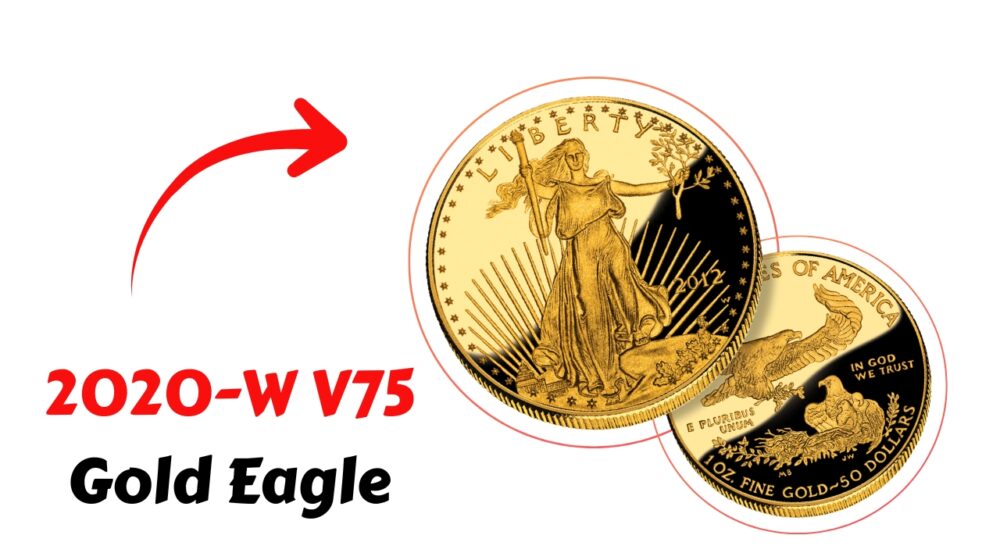
Privy marks have a long tradition in world coinage, historically used to identify a mint, moneyer, or artist, and more recently used by modern mints to commemorate significant anniversaries. For the 2020-W Gold Eagle, the Mint placed a small “V75” mark in the right obverse field, set within a recessed outline shaped after the aerial footprint of the Rainbow Pool at the National World War II Memorial in Washington, D.C. The same V75 symbol also appeared that year on select West Point America the Beautiful quarters and on a special Proof Silver Eagle, but it was the Gold Eagle’s dramatically restricted mintage that transformed the mark from a simple anniversary symbol into an instantly recognizable key-date identifier.
Obverse and Reverse Design Details
Obverse
The obverse features Augustus Saint-Gaudens’ full-length depiction of Liberty striding forward, her right hand holding a torch aloft and her left cradling an olive branch, with the U.S. Capitol building visible in the background and rays of sunlight framing the scene. On the 2020-W V75 issue, this classic design remains fully intact, with the addition of the small V75 privy mark placed discreetly in the right field modeled after the shape of the Rainbow Pool at the National WWII Memorial. The mark is easy to overlook at first glance, which is part of what makes its discovery so rewarding for new collectors examining the coin closely for the first time.
Reverse
The reverse carries Miley Busiek Frost’s “Family of Eagles” design, showing a male eagle descending with an olive branch toward a nest, where a female eagle watches over their young. In the context of a coin commemorating the end of World War II, the olive branch takes on added resonance, visually reinforcing the theme of peace following the deadliest conflict of the 20th century. This marked the final full calendar year in which the Family of Eagles reverse appeared before the Mint retired the design in 2022.
Why This Matters for Collectors
- The lowest mintage in Gold Eagle history. At a maximum of 1,945 pieces, no other American Gold Eagle proof, bullion, or otherwise comes close to this level of scarcity.
- A meaningful, symbolic mintage figure. The 1,945-coin limit directly echoes 1945, the year World War II ended, giving the coin’s rarity historical significance rather than arbitrary scarcity.
- A design at the crossroads of two eras. The coin combines Saint-Gaudens’ century-old Liberty with the final full year of Miley Busiek Frost’s original 1986 Family of Eagles reverse, placing it at a genuine turning point in the American Gold Eagle program’s design history.
- A privy mark tied to a national memorial. The V75 mark’s Rainbow Pool outline creates a direct physical connection between the coin and the National World War II Memorial in Washington, D.C.
- Absolute rarity, not condition rarity. With more than 91% of NGC-certified examples grading PF70 Ultra Cameo, collectors are not competing over top-grade survivors in the way they would with many modern issues the scarcity comes from the tiny original supply itself, regardless of grade or designation.
- A documented, dramatic launch story. The seven-minute sellout, record website traffic, and widespread checkout failures created a genuine numismatic event, not just a limited product release.
- Sustained secondary-market strength. From an original $2,600 issue price to sustained five-figure resale values years later including a $43,200 auction result for an exceptional signed holder the coin has demonstrated lasting collector demand well beyond its initial release window.
Quick-Reference Buying Guide
- Understand the two population figures. Recognize that 1,945 represents the Mint’s announced production limit, while 1,939 reflects later-reported final sales data; both confirm the coin’s status as the lowest-mintage American Gold Eagle.
- Prioritize certified examples. Given the coin’s value, insist on PCGS or NGC certification, and pay attention to designations such as First Strike or First Day of Issue, which can affect price even though the coin’s core rarity applies to all examples equally.
- Don’t assume every PR70 commands auction-record pricing. The widely cited $43,200 result involved a specially numbered Trump-signature holder from a limited 75-piece group; more typical PR70 examples have traded in the roughly $19,500–$24,000 range in recent years.
- Compare recent auction results across multiple houses. Check records from Heritage Auctions, Stack’s Bowers, and GreatCollections to build a realistic sense of current market value before buying.
- Look closely at the privy mark before purchasing. Confirm the V75 mark and Rainbow Pool outline are present and well-struck, since this small detail is central to the coin’s identity and value.
- Understand the coin’s design significance. Appreciate that the coin pairs Saint-Gaudens’ historic Liberty with the final full year of the original Family of Eagles reverse, adding collector interest beyond the mintage figure alone.
- Buy from reputable dealers or established auction houses. Given the coin’s high value and strong demand, purchase through sources with verifiable track records in major U.S. Mint modern rarities.
- Consider long-term holding potential. With sustained demand and rising secondary-market prices years after release, evaluate the coin as both a historically significant collectible and a potential long-term holding, while recognizing that gold and numismatic premiums can each fluctuate independently.