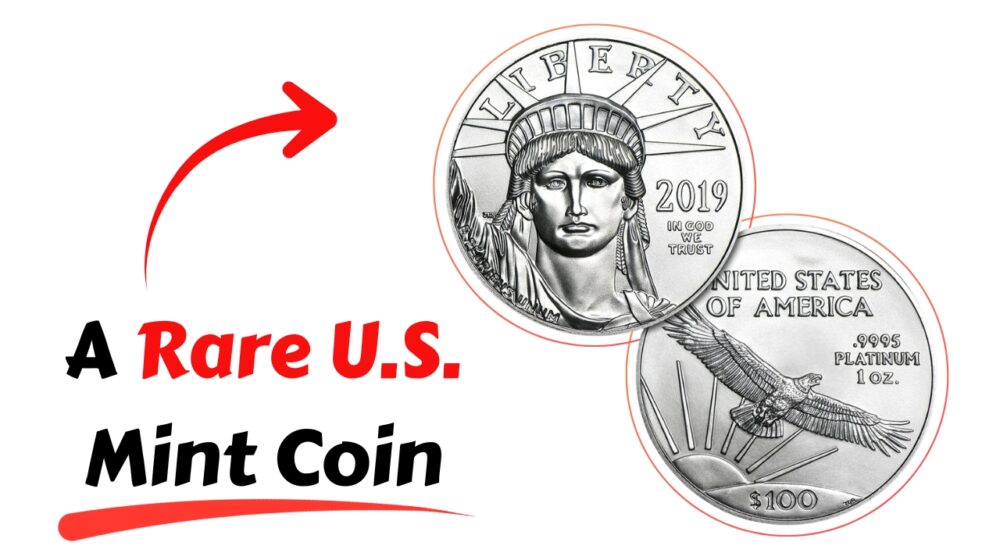
On January 11, 2026, a single ounce of platinum did something few bullion coins ever manage: it sold for nearly $300,000. GreatCollections closed the auction of a 2007-W $100 One-Ounce American Platinum Eagle graded PCGS Proof-70 Deep Cameo and identified as a “Frosted FREEDOM” variety at $290,124, after drawing 109 competing bids. The result set a new auction benchmark for one of modern U.S. coinage’s quietest, strangest rarities.
What makes the coin remarkable isn’t a mint error in the usual sense no doubled die, no off-center strike, no missing mintmark. The entire story turns on the finish applied to seven letters: F-R-E-E-D-O-M. A small batch of pre-production coins, struck while the Mint was still testing a design finish, apparently slipped into regular distribution before anyone caught the mix-up. By the time collectors noticed, nearly four years had passed. Today, this coin sits among the most coveted modern platinum rarities in the hobby, and specialists believe some of the surviving pieces still haven’t been identified.
At a Glance: Specifications
| Detail | Description |
|---|---|
| Country | United States |
| Year | 2007 |
| Mint facility | West Point (W) |
| Denomination | $100 |
| Series | American Platinum Eagle, Proof |
| Theme | Foundations of American Democracy Executive Branch |
| Composition | 99.95% platinum |
| Weight | 31.12 grams (1 troy ounce of platinum) |
| Diameter | 32.70 mm |
| Edge | Reeded |
| Strike type | Proof |
| Obverse design | Statue of Liberty, by John M. Mercanti |
| Reverse design | Eagle with shield, by Thomas S. Cleveland; engraved by Phebe Hemphill |
| Known variety | “Frosted FREEDOM” recessed lettering frosted rather than mirrored |
| Reported trial mintage (1 oz) | Maximum of 12 pieces, per U.S. Mint |
| Total 2007-W $100 Proof mintage | 8,363 coins (only a handful of which are the Frosted variety) |
| Notable auction result | $290,124 (GreatCollections, January 11, 2026, PCGS PF-70 DCAM) |
How This Coin Actually Reaches the Market
Unlike a newly released Mint product, the Frosted Freedom Platinum Eagle isn’t something a collector can order directly from the U.S. Mint — it was never knowingly sold as a distinct item, and no fixed household or per-order limit ever applied to it. Instead, it circulates today strictly through the secondary market: major coin auction houses, dealer private-treaty sales, and occasional appearances at large numismatic shows.
Because the population is so small, opportunities to buy one are infrequent and largely unpredictable. Recorded transactions illustrate just how sporadic the market has been for the one-ounce version:
| Date | Grade/Holder | Sale Type | Price |
|---|---|---|---|
| October 2011 | NGC PF-70 Ultra Cameo, Discovery Specimen | Private treaty trade | ~$45,000 (in coins) |
| November 13, 2022 | PCGS Proof-70 DCAM | GreatCollections auction, 83 bids | $232,624.12 |
| January 11, 2026 | PCGS Proof-70 DCAM | GreatCollections auction, 109 bids | $290,124 |
For collectors hoping to acquire an example, the practical path involves watching major auction platforms (GreatCollections, Heritage, and similar firms), setting standing alerts for “Frosted Freedom” or “2007-W Platinum Eagle trial,” and building a relationship with dealers who specialize in modern U.S. Mint rarities and patterns. Because population reports remain incomplete, new discovery pieces occasionally surface from old, unexamined holdings meaning the next example to hit the market could come from an unexpected source rather than a scheduled sale.
Coin History and Design Background
The American Platinum Eagle Series
The U.S. Mint introduced the American Platinum Eagle in 1997, giving American platinum bullion its own dedicated coin program. What set the Proof version apart from its bullion counterpart was a willingness to rotate reverse designs regularly, turning the series into an evolving showcase of American themes rather than a fixed, unchanging design. Between 2006 and 2008, the Mint used this flexibility to run its “Foundations of American Democracy” series, dedicating one year’s reverse to each branch of the federal government: the Legislative Branch in 2006, the Executive Branch in 2007, and the Judicial Branch in 2008.
The 2007 Reverse Design
For the 2007 issue, Mint Artistic Infusion Program Master Designer Thomas S. Cleveland created a reverse centered on a bald eagle with wings spread wide, a visual reference to the concept of freedom. In front of the eagle, Cleveland placed a shield symbolizing the government’s role in enforcing the laws that protect civil liberties. Across that shield runs a ribbon bearing a single word: FREEDOM. Sculptor-Engraver Phebe Hemphill translated Cleveland’s design into the coin die.
A Late Change to the Finish
Before full production began, Mint officials reviewed pre-production strikes of Cleveland’s design. On those early pieces, the incuse letters spelling FREEDOM carried the same frosted, textured finish as the ribbon surrounding them which caused the word to visually blend into its background rather than stand apart. Mint officials wanted stronger contrast, so the production dies were revised: the recessed lettering was polished to a mirror-bright finish, making FREEDOM stand out sharply against the frosted ribbon on every coin intended for regular sale.
That decision, made before public release, quietly created two versions of the same 2007 design one intended for the market, and one that should have stayed inside the Mint.
Obverse and Reverse Design Details
Obverse
The obverse retained the design the Platinum Eagle series had used since its 1997 launch: John M. Mercanti’s close-cropped, dramatic portrait of the Statue of Liberty’s head and torch, rendered in high relief. This obverse remained constant even as reverse themes changed year to year, giving the Platinum Eagle series a consistent visual anchor.
Reverse
The 2007 reverse depicts a bald eagle at the center of the design, wings extended outward in a pose meant to evoke freedom itself. In front of the bird sits a shield, a traditional symbol of governmental protection and the enforcement of law. A ribbon crosses the shield, bearing the word FREEDOM in raised, incuse lettering. On standard-issue coins, that lettering is polished to a brilliant mirror finish against the frosted textures of the shield and ribbon producing the dramatic cameo contrast for which modern proof coinage is known. On the rare trial pieces, however, the lettering itself carries the same frosted texture as its surroundings, causing the word to visually disappear into the design rather than stand apart from it.
Population and the Discovery Story
According to figures the Mint later supplied, the trial run affecting the “Frosted FREEDOM” finish was extremely limited across the various Platinum Eagle sizes:
| Denomination | Weight | Reported Frosted Freedom Mintage |
|---|---|---|
| $100 | 1 oz | 12 |
| $50 | 1/2 oz | 21 |
| $25 | 1/4 oz | 21 |
| $10 | 1/10 oz | 0 |
Mint officials explained that these were pre-production coins struck during internal review of the finish not random mechanical errors. The pieces were never meant to reach collectors, but some were apparently mixed into the regular production stream while staff prepared for an internal audit, and from there entered normal Mint distribution channels.
The variety went completely unnoticed for nearly four years. That changed in January 2011, when dealer Jason Fishman submitted a one-ounce example to Numismatic Guaranty Company. NGC certified the coin as PF-70 Ultra Cameo on January 14, 2011, labeling the holder “FROSTED FREEDOM” and “DISCOVERY SPECIMEN.” Within weeks, a second variety appeared on a quarter-ounce $25 coin, and later that year a half-ounce $50 example traced to collector Lawrence B. Gratt’s holdings was also confirmed by NGC.
These discoveries prompted the Mint to clarify what had actually happened, transforming what collectors initially suspected was a simple die-polishing mistake into a documented account of an abandoned pre-production design that had escaped official channels.
Why This Matters for Collectors
The 2007-W Frosted Freedom Platinum Eagle occupies an unusual niche in modern numismatics for several reasons:
- Genuine Mint-origin story. This isn’t a theoretical or disputed variety the U.S. Mint itself confirmed the pre-production origin and supplied production figures after the fact.
- Extreme rarity within a modern series. A maximum of 12 one-ounce examples were reportedly struck, out of a total mintage of 8,363 standard 2007-W Proof Platinum Eagles a scarcity level rarely seen in coins produced after 2000.
- A real discovery narrative. The variety sat completely unnoticed for nearly four years, giving the coin the kind of “hidden in plain sight” story that collectors find especially compelling.
- Incomplete population data. Not all 12 reported one-ounce pieces have been publicly identified, meaning examples may still be sitting unrecognized in older collections.
- Demonstrated price growth. Auction results have climbed sharply from roughly $45,000 in a 2011 private trade to $232,624 in 2022 and $290,124 in early 2026 showing sustained, strengthening collector demand.
- Numismatic classification as a pattern. Several references treat the Frosted Freedom coins as modern patterns or major varieties rather than simple errors, which affects how seriously the market treats them.
Quick-Reference Buying Guide
- Learn to identify the variety. Compare the FREEDOM lettering on the ribbon: frosted/textured lettering blending into the ribbon indicates a trial piece; a bright mirror finish indicates a standard-issue coin.
- Confirm third-party grading. Look specifically for PCGS or NGC holders that explicitly note “Frosted Freedom” (or similar wording) on the label, since visual identification alone can be unreliable for beginners.
- Check the denomination and reported population. Note whether the coin is the $100 (1 oz), $50 (1/2 oz), or $25 (1/4 oz) size, since no 2007-W $10 (1/10 oz) Frosted Freedom pieces were reported.
- Research recent auction results. Review comparable sales (such as the 2022 and 2026 GreatCollections results) to understand current market value before bidding or buying.
- Monitor major auction houses. Set alerts with platforms like GreatCollections and Heritage Auctions, since these coins appear infrequently and without much advance notice.
- Work with a specialist dealer. Given the coin’s rarity and value, consider consulting a dealer experienced in modern U.S. Mint patterns and errors before finalizing a purchase.
- Verify authentication paperwork. For any private-treaty or dealer purchase, confirm the grading certificate number directly with PCGS or NGC before completing the transaction.
- Consider long-term holding potential. Given the documented rarity and rising auction prices, evaluate the coin as both a collectible and a long-term store of value, while recognizing that a modern platinum market carries its own price volatility separate from the coin’s numismatic premium.