Some Morgan dollars earn their reputation purely from a low mintage figure. The 1889-CC earns its reputation from something rarer than that: a mint that had to come back from the dead, and then barely had time to strike any coins before the calendar turned.
Stack’s Bowers Galleries offered a standout example of this Carson City rarity graded MS-63 by PCGS, with CAC approval and a CMQ designation in its Summer 2026 Global Showcase Auction. The coin crossed the block as Lot 2141 during Session 2, Rarities Night, and realized $48,800. It also carries strong provenance, having come from the KBella Collection of Morgan Dollars, a cabinet originally assembled back in the 1960s.
For casual buyers, a $48,800 result on an MS-63 coin might look surprising at first glance that’s a solid, but not top-tier, Mint State grade. For serious Morgan dollar collectors, though, the price makes complete sense. The 1889-CC isn’t just scarce on paper. It’s a coin that largely missed the great 20th-century rediscovery that rescued millions of its Carson City siblings from government vaults, and that single quirk of history has made it arguably the single hardest business-strike Morgan dollar to find in top condition.
Specifications at a Glance
| Attribute | Detail |
|---|---|
| Denomination | One Dollar |
| Series | Morgan Dollar |
| Date and Mint | 1889-CC |
| Mint Facility | Carson City |
| Designer | George T. Morgan |
| Composition | 90% silver, 10% copper |
| Weight | 26.73 grams |
| Diameter | 38.10 mm |
| Edge | Reeded |
| Original Mintage | 350,000 |
| PCGS Number | 7190 |
| NGC ID | 2559 |
| Grade of Featured Auction Coin | PCGS MS-63 |
| Additional Designations | CAC approval, CMQ |
| Provenance | KBella Collection of Morgan Dollars, assembled in the 1960s |
| Auction House | Stack’s Bowers Galleries |
| Sale | Summer 2026 Global Showcase Auction |
| Session | Session 2, Rarities Night |
| Lot Number | 2141 |
| Realized Price | $48,800 |
| Estimated Surviving Population (All Grades) | Fewer than 30,000 |
| Estimated Population MS-60 or Better | Approximately 5,000 |
| CAC Stickered Population at MS-63 | 18, with 9 graded finer |
| Auction Record for the Date | $881,250 for a PCGS MS-68 example, sold by Stack’s Bowers, July 2013 |
The Buying Process: How This Coin Reached the Auction Block
Like most significant rare coins today, the 1889-CC didn’t come with a mintage limit collectors could order against or a fixed retail release window it reached the market through a major numismatic auction, where price is set entirely by competitive bidding rather than a published list price. Here’s how that process worked for this specific coin, along with guidance for collectors pursuing something similar:
- Sale format. The coin was offered through Stack’s Bowers Galleries’ Summer 2026 Global Showcase Auction, a large-scale sale structured across multiple sessions that combine floor, phone, and online bidding.
- Session placement. This particular lot was placed in Session 2, designated “Rarities Night” the portion of the auction reserved for the sale’s most significant and valuable material, which is standard practice for coins expected to draw strong competitive bidding.
- Lot identification. The coin was cataloged with full attribution: date, mint, PCGS grade, CAC sticker, and CMQ designation, along with its documented collection provenance details that matter enormously to bidders evaluating a coin of this caliber.
- No mintage cap on demand, only on supply. There’s no purchase limit to worry about as a buyer, but supply is inherently capped by history: PCGS estimates fewer than 30,000 total surviving examples across all grades, and only around 5,000 in Mint State (MS-60 or better) meaning real competition exists for a genuinely finite population.
- Certified population tracking. Because CAC stickers only go to coins that meet a stricter quality bar within their grade, bidders can reference CAC’s population reports in this case, just 18 coins stickered at MS-63, with 9 finer to gauge exactly how competitive a given grade tier is before bidding.
- Provenance verification. Coins with old, well-documented collection histories (like the KBella Collection here, assembled in the 1960s) typically draw added bidder confidence and often command a premium over similarly graded pieces without a comparable paper trail.
For a collector hoping to acquire a comparable 1889-CC in the future, the realistic path is to work through a major auction house Stack’s Bowers, Heritage, or a similarly established firm register for upcoming Showcase or Signature sales, and be ready to bid against a genuinely thin pool of competing collectors, since Mint State examples of this date rarely sit on dealer shelves for long.
Historical Background
George T. Morgan and the Birth of the Series
The Morgan Dollar takes its name from its designer, U.S. Mint engraver George T. Morgan, who created the design that would go on to become one of the most collected series in American numismatics. The series began in 1878, made possible by the Bland-Allison Act passed that same year legislation that emerged from a much larger national fight over silver’s role in the U.S. monetary system, and which effectively guaranteed the Treasury would purchase large quantities of silver for coinage into dollars.
Carson City’s Place in the Story
Carson City’s branch mint existed because of the Comstock Lode, the enormous silver strike that made Nevada one of the most economically significant mining regions in the country during the 19th century. Congress had authorized the Carson City facility specifically to convert that regional silver output into coin, giving the small Nevada mint outsized importance relative to its size.
A Mint Shut Down by Politics
The 1889-CC’s story really begins with an ending: after striking its 1885-dated Morgan dollars, the Carson City Mint went silent. The U.S. Mint has confirmed that the facility was shut down in 1885 for political reasons, and it stayed closed through most of Grover Cleveland’s first presidential term.
That closure sat squarely inside one of the era’s fiercest economic debates. Cleveland opposed the free-silver movement and favored protecting the nation’s gold reserves a position that put him directly at odds with western mining interests who wanted the federal government absorbing far more silver than his administration was willing to support. Carson City, sitting at the heart of America’s silver-mining economy, became something of a symbol in that larger fight.
Reopening After the 1888 Election
Politics shifted again when Republican Benjamin Harrison defeated Cleveland in the 1888 presidential election. Soon after, plans moved forward to bring the Carson City Mint back into operation. But a facility left dormant for years couldn’t simply flip a switch it needed repairs and preparation before coinage could resume. The U.S. Mint confirms that production didn’t actually restart until October 1889, leaving the branch only a few months to strike coins before the calendar rolled over to 1890.
That narrow window is precisely why only 350,000 Morgan dollars carry the 1889-CC date and mintmark.
Why 1889-CC Outranks Even Lower-Mintage Carson City Dates
On mintage alone, the 1889-CC isn’t even the scarcest Carson City Morgan the 1885-CC holds that title with just 228,000 pieces struck. But far more 1885-CC dollars survived in high grade, which is what actually determines difficulty for collectors chasing Mint State coins.
The real story behind the 1889-CC’s rarity involves one of the most famous chapters in Morgan dollar history: the U.S. General Services Administration’s sales of Carson City silver dollars during the 1970s, when the federal government sold off nearly 2.8 million Carson City Morgans that had sat in Treasury vaults for decades. That program is largely responsible for why so many “CC” Morgan dates remain relatively obtainable in Mint State today.
The 1889-CC almost entirely missed that windfall. PCGS reports that the massive GSA offering contained only a single 1889-CC dollar. While millions of other Carson City dollars flowed out of government storage and into collector hands during that era, the 1889-CC largely stayed scarce which is exactly why its surviving Mint State population is so thin relative to other CC-mint dates with comparable or even lower original mintages.
Obverse and Reverse Design
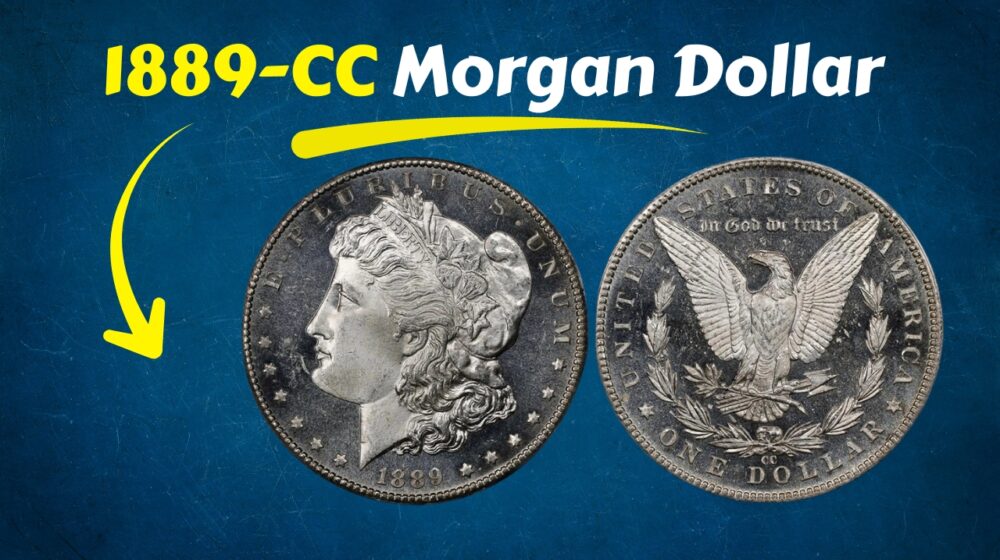
Obverse: The Morgan Dollar’s obverse features George T. Morgan’s rendering of Liberty in profile, facing left, wearing a cap adorned with wheat, cotton, and other agricultural motifs meant to symbolize American abundance. Her hair is gathered beneath the cap with flowing curls visible at the back. The word LIBERTY appears on a band across the cap, and thirteen stars representing the original colonies arc around the upper portion of the coin, with the date positioned below the portrait. On the 1889-CC specifically, cataloguers of the featured example note faintly semi-reflective fields set against frosty design elements, along with sharp overall striking detail across Liberty’s features. Attractive peripheral toning is also present, with the most pronounced color warm powder-blue and reddish-tan crescents concentrated along the left side of the obverse.
Reverse: The reverse depicts a heraldic eagle with wings outstretched, clutching an olive branch in one talon and a bundle of arrows in the other a design meant to evoke both peace and strength. A wreath partially encircles the eagle, and the mintmark “CC,” denoting Carson City, appears below the wreath the two tiny letters that carry outsized significance for collectors of this series. The denomination and national mottos surround the design in the standard Morgan dollar arrangement. On well-preserved examples like this one, the strike brings out crisp detail in the eagle’s feathers, and the reverse fields can show the same semi-reflective character often found on the obverse of high-quality Carson City Morgans.
Why This Matters for Collectors
The 1889-CC has earned a reputation that goes well beyond a simple mintage figure, and several factors combine to make it one of the most sought-after issues in the entire Morgan dollar series:
- It’s widely regarded as the rarest Carson City Morgan dollar in Mint State. Both Stack’s Bowers and PCGS single out the 1889-CC as the most elusive Carson City issue when it comes to surviving high-grade examples a distinction that places it among the true business-strike key dates of the entire series, frequently discussed alongside the famous 1893-S.
- It largely missed the GSA rescue that saved so many other CC dates. With only one confirmed example among nearly 2.8 million Carson City dollars sold through the GSA program in the 1970s, the 1889-CC simply didn’t benefit from the event that put so many other Carson City dollars into circulation among collectors making it disproportionately hard to find today relative to its original mintage.
- Average strike quality raises the bar for exceptional examples. PCGS notes the issue often comes with an average strike, and Stack’s Bowers describes Mint State pieces as few and far between meaning coins that combine strong strike, clean surfaces, and attractive toning, like the featured MS-63, stand out even among an already-scarce population.
- CAC approval meaningfully narrows an already-thin field. With a CAC stickered population of just 18 coins at MS-63 and only 9 graded finer, a CAC-approved example represents a genuinely small subset of an already rare date a detail that matters enormously to advanced collectors who use CAC approval as a quality benchmark within a given grade.
- The coin carries a compelling historical narrative. Beyond rarity statistics, the 1889-CC is tied directly to a real political and economic drama a mint shuttered by presidential policy, revived only after an election, and given just months to strike coins before the year ran out. That story adds context that pure numbers can’t.
- Old, documented provenance adds confidence and value. A coin traceable to a specific long-standing collection, like the KBella Collection assembled in the 1960s, offers collectors reassurance about authenticity and history that isn’t available with pieces lacking a clear paper trail.
Quick-Reference Buying Guide
- Understand the date’s true rarity, not just its mintage. Recognize that the 1889-CC’s importance comes from its scarcity in Mint State and its near-total absence from the GSA hoard, not from having the lowest original mintage among Carson City dates.
- Prioritize third-party certification. Look for PCGS or NGC certification as a baseline, since grading consistency matters enormously for a date where strike quality varies and eye appeal differs significantly between examples of the same numeric grade.
- Weigh CAC approval carefully. Given the extremely small CAC population at most Mint State grades for this date, a CAC sticker can meaningfully affect both desirability and price check current CAC population data before setting a budget.
- Inspect strike and surface quality directly. Because the issue is known for an inconsistent strike, evaluate detail sharpness on Liberty’s hair and the eagle’s feathers, along with overall surface marks, rather than relying on the grade number alone.
- Consider toning and eye appeal. Attractive, natural peripheral toning like the warm blue and reddish-tan color often seen on well-preserved examples can significantly enhance both desirability and value beyond the base grade.
- Research provenance when available. A documented collection history, especially one tracing to a well-regarded older cabinet, adds both confidence and often a price premium; ask for full pedigree information before bidding or buying.
- Monitor major auction house Showcase and Signature sales. Coins of this caliber are most reliably found through major auction houses such as Stack’s Bowers and Heritage register in advance for sales featuring Carson City Morgan dollars and Rarities Night sessions.
- Set a realistic budget using recent comparable results. Use recent realized prices from solid Mint State examples in the tens of thousands of dollars up to the record $881,250 paid for the finest-known MS-68 to establish an appropriate target range for the grade level you’re pursuing.