Error Coins

1652 Pine Tree Shilling: History of the Rare Massachusetts Coin

by Denio Marca
# 1652 Pine Tree Shilling: History of the Rare Massachusetts Coin ## Introduction Every coin in the Pine Tree Shilling series carries the same date — 1652 — no matter when it actually left the press. That single quirk has turned a piece of 17th-century small change into one of the most talked-about puzzles in American numismatics, and it's a big part of why choice examples now change hands for tens of thousands of dollars. The coin itself is the product of a bold act of colonial self-reliance. Facing a chronic shortage of dependable coinage, the Massachusetts Bay Colony did something almost no English colony had the nerve to try: it opened its own mint and started striking silver money under its own authority, with no direct blessing from the Crown. The Pine Tree Shilling, with its distinctive tree stamped where a king's portrait would normally sit, became the enduring symbol of that experiment. For collectors today, it's not just a rare coin — it's a physical artifact of the moment colonial Massachusetts decided to solve its own money problem, consequences be damned. This guide walks through the coin's specifications, the story behind its design, how the market values different examples, and what a collector should know before trying to acquire one. ## Specifications at a Glance | Attribute | Detail | |---|---| | Issuing Authority | Massachusetts Bay Colony | | Mint | Boston | | Mintmasters | John Hull and Robert Sanderson | | Date Shown on Coin | 1652 (fixed, regardless of actual strike year) | | Actual Pine Tree Production Window | Circa 1667–1682 | | Denomination | One shilling (12 pence) | | Metal | Sterling-standard silver | | Official Weight Standard | 72 grains | | Large Planchet Diameter | Roughly 30 mm (varies by example) | | Small Planchet Diameter | Roughly 24 mm | | Large Planchet Production Method | Rocker/roller-style press (circa 1667–1674) | | Small Planchet Production Method | Screw press (circa 1675–1682) | | Obverse | Pine tree design with legend MASATHVSETS IN | | Reverse | NEW ENGLAND, AN DOM, 1652, denomination mark XII | | Recorded Mintage | Unknown; no surviving mint production figures | | Key Reference Works | Sydney P. Noe's die-variety study; later refinements by Walter Breen, Richard Picker, and Christopher J. Salmon | | Typical Auction Price Range | Roughly $25,000 to $78,000+ for well-preserved, pedigreed Mint State examples | Because the coin is a 17th-century issue rather than a modern commemorative, there is no official mintage figure, no fixed composition tolerance published by a mint authority, and no catalog list price — value is entirely a function of variety, condition, and pedigree, discussed below. ## How Collectors Actually Acquire One Unlike a modern commemorative coin, there was never a public "order window" for the Pine Tree Shilling — it circulated as everyday money in Massachusetts more than three centuries ago and later moved entirely into the collector market. That means there are no mintage limits to watch for or release dates to mark on a calendar. Instead, acquiring one requires navigating the rare coin auction and dealer ecosystem. Here's what that process looks like in practice: - **Major auction houses.** Firms such as Stack's Bowers and Heritage Auctions regularly handle Colonial American coinage, including Pine Tree Shillings, as part of scheduled numismatic auctions (often tied to events like the ANA World's Fair of Money). These sales are where the most significant pedigreed examples tend to surface. - **Specialist dealers.** A number of dealers focus specifically on Colonial and early American coinage. Buying through a specialist gives access to inventory that never reaches public auction, along with expert guidance on variety attribution. - **Grading and authentication.** Nearly every serious example on the market has been certified by PCGS or NGC. Certification confirms authenticity, assigns a numeric grade, and — critically for this series — often identifies the Noe die variety. - **Budget expectations.** Entry-level, lower-grade, or more common varieties can sometimes be found in the low thousands of dollars. Choice Mint State examples with strong pedigrees routinely reach five figures, and the finest known specimens with historic provenance have sold for $75,000 or more. - **Provenance research.** Because many surviving examples trace back through famous 20th-century collections (Garrett, Norweb, Ford, Eliasberg, and others), a serious buyer will want the full pedigree chain documented before purchase — it materially affects both authenticity confidence and resale value. In short: there's no waiting in line for release day. The "buying process" here is really a research process — identifying the right variety, grade, and pedigree, then working through an established auction house or dealer to secure it. ## Historical Background ### A Colony Short on Money By the mid-1600s, Massachusetts Bay had a thriving commercial economy but almost no reliable coinage to run it on. English coin rarely stayed in the colony long — it tended to flow back across the Atlantic to pay for imports. Colonists made do with barter, foreign coin, credit arrangements, and wampum, though the latter's usefulness as money was fading fast. Spanish-American silver filled some of the gap, but it came with its own headaches. A debasement scandal at the Potosí Mint in the late 1640s undermined confidence in Spanish coin, and Boston merchants regularly ran into clipped, underweight, or outright counterfeit pieces. Mintmaster John Hull himself later wrote that counterfeit money had caused real financial damage and even disrupted trade. ### The Colony Takes Matters Into Its Own Hands In May 1652, the Massachusetts General Court authorized the colony to open its own mint in Boston — an extraordinary move, since coinage was traditionally treated as an exclusive right of sovereign governments, not colonies. Massachusetts had no specific royal permission to do this. What made it possible, at least in part, was timing: England was in the middle of its republican Interregnum following the execution of Charles I in 1649, so there was no king on the throne to object. The General Court put silversmith John Hull in charge as mintmaster, and Hull brought in fellow silversmith Robert Sanderson as his partner. Residents could bring in silver plate, bullion, or Spanish coin, and the mint would convert it into standardized Massachusetts shillings, sixpences, and threepences. Notably, the Massachusetts shilling was deliberately struck lighter than its English counterpart — about 72 grains versus roughly 92.9 grains for an English shilling, a difference of more than 20 percent. Inside the colony, it still functioned as a full 12-pence shilling; outside it, its lower silver content made it less useful as bullion. It was, in effect, a built-in incentive for the coin to stay in circulation at home — an early and fairly sophisticated piece of monetary engineering. ### From NE Punches to the Pine Tree The Pine Tree design wasn't the mint's first attempt. The earliest Massachusetts coins were far simpler: one side punched with the letters "NE" for New England, the other with a Roman-numeral denomination. Those crude pieces were an open invitation to clipping, since a thief could shave silver from the edge without disturbing any design element. The mint responded with progressively more elaborate coinage: first the Willow Tree series, then the Oak Tree series, and finally — around 1667 — the Pine Tree design that would become the signature image of the entire series. Pine Tree coins continued to be struck until the Boston mint shut down in 1682. ### Designer and Minting Method There's no dedicated "designer" in the modern sense — Hull and Sanderson, as mintmasters and die-sinkers, were responsible for the coin's appearance and production. Within the Pine Tree series, collectors recognize two broad production phases based on physical characteristics: - **Large Planchet coins** (roughly 1667–1674) were struck using a rocker or roller-style press. This method often left the finished coin with a slight wave or S-curve — a hallmark of the process rather than a sign of later damage. - **Small Planchet coins** (roughly 1675–1682) used smaller, thicker blanks and a screw press, producing a noticeably different look and feel from their earlier counterparts. Mint workers also sometimes trimmed coins to bring them closer to the authorized weight — a practice known today as mint-made clipping, which is distinct from (and far more forgivable than) the fraudulent clipping done by dishonest hands during circulation. ## Why the Coin Is Dated 1652 Even Though It Was Struck Decades Later This is the single most debated detail in the series. Almost every Massachusetts tree-type coin — Willow, Oak, and Pine alike — carries the date 1652, even though minting continued for roughly three decades afterward. (The lone major exception is the twopence, dated 1662.) The popular story holds that Massachusetts deliberately froze the date at 1652 because that was the last year England had no king — meaning colonial officials could later argue their mint had been authorized during a period without royal oversight, giving them a defense once Charles II retook the throne in 1660. It's a great story, and it's repeated often. But it's worth treating with some caution. Major institutions differ on how much weight to give it: some present the political-cover explanation as one plausible theory among others, some suggest 1652 may simply commemorate the year the mint was founded, and some describe the "royal deception" story as more myth than documented fact, arguing the date more likely just marks the General Court's original authorization. There's no definitive surviving mint record that settles the question either way — which is exactly what keeps the debate alive among historians and collectors alike. ## The Design: Obverse and Reverse **Obverse:** The centerpiece is a stylized pine tree, rendered simply but with unmistakable visual presence, surrounded by the legend MASATHVSETS IN. There's no confirmed mint record explaining exactly why Hull and Sanderson chose a pine specifically — though New England timber, especially tall, straight pine suited to ship masts, was a major regional export, and many collectors and historians read the tree as a nod to that economic importance. What's certain is the symbolism of the choice: Massachusetts put a New England tree where European coinage traditionally placed a monarch's portrait, royal arms, or other emblem of sovereign authority. The visual break from Old World coinage is deliberate and striking. **Reverse:** The reverse carries the legend NEW ENGLAND, along with AN DOM (anno domini), the frozen date 1652, and the Roman numeral denomination mark — XII for the shilling, indicating its value of 12 pence. Physical presentation varies meaningfully between the two planchet types. Large Planchet coins tend to show a gentle wave or bend from the rocker-press striking method, along with generally broader, thinner flans. Small Planchet coins are smaller, thicker, and more uniformly struck, reflecting the shift to screw-press technology later in the mint's operating life. ## Why This Matters for Collectors Plenty of coins are valuable simply because few of them survive. The Pine Tree Shilling offers something layered on top of scarcity: it's tied to a genuinely pivotal moment in colonial history. A few reasons this series holds such a firm place in serious collections: - **It's the first locally produced silver coinage struck in what would become the United States** — a direct response to a real monetary crisis, not a novelty issue. - **It represents an act of colonial defiance.** Massachusetts minted its own money without direct royal authorization, continued doing so after the monarchy was restored, and kept at it even as Crown officials formally objected and eventually demanded repeal of the mint law in 1665. The mint didn't close until 1682, and the colony's charter itself fell two years later — though attributing that collapse solely to the coinage oversimplifies a much broader conflict over trade policy, governance, and colonial autonomy. - **The manufacturing imperfections are part of the story, not a flaw.** A curved Large Planchet flan reflects the rocker press. A trimmed edge may reflect deliberate mint-made weight adjustment rather than fraud. A reversed letter in the legend can pin a coin to a specific die marriage. None of that would matter on a modern coin; on a Pine Tree Shilling, it's evidence of exactly how Boston made money in the 1670s. - **Pedigree carries real weight in this market.** Because so many surviving examples have passed through celebrated 20th-century collections — Garrett, Norweb, Ford, Eliasberg, and others — ownership history isn't just trivia. It's a documented chain that both supports authenticity and drives price. Two coins of nearly identical grade and weight can sell tens of thousands of dollars apart depending on who owned them before. - **The variety study is deep enough to be its own specialty.** Sydney P. Noe's classification system, later expanded by researchers including Walter Breen, Richard Picker, and Christopher J. Salmon, breaks the series into distinct die marriages and states. A collector can spend years chasing variations within this one coin type alone. ## Quick-Reference Buying Guide 1. **Learn the basic type first.** Understand the difference between Large Planchet (circa 1667–1674, rocker press, gentle curve) and Small Planchet (circa 1675–1682, screw press, smaller and thicker) before evaluating any specific coin. 2. **Confirm third-party certification.** Look for PCGS or NGC certification on any example under serious consideration — this authenticates the coin and assigns a verifiable grade. 3. **Identify the die variety.** Ask the seller or auction listing for the Noe number (e.g., Noe-1, Noe-2, Noe-4). Variety significantly affects both rarity and demand. 4. **Weigh grade against physical quality.** A lower numeric grade with strong centering, full legends, and good color can be more desirable — and better value — than a higher grade with weak strike or poor eye appeal. 5. **Investigate pedigree.** Ask for documented ownership history. A coin with a traceable line through recognized historic collections will generally command a premium and offers added assurance of authenticity. 6. **Compare recent auction results.** Look at realized prices for similar variety, grade, and weight combinations at Stack's Bowers, Heritage, and other major houses to calibrate a fair offer. 7. **Buy from a reputable auction house or established Colonial specialist dealer.** Given the sums involved, work only with sellers who have a verifiable track record in early American numismatics. 8. **Set a budget range in advance.** Entry-level examples can be found in the low thousands of dollars, while premier pedigreed Mint State pieces regularly reach $50,000–$80,000 or more — decide where your target fits before bidding.

Every coin in the Pine Tree Shilling series carries the same date 1652 no matter when it actually left the press. That single quirk has turned a piece of 17th-century small change into one of the most talked-about puzzles in American numismatics, and it’s a big part of why choice examples now change hands for tens of thousands of dollars.
The coin itself is the product of a bold act of colonial self-reliance. Facing a chronic shortage of dependable coinage, the Massachusetts Bay Colony did something almost no English colony had the nerve to try: it opened its own mint and started striking silver money under its own authority, with no direct blessing from the Crown. The Pine Tree Shilling, with its distinctive tree stamped where a king’s portrait would normally sit, became the enduring symbol of that experiment. For collectors today, it’s not just a rare coin it’s a physical artifact of the moment colonial Massachusetts decided to solve its own money problem, consequences be damned.

This guide walks through the coin’s specifications, the story behind its design, how the market values different examples, and what a collector should know before trying to acquire one.
Specifications at a Glance

AttributeDetail
Issuing AuthorityMassachusetts Bay Colony
MintBoston
MintmastersJohn Hull and Robert Sanderson
Date Shown on Coin1652 (fixed, regardless of actual strike year)
Actual Pine Tree Production WindowCirca 1667–1682
DenominationOne shilling (12 pence)
MetalSterling-standard silver
Official Weight Standard72 grains
Large Planchet DiameterRoughly 30 mm (varies by example)
Small Planchet DiameterRoughly 24 mm
Large Planchet Production MethodRocker/roller-style press (circa 1667–1674)
Small Planchet Production MethodScrew press (circa 1675–1682)
ObversePine tree design with legend MASATHVSETS IN
ReverseNEW ENGLAND, AN DOM, 1652, denomination mark XII
Recorded MintageUnknown; no surviving mint production figures
Key Reference WorksSydney P. Noe’s die-variety study; later refinements by Walter Breen, Richard Picker, and Christopher J. Salmon
Typical Auction Price RangeRoughly $25,000 to $78,000+ for well-preserved, pedigreed Mint State examples

Because the coin is a 17th-century issue rather than a modern commemorative, there is no official mintage figure, no fixed composition tolerance published by a mint authority, and no catalog list price value is entirely a function of variety, condition, and pedigree, discussed below.

How Collectors Actually Acquire One

Unlike a modern commemorative coin, there was never a public “order window” for the Pine Tree Shilling it circulated as everyday money in Massachusetts more than three centuries ago and later moved entirely into the collector market. That means there are no mintage limits to watch for or release dates to mark on a calendar. Instead, acquiring one requires navigating the rare coin auction and dealer ecosystem. Here’s what that process looks like in practice:
  • Major auction houses. Firms such as Stack’s Bowers and Heritage Auctions regularly handle Colonial American coinage, including Pine Tree Shillings, as part of scheduled numismatic auctions (often tied to events like the ANA World’s Fair of Money). These sales are where the most significant pedigreed examples tend to surface.
  • Specialist dealers. A number of dealers focus specifically on Colonial and early American coinage. Buying through a specialist gives access to inventory that never reaches public auction, along with expert guidance on variety attribution.
  • Grading and authentication. Nearly every serious example on the market has been certified by PCGS or NGC. Certification confirms authenticity, assigns a numeric grade, and critically for this series often identifies the Noe die variety.
  • Budget expectations. Entry-level, lower-grade, or more common varieties can sometimes be found in the low thousands of dollars. Choice Mint State examples with strong pedigrees routinely reach five figures, and the finest known specimens with historic provenance have sold for $75,000 or more.
  • Provenance research. Because many surviving examples trace back through famous 20th-century collections (Garrett, Norweb, Ford, Eliasberg, and others), a serious buyer will want the full pedigree chain documented before purchase it materially affects both authenticity confidence and resale value.

In short: there’s no waiting in line for release day. The “buying process” here is really a research process identifying the right variety, grade, and pedigree, then working through an established auction house or dealer to secure it.

Historical Background

A Colony Short on Money

By the mid-1600s, Massachusetts Bay had a thriving commercial economy but almost no reliable coinage to run it on. English coin rarely stayed in the colony long it tended to flow back across the Atlantic to pay for imports. Colonists made do with barter, foreign coin, credit arrangements, and wampum, though the latter’s usefulness as money was fading fast.
Spanish-American silver filled some of the gap, but it came with its own headaches. A debasement scandal at the Potosí Mint in the late 1640s undermined confidence in Spanish coin, and Boston merchants regularly ran into clipped, underweight, or outright counterfeit pieces. Mintmaster John Hull himself later wrote that counterfeit money had caused real financial damage and even disrupted trade.

The Colony Takes Matters Into Its Own Hands

In May 1652, the Massachusetts General Court authorized the colony to open its own mint in Boston an extraordinary move, since coinage was traditionally treated as an exclusive right of sovereign governments, not colonies. Massachusetts had no specific royal permission to do this. What made it possible, at least in part, was timing: England was in the middle of its republican Interregnum following the execution of Charles I in 1649, so there was no king on the throne to object.

The General Court put silversmith John Hull in charge as mintmaster, and Hull brought in fellow silversmith Robert Sanderson as his partner. Residents could bring in silver plate, bullion, or Spanish coin, and the mint would convert it into standardized Massachusetts shillings, sixpences, and threepences.

Notably, the Massachusetts shilling was deliberately struck lighter than its English counterpart about 72 grains versus roughly 92.9 grains for an English shilling, a difference of more than 20 percent. Inside the colony, it still functioned as a full 12-pence shilling; outside it, its lower silver content made it less useful as bullion. It was, in effect, a built-in incentive for the coin to stay in circulation at home an early and fairly sophisticated piece of monetary engineering.

From NE Punches to the Pine Tree

The Pine Tree design wasn’t the mint’s first attempt. The earliest Massachusetts coins were far simpler: one side punched with the letters “NE” for New England, the other with a Roman-numeral denomination. Those crude pieces were an open invitation to clipping, since a thief could shave silver from the edge without disturbing any design element.

The mint responded with progressively more elaborate coinage: first the Willow Tree series, then the Oak Tree series, and finally around 1667 the Pine Tree design that would become the signature image of the entire series. Pine Tree coins continued to be struck until the Boston mint shut down in 1682.

Designer and Minting Method

There’s no dedicated “designer” in the modern sense Hull and Sanderson, as mintmasters and die-sinkers, were responsible for the coin’s appearance and production. Within the Pine Tree series, collectors recognize two broad production phases based on physical characteristics:

  • Large Planchet coins (roughly 1667–1674) were struck using a rocker or roller-style press. This method often left the finished coin with a slight wave or S-curve a hallmark of the process rather than a sign of later damage.
  • Small Planchet coins (roughly 1675–1682) used smaller, thicker blanks and a screw press, producing a noticeably different look and feel from their earlier counterparts.

Mint workers also sometimes trimmed coins to bring them closer to the authorized weight a practice known today as mint-made clipping, which is distinct from (and far more forgivable than) the fraudulent clipping done by dishonest hands during circulation.

Why the Coin Is Dated 1652 Even Though It Was Struck Decades Later

This is the single most debated detail in the series. Almost every Massachusetts tree-type coin Willow, Oak, and Pine alike carries the date 1652, even though minting continued for roughly three decades afterward. (The lone major exception is the twopence, dated 1662.)

The popular story holds that Massachusetts deliberately froze the date at 1652 because that was the last year England had no king meaning colonial officials could later argue their mint had been authorized during a period without royal oversight, giving them a defense once Charles II retook the throne in 1660. It’s a great story, and it’s repeated often.

But it’s worth treating with some caution. Major institutions differ on how much weight to give it: some present the political-cover explanation as one plausible theory among others, some suggest 1652 may simply commemorate the year the mint was founded, and some describe the “royal deception” story as more myth than documented fact, arguing the date more likely just marks the General Court’s original authorization. There’s no definitive surviving mint record that settles the question either way which is exactly what keeps the debate alive among historians and collectors alike.

The Design: Obverse and Reverse

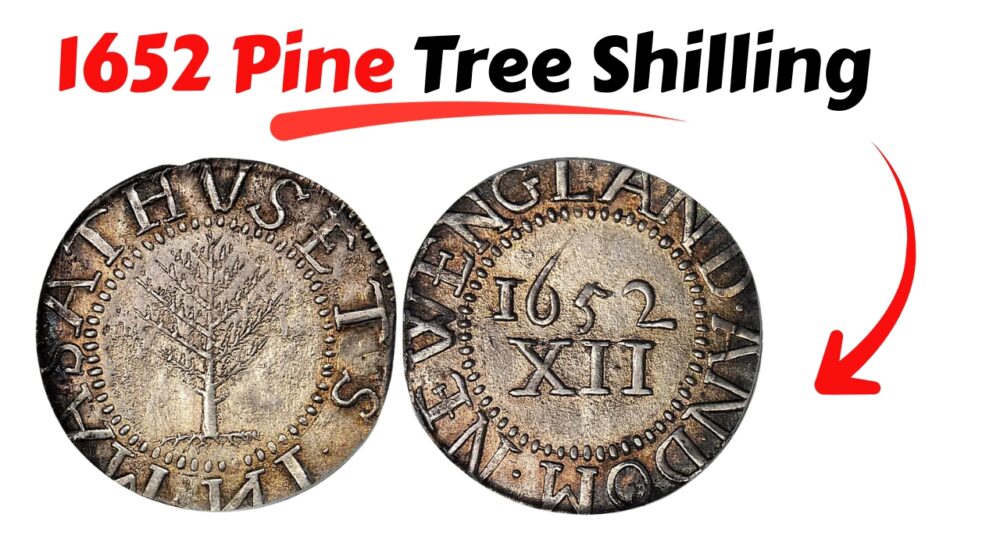
Obverse: The centerpiece is a stylized pine tree, rendered simply but with unmistakable visual presence, surrounded by the legend MASATHVSETS IN. There’s no confirmed mint record explaining exactly why Hull and Sanderson chose a pine specifically though New England timber, especially tall, straight pine suited to ship masts, was a major regional export, and many collectors and historians read the tree as a nod to that economic importance. What’s certain is the symbolism of the choice: Massachusetts put a New England tree where European coinage traditionally placed a monarch’s portrait, royal arms, or other emblem of sovereign authority. The visual break from Old World coinage is deliberate and striking.

Reverse: The reverse carries the legend NEW ENGLAND, along with AN DOM (anno domini), the frozen date 1652, and the Roman numeral denomination mark XII for the shilling, indicating its value of 12 pence.

Physical presentation varies meaningfully between the two planchet types. Large Planchet coins tend to show a gentle wave or bend from the rocker-press striking method, along with generally broader, thinner flans. Small Planchet coins are smaller, thicker, and more uniformly struck, reflecting the shift to screw-press technology later in the mint’s operating life.

Why This Matters for Collectors

Plenty of coins are valuable simply because few of them survive. The Pine Tree Shilling offers something layered on top of scarcity: it’s tied to a genuinely pivotal moment in colonial history.

A few reasons this series holds such a firm place in serious collections:

  • It’s the first locally produced silver coinage struck in what would become the United States a direct response to a real monetary crisis, not a novelty issue.
  • It represents an act of colonial defiance. Massachusetts minted its own money without direct royal authorization, continued doing so after the monarchy was restored, and kept at it even as Crown officials formally objected and eventually demanded repeal of the mint law in 1665. The mint didn’t close until 1682, and the colony’s charter itself fell two years later though attributing that collapse solely to the coinage oversimplifies a much broader conflict over trade policy, governance, and colonial autonomy.
  • The manufacturing imperfections are part of the story, not a flaw. A curved Large Planchet flan reflects the rocker press. A trimmed edge may reflect deliberate mint-made weight adjustment rather than fraud. A reversed letter in the legend can pin a coin to a specific die marriage. None of that would matter on a modern coin; on a Pine Tree Shilling, it’s evidence of exactly how Boston made money in the 1670s.
  • Pedigree carries real weight in this market. Because so many surviving examples have passed through celebrated 20th-century collections Garrett, Norweb, Ford, Eliasberg, and others ownership history isn’t just trivia. It’s a documented chain that both supports authenticity and drives price. Two coins of nearly identical grade and weight can sell tens of thousands of dollars apart depending on who owned them before.
  • The variety study is deep enough to be its own specialty. Sydney P. Noe’s classification system, later expanded by researchers including Walter Breen, Richard Picker, and Christopher J. Salmon, breaks the series into distinct die marriages and states. A collector can spend years chasing variations within this one coin type alone.

Quick-Reference Buying Guide

  1. Learn the basic type first. Understand the difference between Large Planchet (circa 1667–1674, rocker press, gentle curve) and Small Planchet (circa 1675–1682, screw press, smaller and thicker) before evaluating any specific coin.
  2. Confirm third-party certification. Look for PCGS or NGC certification on any example under serious consideration this authenticates the coin and assigns a verifiable grade.
  3. Identify the die variety. Ask the seller or auction listing for the Noe number (e.g., Noe-1, Noe-2, Noe-4). Variety significantly affects both rarity and demand.
  4. Weigh grade against physical quality. A lower numeric grade with strong centering, full legends, and good color can be more desirable and better value than a higher grade with weak strike or poor eye appeal.
  5. Investigate pedigree. Ask for documented ownership history. A coin with a traceable line through recognized historic collections will generally command a premium and offers added assurance of authenticity.
  6. Compare recent auction results. Look at realized prices for similar variety, grade, and weight combinations at Stack’s Bowers, Heritage, and other major houses to calibrate a fair offer.
  7. Buy from a reputable auction house or established Colonial specialist dealer. Given the sums involved, work only with sellers who have a verifiable track record in early American numismatics.
  8. Set a budget range in advance. Entry-level examples can be found in the low thousands of dollars, while premier pedigreed Mint State pieces regularly reach $50,000–$80,000 or more decide where your target fits before bidding.
Written by

Denio Marca

Denio Marca is a passionate writer and coin enthusiast who specializes in old coins, rare coins, coin values, and collectible currency. He shares informative articles about valuable coins, collecting tips, historical facts, and the latest updates from the world of numismatics.

View all posts →

Leave a Comment

Your email address will not be published. Required fields are marked *