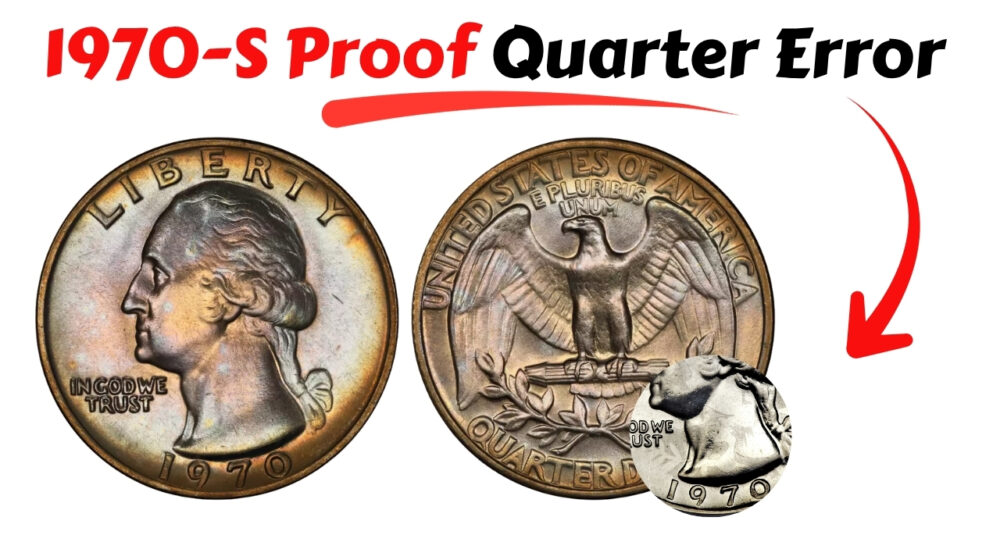
Nearly every 1970-S Washington Quarter started life the same way: as an ordinary copper-nickel clad planchet. One did not. This particular coin began its existence in 1898, as a $5 gold Liberty Head Half Eagle and somehow, 72 years later, it found its way into a San Francisco Mint Proof press, where Washington Quarter dies struck directly over it. The result is one of the strangest and most compelling mint errors in American numismatics: a Proof quarter overstruck on 19th-century gold, now heading to auction through GreatCollections.
GreatCollections describes the coin as “Believed Unique,” and PCGS has certified it Proof-66. Bidding is scheduled to close Sunday, September 13, 2026, at 7:07:05 p.m. Pacific Time. Here’s the complete story behind how a McKinley-era gold coin ended up masquerading as a modern clad quarter, what makes it so significant, and what collectors should know before the auction closes.
Specifications at a Glance
| Category | Detail |
|---|---|
| Country | United States |
| Date | 1970-S |
| Denomination Struck | Washington Quarter Dollar |
| Mint | San Francisco |
| Quarter Design | John Flanagan |
| Host Coin | 1898 Liberty Head Half Eagle ($5 gold) |
| Half Eagle Designer | Christian Gobrecht |
| Host Coin Composition | 90% gold, 10% copper |
| Error Coin Weight | 8.3 grams |
| Standard 1898 Half Eagle Weight | 8.36 grams |
| Standard 1970-S Proof Quarter Weight | 5.67 grams |
| Standard 1970-S Proof Quarter Composition | Copper-nickel clad outer layers over a pure copper core |
| 1970-S Proof Quarter Mintage | 2,632,810 |
| 1898 Philadelphia Half Eagle Mintage | 633,420 |
| Current Grade | PCGS Proof-66 |
| PCGS Certification Number | 48183803 |
| Prior Certification | NGC PF66 |
| Rarity | GreatCollections lists the coin as “Believed Unique” |
| Auction House | GreatCollections |
| Auction Close | Sunday, September 13, 2026, at 7:07:05 p.m. Pacific Time |
The coin’s 8.3-gram weight is the clearest physical evidence of what happened here sitting far closer to the 8.36-gram standard for an 1898 Half Eagle than to the 5.67-gram weight expected of a normal 1970-S Proof Quarter.
Bidding and Auction Details
Since this coin is heading to a live numismatic auction rather than a Mint sale, there’s no fixed price, purchase limit, or order form involved. Here’s what prospective bidders should know:
- Platform: GreatCollections, an established auction house known for handling major U.S. numismatic rarities.
- Closing date and time: Sunday, September 13, 2026, at 7:07:05 p.m. Pacific Time.
- Certification history: The coin currently sits in a PCGS Proof-66 holder under certification number 48183803, with a documented earlier NGC PF66 grade both independently verifiable by bidders.
- Uniqueness claim: GreatCollections markets the coin as “Believed Unique,” meaning no confirmed second example is known to exist, a status that typically intensifies bidding among advanced error-coin collectors.
- Provenance to review: Interested bidders should examine the coin’s full grading and ownership history, including its earlier appearance on the cover of Mint Error News Magazine Issue 66, before placing a bid.
- Standard auction terms: As with most major coin auctions, expect a detailed lot description, high-resolution photography, and a buyer’s premium added to the final hammer price bidders should confirm GreatCollections’ current terms before participating.
Given that no comparable example is known to exist, the final price will likely be shaped entirely by competitive bidding among specialized collectors rather than any pre-established valuation.
Historical Background
The Host Coin: 1898 Liberty Head Half Eagle
The $5 gold piece that unknowingly became this error’s foundation started out as an ordinary Liberty Head Half Eagle, a design created by Christian Gobrecht that anchored much of 19th-century American gold coinage. The Philadelphia Mint struck 633,420 examples of the 1898 Half Eagle coins that were fully produced, released into circulation or collector hands, and presumably held for decades before this particular piece met an extraordinary second fate.
The Overstriking Coin: 1970-S Washington Quarter
The Washington Quarter design traces back to 1932, when sculptor John Flanagan created it to mark the bicentennial of George Washington’s birth. By 1970, the design was a familiar fixture of American coinage, produced in massive numbers for circulation and in smaller, more tightly controlled Proof format at the San Francisco Mint for collectors. The 1970-S Proof Quarter alone had a mintage of 2,632,810 an unremarkable production run that, in this one case, somehow intersected with a 72-year-old piece of gold.

How the Error Likely Happened
Proof coinage in 1970 involved considerable hands-on production. Mint technicians fed individually prepared, highly polished planchets into specialized presses, and finished coins underwent inspection and packaging under strict quality control standards. At some point in that process, an already-struck 1898 Half Eagle entered the Proof production line reserved for 1970-S quarters. Quarter dies then struck directly over the existing gold coin, overlaying Flanagan’s design on top of Gobrecht’s decades-old Liberty Head Half Eagle composition. No surviving documentation explains exactly how the older gold coin made its way into that production stream at San Francisco the coin itself remains the only physical evidence of what actually occurred.
A related but separate chapter in numismatic history involves a cache of several hundred U.S. error coins, including other significant Proof errors, that surfaced from a safe-deposit box in the early 2000s. That group was purchased by error specialist Fred Weinberg, reviewed by the United States Secret Service, and ultimately released to the California State Controller’s Office of Unclaimed Property, which then auctioned the coins into the marketplace. That episode illustrates one documented pathway by which extraordinary Proof errors have moved from Mint custody into private hands historically, though it shouldn’t be assumed to explain this specific coin’s origin.
Description of the Obverse and Reverse
Obverse
At first glance, the obverse shows Flanagan’s familiar profile of George Washington, facing left, with “LIBERTY” arcing above his head and the date “1970” below. Because the underlying Half Eagle was already a fully struck coin before quarter dies came down on it, portions of the original gold coin’s design remain faintly traceable beneath the Washington portrait under close examination — softened by the second strike, but not completely erased.
Reverse
The reverse is where this coin’s extraordinary nature becomes most visible. Flanagan’s heraldic eagle, wings spread and perched above crossed olive branches, shares the design space with “QUARTER DOLLAR” and “UNITED STATES OF AMERICA.” Remarkably, remnants of the original 1898 date from the underlying Half Eagle remain legible directly above the words “QUARTER DOLLAR” a faint trace of the coin’s earlier identity showing through its 1970 overstrike. Additional faint elements of the Liberty Head Half Eagle design survive on this side as well, giving collectors the rare opportunity to see two distinct centuries of American coin design occupying a single piece of gold.
Why This Matters for Collectors
- It may be a genuine one-of-one. GreatCollections’ “Believed Unique” designation places this coin in the rarest possible tier of mint error one with no confirmed counterpart anywhere.
- It physically bridges two centuries of American coinage. Few errors let a collector examine a 19th-century gold design and a 20th-century clad design occupying the exact same coin, struck 72 years apart.
- Gold-related mint errors consistently command premium attention. Comparable pieces including a 1913 Buffalo Nickel struck on a $5 Indian Half Eagle planchet ($400,000) and a 1915 Panama-Pacific Half Dollar struck in gold ($750,000 in 2022) demonstrate that errors involving gold host coins draw outsized collector interest relative to base-metal counterparts.
- Its grade has survived remarkably well. Despite more than five decades of existence and an unusual second strike, the coin retains a Gem-level PCGS Proof-66 grade with clean surfaces.
- A documented certification trail reduces buyer risk. The coin’s transition from an NGC PF66 grade to its current PCGS Proof-66 holder, along with a specific, verifiable PCGS certification number, gives bidders an unusually clear paper trail for such an extraordinary piece.
Quick-Reference Buying Guide
- Confirm the auction details before bidding. Verify the current listing directly through GreatCollections and note the precise closing time September 13, 2026, at 7:07:05 p.m. Pacific Time.
- Independently verify the certification. Check PCGS certification number 48183803 through PCGS’s official verification system, and review the coin’s earlier NGC PF66 grading history for consistency.
- Study high-resolution photography closely. Pay particular attention to the reverse, where remnants of the 1898 date and underlying Half Eagle design remain visible.
- Research comparable gold-overstrike error sales. Review past results for pieces like the 1913 gold-planchet Buffalo Nickel and the 1915 Panama-Pacific gold Half Dollar to understand pricing context for major gold-related mint errors.
- Set your maximum bid in advance. Because the coin is believed unique, competitive bidding can escalate quickly decide on a firm bidding limit based on your own research rather than in the moment.
- Factor in buyer’s premium and fees. Confirm GreatCollections’ current buyer’s premium and payment terms before placing your final bid.
- Plan for secure post-purchase logistics. Given the coin’s rarity and likely value, arrange insured shipping and secure long-term storage in advance of the auction’s close.
- Retain complete documentation after purchase. Keep the auction record, certification details, and any provenance information provided, since this history will matter significantly for future authentication or resale.