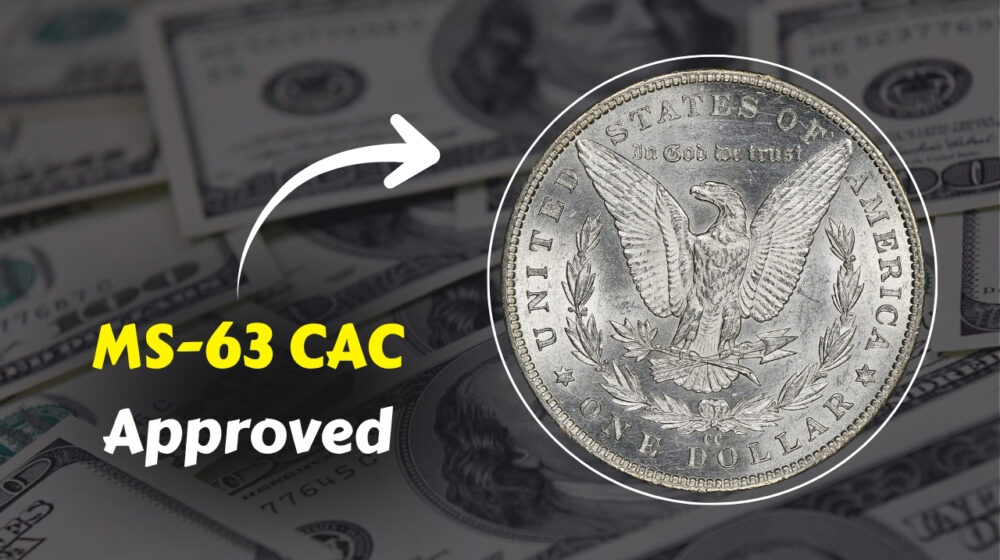
Few coins in the Morgan dollar series carry as much historical weight packed into two tiny letters as the 1889-CC. This is the date collectors point to when they want to explain what “condition rarity” really means not simply a coin with a small mintage, but one whose survivors in top grade are shockingly scarce. Now a standout example, graded MS-63 by PCGS and carrying both CAC approval and a CMQ (CAC Market Quality) designation, is set to cross the auction block as Lot 2141 in Session 2, Rarities Night, at Stack’s Bowers Galleries’ Summer 2026 Global Showcase Auction.
The coin’s pedigree adds another layer of appeal: it comes from the KBella Collection of Morgan Dollars, a cabinet originally put together in the 1960s. For advanced Morgan collectors and anyone building a serious Carson City set, this lot represents a rare convergence of key-date status, eye-catching originality, third-party grading, and old-time provenance.
This article walks through the coin’s full specifications, what collectors should know about bidding in a Stack’s Bowers auction, the historical drama behind the Carson City Mint’s four-year shutdown, a close look at the Morgan dollar’s design, and why this particular piece deserves serious consideration.
Specifications at a Glance
| Detail | Description |
|---|---|
| Denomination | One Dollar |
| Series | Morgan Dollar |
| Date and Mint Mark | 1889-CC |
| Minting Facility | Carson City Mint |
| Designer | George T. Morgan |
| Composition | 90% silver, 10% copper |
| Weight | 26.73 grams |
| Diameter | 38.10 mm |
| Edge | Reeded |
| Total Mintage | 350,000 |
| PCGS Number | 7190 |
| NGC ID | 2559 |
| Grade of Auction Coin | PCGS MS-63 |
| Additional Designations | CAC approved, CMQ |
| Provenance | KBella Collection of Morgan Dollars (assembled 1960s) |
| Offering | Stack’s Bowers Galleries, Summer 2026 Global Showcase Auction |
| Lot Number | 2141, Session 2 Rarities Night |
| CAC Stickered Population | 18 at MS-63; 9 finer |
| Estimated Surviving Population (all grades) | Fewer than 30,000 |
| Estimated Surviving Population (MS-60 or better) | Approximately 5,000 |
How to Bid: Understanding the Auction Process
Because this coin is being sold at public auction rather than offered at a fixed retail price, prospective buyers should understand how the process typically works with a major numismatic auction house like Stack’s Bowers rather than expecting a simple purchase-order transaction. While exact catalog release dates, lot viewing windows, and closing times for the Summer 2026 Global Showcase Auction should always be confirmed directly with Stack’s Bowers, the general framework for participating in one of their sales follows a consistent pattern:
- Registration. Bidders must create or log into a Stack’s Bowers account and register for the specific auction session in which the lot appears. Registration is typically free and may require identity verification for higher-value lots.
- Lot review and grading verification. Interested bidders should review the full lot description, high-resolution images, and PCGS/CAC certification details before bidding. Because this is a certified coin, its grade and CAC status can be independently verified through PCGS’s and CAC’s public population and verification tools.
- Choosing a bidding method. Stack’s Bowers auctions generally accept several bidding formats: live online bidding during the session, pre-auction absentee (proxy) bids submitted in advance, live phone bidding arranged with a specialist, and in some cases in-person bidding for those attending the physical sale.
- Setting a maximum bid or bidding live. Absentee bidders set the highest amount they are willing to pay; the house’s bidding system executes bids incrementally up to that ceiling. Live bidders compete in real time during Session 2, Rarities Night, when Lot 2141 comes up.
- Buyer’s premium and payment. As with virtually all major auction houses, the final purchase price includes a buyer’s premium on top of the hammer price. Bidders should check Stack’s Bowers’ current premium structure and accepted payment methods before bidding, since these terms are set by the auction house and subject to change.
- Settlement and shipping. Once payment clears, the coin is shipped insured or made available for pickup, depending on the buyer’s preference and the auction house’s policies.
Because rarities of this caliber can draw intense competition particularly from specialists chasing the CAC-approved population of only 18 coins at the MS-63 level collectors seriously interested in this lot are well advised to register early, study the CAC population figures, and set a firm bidding limit in advance.
Historical Background: The Morgan Dollar and the Carson City Mint
George T. Morgan and the Birth of the Series
The Morgan dollar takes its name from its designer, United States Mint engraver George T. Morgan, an English-born artist recruited to the U.S. Mint in the 1870s. The series owes its existence to the Bland-Allison Act of 1878, a piece of legislation born from the same silver-versus-gold monetary debates that would later shape the fate of the Carson City Mint itself. That act compelled the federal government to purchase large quantities of domestic silver and coin it into dollars, and the first Morgan dollars were struck that same year.
Carson City: A Mint Forged by the Comstock Lode
The Carson City Mint owed its very existence to Nevada’s mining boom. Congress authorized the branch mint to process the enormous quantities of silver flowing out of the nearby Comstock Lode, giving the facility both economic weight and political symbolism as a representative of western mining interests in the national currency debate.
Four Years of Silence
After striking its 1885-dated Morgan dollars, the Carson City Mint went dark. The shutdown was political in nature, tied to President Grover Cleveland’s opposition to the free-silver movement and his administration’s preference for policies that protected the nation’s gold reserves a stance that put him squarely at odds with the western mining interests that Carson City represented. The facility remained closed through most of Cleveland’s first term.
A New Administration, A Mint Reborn
The political tide turned with the 1888 presidential election, when Republican Benjamin Harrison unseated Cleveland. Carson City’s presses did not roar back to life immediately, however; the long-dormant facility needed repairs and preparation before resuming operations. Coining did not restart until October 1889, leaving only a few months in the year to strike the 1889-dated issue. That truncated production window is the direct reason the mintage came in at just 350,000 coins a small figure, though not the smallest in the Carson City Morgan series.
Why the 1889-CC Is Rarer Than Its Mintage Suggests
On paper, the 1889-CC isn’t even the lowest-mintage Carson City Morgan dollar that distinction belongs to the 1885-CC, struck at just 228,000 pieces. Yet far more 1885-CC dollars survived in high grade, which is precisely what makes the 1889-CC the true condition rarity of the branch mint’s output.
The clearest evidence of this scarcity comes from the U.S. government’s own General Services Administration sales of the 1970s, when nearly 2.8 million Carson City Morgan dollars long stored in Treasury vaults were released to the public. Only a single 1889-CC dollar was reportedly included in that entire program. While millions of other “CC” dollars flowed into collectors’ hands through the GSA sales, the 1889-CC largely missed out on that numismatic resurrection, leaving today’s supply dramatically thinner than its mintage figure alone would imply.
As a result, PCGS estimates that fewer than 30,000 examples of the date survive across all grades, with only around 5,000 surviving in Mint State (MS-60 or better). At the higher end of the Mint State range, populations thin out even further, and the finest known example an MS-68 specimen sold for $881,250 when Stack’s Bowers auctioned it in July 2013, underscoring just how steep the value curve becomes as grade climbs.
Design Details: Obverse and Reverse
Obverse: Lady Liberty
The obverse of every Morgan dollar features a left-facing portrait of Liberty, modeled in part on Philadelphia schoolteacher Anna Willess Williams. Liberty wears a Phrygian-style cap adorned with wheat, cotton, and other agricultural motifs, and her hair is gathered beneath a headband inscribed “LIBERTY.” Surrounding the portrait are thirteen stars representing the original colonies, split along the upper rim, with the date positioned below the truncation of Liberty’s neck. On this particular coin, the CC mintmark does not appear on the obverse; it is found on the reverse, beneath the eagle.
On the KBella Collection example being offered, the obverse displays the coin’s most striking cosmetic feature: peripheral toning, with the strongest color developing along the left side of the field. Crescents of warm powder-blue and reddish-tan hues frame Liberty’s portrait, contrasting against faintly semi-reflective fields and giving the coin unusual visual presence for a Select Uncirculated grade.
Reverse: The Eagle
The reverse depicts a heraldic eagle with wings outstretched, clutching an olive branch in one talon and a bundle of arrows in the other — a design symbolizing the nation’s readiness for both peace and war. A wreath of laurel and oak encircles the lower portion of the eagle, and the mintmark “CC” appears below the wreath, denoting the coin’s origin at the Carson City facility. The inscription “UNITED STATES OF AMERICA” arcs above the eagle, with “E PLURIBUS UNUM” on a ribbon threading through the talons and “IN GOD WE TRUST” above the eagle’s head. “ONE DOLLAR” appears at the bottom rim.
On this example, the reverse displays sharp striking detail across the eagle’s feathers, along with the same fewer-than-usual surface marks noted on the obverse an important factor given that the 1889-CC is often found with an average strike and can be difficult to locate with strong overall eye appeal, even in properly graded Mint State holders.
Why This Matters for Collectors
Several factors converge to make this particular lot significant beyond the simple fact that it’s an 1889-CC:
- True condition rarity. With PCGS estimating only about 5,000 surviving examples in MS-60 or better across all grades, an MS-63 example already sits in relatively select company.
- CAC verification narrows the field further. Stack’s Bowers reports a CAC-stickered population of just 18 coins at the MS-63 level, with only nine graded finer for the entire issue. That is an exceptionally tight population for a date this widely sought after.
- The GSA anomaly. Unlike most Carson City Morgan dollars, which entered the market in bulk through the 1970s GSA sales, the 1889-CC essentially bypassed that supply channel, meaning collectors cannot rely on GSA hoards to fill this hole in a Carson City set.
- Exceptional eye appeal for the grade. The coin’s peripheral toning, semi-reflective fields, and relatively mark-free surfaces exceed what collectors typically expect to see on this notoriously difficult date, even at the MS-63 level.
- Documented provenance. A pedigree tracing back to a 1960s-era collection adds a layer of historical continuity and collector confidence that undocumented coins simply can’t offer.
- Historical narrative. Beyond the numbers, the 1889-CC embodies a genuine turning point in American monetary and political history the reopening of a mint shuttered for four years amid one of the era’s fiercest currency debates.
Numismatic authorities frequently rank the 1889-CC alongside the 1893-S as one of the two great business-strike key dates of the entire Morgan dollar series, and Stack’s Bowers itself describes it as the most elusive Carson City Morgan dollar in Mint State condition. For collectors assembling a complete Carson City run or a high-quality Morgan dollar type set, opportunities to acquire a CAC-approved MS-63 example with this level of eye appeal do not come along often.
Quick-Reference Buying Guide
- Confirm the lot. Verify Lot 2141, Session 2 (Rarities Night), in the Stack’s Bowers Galleries Summer 2026 Global Showcase Auction directly on the Stack’s Bowers website or catalog.
- Verify the certification. Cross-check the PCGS MS-63 grade and CAC/CMQ designations using PCGS’s and CAC’s official online verification tools before bidding.
- Register with Stack’s Bowers. Create or log into an account and complete any required bidder registration and verification for the auction session.
- Review high-resolution images and the full catalog description. Pay close attention to the toning pattern, strike quality, and surface preservation described for this specific coin.
- Decide on a bidding method. Choose between live online bidding, absentee (proxy) bidding, or live phone bidding based on your availability during Session 2.
- Set a maximum bid in advance. Given the tight CAC population (18 at MS-63, 9 finer), decide on a firm ceiling informed by recent comparable sales and your own collecting goals.
- Factor in the buyer’s premium. Add the applicable buyer’s premium to your target hammer price when calculating your true maximum cost.
- Complete payment and arrange delivery. Once the auction closes and payment is settled, arrange for insured shipping or in-person pickup according to Stack’s Bowers’ policies.
This article is based on publicly available auction lot information and historical research regarding the Carson City Mint and the Morgan dollar series. Bidders should confirm all current auction terms, dates, and conditions directly with Stack’s Bowers Galleries before participating.