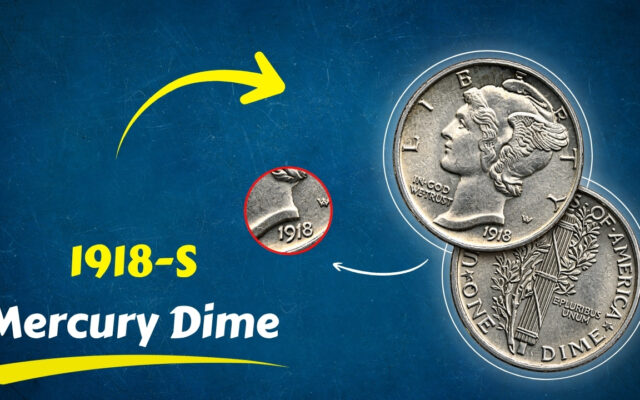
The Mercury dime officially the Winged Liberty Head dime is one of the most beloved series in American numismatics, and in 2026 it remains one of the most actively traded areas of the pre-1965 silver coin market. Struck from 1916 to 1945, the design is often mistaken for a portrait of the Roman god Mercury because of the winged cap Liberty wears on the obverse, a resemblance that gave the coin its enduring nickname.
While the vast majority of the roughly 2.6 billion Mercury dimes minted are common, worth little beyond their 90% silver melt value, a small handful of dates and varieties are true rarities. Low original mintages, wartime metal shortages, weak strikes, and a famous die error have turned certain dates into five- and six-figure coins. This guide walks through the ten most valuable Mercury dimes, what makes each one significant, how to tell a genuine example from a fake, and how collectors actually go about buying one today.
Because Mercury dimes have not been struck since 1945, there is no “official” mint ordering window the way there is for a modern commemorative release. Every coin discussed here trades on the secondary market through coin dealers, major auction houses, and third-party grading services and this guide explains how that process works.
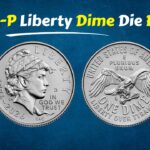
Mercury Dime Specifications
| Attribute | Detail |
|---|---|
| Official name | Winged Liberty Head Dime (“Mercury Dime”) |
| Years struck | 1916–1945 |
| Designer | Adolph A. Weinman |
| Mints | Philadelphia (no mint mark), Denver (“D”), San Francisco (“S”) |
| Composition | 90% silver, 10% copper |
| Weight | 2.5 grams (0.0723 troy oz. actual silver weight) |
| Diameter | 17.9 mm |
| Edge | Reeded |
| Total mintage (series) | Approximately 2.6 billion |
| Rarest regular-issue date | 1916-D (264,000 minted) |
| Most famous error | 1942/1 and 1942/1-D overdate |
| Typical common-date value (circulated) | Roughly silver melt value, about $6–$15 |
| Silver melt floor (approx., 2026 spot) | Roughly $6–$8 per coin, fluctuating with the spot silver price |
Top 10 Most Valuable Mercury Dimes at a Glance
| Rank | Date & Mint | Mintage | Circulated Value Range | Mint State / Gem Value Range |
|---|---|---|---|---|
| 1 | 1916-D | 264,000 | ~$1,200–$12,000+ | $35,000–$200,000+ |
| 2 | 1942/1 Overdate (Philadelphia) | Included in 205,410,000 | ~$450–$3,000 | $3,250–$25,000+ |
| 3 | 1942/1-D Overdate (Denver) | Included in Denver 1942 total | ~$500–$3,500 | $3,250–$18,000+ |
| 4 | 1921 (Philadelphia) | 1,230,000 | ~$50–$1,000 | $2,000–$8,000+ |
| 5 | 1921-D | 1,080,000 | ~$100–$1,700 | $2,500–$10,000+ |
| 6 | 1926-S | 1,520,000 | ~$15–$900 | $2,000–$10,000+ (rare in FB) |
| 7 | 1919-D | 9,939,000 | ~$10–$220 | $1,500–$6,000+ |
| 8 | 1919-S | 8,850,000 | ~$10–$200 | $1,500–$5,000+ |
| 9 | 1923-S | 6,440,000 | ~$8–$150 | $800–$3,500+ |
| 10 | 1927-D | 4,812,000 | ~$10–$180 | $1,200–$4,500+ |
Values are approximate retail ranges compiled from PCGS, NGC, Heritage Auctions, and dealer price guides, and vary significantly with grade, strike quality, Full Bands (FB) designation, and current silver spot price. Always confirm current pricing before buying or selling.
How Collectors Actually Buy These Coins
Unlike a new commemorative coin sold directly by the U.S. Mint, there is no order window, household purchase limit, or release date for a Mercury dime these coins were struck decades ago and now circulate entirely through the collector marketplace. Here’s how the buying process typically works in practice:
- Certified vs. raw coins: Any Mercury dime worth more than roughly $100–$150, and especially the 1916-D and both 1942/1 overdates, should be purchased only in a sealed, graded holder from PCGS (Professional Coin Grading Service) or NGC (Numismatic Guaranty Company). These services authenticate the coin and assign a numeric grade (typically 1–70), which anchors its market value.
- Where to buy: Established coin dealers (many belong to the PNG or ANA), major numismatic auction houses such as Heritage Auctions and Stack’s Bowers Galleries, and no-reserve online auction platforms such as GreatCollections are the primary marketplaces. Bullion dealers like APMEX and JM Bullion also carry lower-grade, silver-melt-level Mercury dimes.
- Auction timing: Heritage and Stack’s Bowers hold scheduled numismatic auctions several times a year, often tied to major coin shows (such as the ANA World’s Fair of Money or the FUN convention). GreatCollections runs weekly no-reserve online auctions, which is where many mid-range key dates change hands.
- Buyer’s premiums and fees: Expect a buyer’s premium of roughly 15–20% on top of the hammer price at major auction houses; online platforms like GreatCollections typically charge a smaller consignor fee rather than a buyer’s premium.
- No purchase limits: Because these are collectible antiques rather than a bullion product, there are no per-household ordering limits — availability is simply a function of how many certified examples exist and are being offered for sale at any given time.
- Budgeting by grade: Set your target grade before shopping. A well-worn Good-4 1921-D and a gem Mint State 1921-D can differ in price by a factor of 50 or more, so decide whether you’re buying a set-filler or an investment-grade coin.
Historical Background of Each Key Coin
1. 1916-D – The King of Mercury Dimes
Designer Adolph A. Weinman’s Winged Liberty Head design debuted in 1916, replacing the long-running Barber dime. The Philadelphia Mint struck the new design in large numbers, but the Denver Mint, busy fulfilling a large order of quarters that year, produced only 264,000 dimes with the new design before switching over making the 1916-D the lowest-mintage regular-issue Mercury dime and the single key date of the entire series. Its rarity was recognized almost immediately by collectors, and it has anchored “key date” want-lists for over a century.
2 & 3. 1942/1 and 1942/1-D Overdates – America’s Most Famous Die Error
In 1942, a Philadelphia Mint die was mistakenly created by impressing a 1942-dated hub over a die that had already been impressed with a 1941-dated hub, leaving a visible “1” trapped beneath the “2” in the date, along with doubling on the word LIBERTY and the motto IN GOD WE TRUST. A nearly identical error occurred independently at the Denver Mint that same year, producing the rarer and generally more valuable 1942/1-D. Collector Arnold Kohn of Kingston, New York, is credited with discovering the Philadelphia variety in 1943; it was publicized in Numismatic Scrapbook Magazine and quickly became one of the most sought-after 20th-century U.S. coin errors.
4 & 5. 1921 and 1921-D – The Post-War Recession Dates
After the Pittman Act of 1918 required the Treasury to melt and later re-strike large numbers of silver dollars, the Mint’s silver coin production shifted priorities, and the country was also in the grip of a sharp post-World War I recession. As a result, Philadelphia struck only 1,230,000 dimes in 1921 and Denver struck just 1,080,000 both among the lowest mintages in the series outside the 1916-D. Because collecting was a lower priority during the economic downturn, survival rates in high grade are especially low, making both dates true semi-key rarities.
6. 1926-S – Common Mintage, Uncommon Quality
The 1926-S isn’t rare by mintage alone (1,520,000 struck), but it earned its reputation as a condition rarity: San Francisco dies of this date are notorious for weak strikes, meaning even Mint State survivors often lack full detail. A true Full Bands 1926-S — where the central bands on the reverse fasces are completely separated is extraordinarily scarce, with only a small number ever certified by PCGS or NGC.
7 & 8. 1919-D and 1919-S – Denver and San Francisco’s Overlooked Keys
Both dates had respectable mintages for their era (9,939,000 and 8,850,000 respectively) but suffer from generally weak, mushy strikes typical of their mints and year. High-grade, well-struck examples particularly with Full Bands are disproportionately scarce relative to their mintage figures, which has pushed both dates into the top ten by value in better condition.
9. 1923-S – A San Francisco Semi-Key
With a mintage of 6,440,000, the 1923-S isn’t the rarest coin on this list by production numbers, but strike quality and survival rates in upper Mint State grades keep it in strong demand among date collectors assembling a complete circulated-to-uncirculated set.
10. 1927-D – The Overlooked Denver Rarity
The 1927-D, with 4,812,000 struck, is often underrated compared to its 1921-dated cousins, but in higher Mint State grades and especially with Full Bands it becomes surprisingly difficult to locate, making it a favorite target for advanced series specialists.
Obverse and Reverse Design
Obverse: Winged Liberty Head
The obverse depicts a young Liberty in profile, facing left, wearing a winged Phrygian cap a design element symbolizing freedom of thought rather than any literal connection to the Roman messenger god Mercury, despite the coin’s popular nickname. The word LIBERTY arcs along the upper rim, and the motto IN GOD WE TRUST sits in the left field beside Liberty’s neck. The date appears at the lower right. It has long been rumored, though never officially confirmed by Weinman, that Elsie Kachel Stevens wife of poet Wallace Stevens served as the model for Liberty’s profile.
Reverse: Fasces and Olive Branch
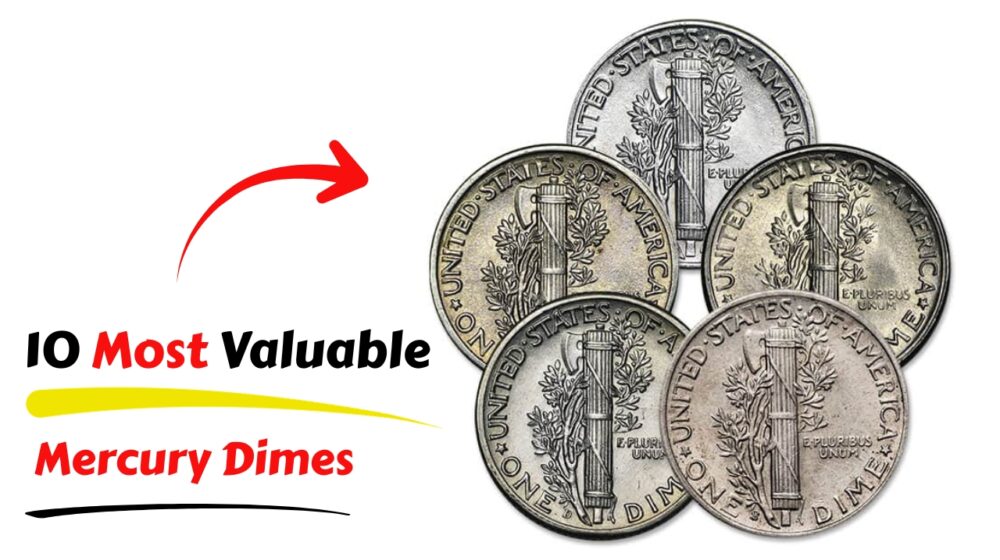
The reverse features a fasces a bound bundle of rods with a projecting axe blade, an ancient symbol of authority and civic unity oriented vertically and crossed diagonally by an olive branch, representing America’s strength paired with a desire for peace. E PLURIBUS UNUM curves along the right edge, UNITED STATES OF AMERICA arcs around the top, and ONE DIME appears at the bottom. The mint mark, when present, sits to the lower left of the fasces, between the rim and the base of the olive branch. The horizontal bands binding the center of the fasces are the source of the “Full Bands” (FB) or “Full Split Bands” (FSB) grading designation collectors prize full, sharply separated bands indicate an exceptionally well-struck coin.
Why This Matters for Collectors
- A genuinely finite supply. Unlike modern commemoratives, no more Mercury dimes will ever be struck. Every certified 1916-D or 1921-D in existence today is all that will ever exist, and that population only shrinks over time as coins are lost, damaged, or melted.
- A gateway to classic U.S. numismatics. The Mercury dime series is widely considered one of the most collectible and completable classic U.S. series — nearly 80% of the dates are affordable near silver melt value, making the key dates attainable goals rather than permanently out of reach.
- Tangible silver plus numismatic premium. Every Mercury dime carries intrinsic silver value as a floor, but the key dates on this list trade at enormous premiums over that floor purely on rarity and collector demand a combination that has historically provided some insulation against silver price volatility.
- Counterfeiting risk makes authentication essential. The 1916-D in particular is one of the most counterfeited U.S. coins, commonly faked by adding a tooled “D” mint mark to a common 1916 Philadelphia dime. This makes third-party certification not just a nicety but a near-requirement for any high-value purchase.
- Strike quality adds a second collecting dimension. The Full Bands designation means collectors aren’t just chasing dates and mint marks — they’re also chasing strike quality, which keeps dates like 1926-S, 1919-D, and 1919-S relevant and desirable even though their raw mintages aren’t the lowest in the series.
Quick-Reference Buying Guide
- Learn the key dates first. Memorize the ten dates and mint marks above before you start shopping they are what separates a $10 coin from a $10,000 coin.
- Set a target grade and budget. Decide whether you want a modest circulated example or a high-grade Mint State/Full Bands coin before searching, since prices scale dramatically with condition.
- Buy certified coins for anything over $100–$150. Only purchase PCGS- or NGC-graded examples of the 1916-D, both 1942/1 overdates, 1921, and 1921-D never buy these raw from an unverified seller.
- Check the mint mark placement and style. On genuine Denver and San Francisco coins, the mint mark is small, cleanly struck, and sits between the rim and the olive branch inspect under magnification for signs of tooling or addition.
- Shop reputable venues. Use established dealers, Heritage Auctions, Stack’s Bowers Galleries, or GreatCollections rather than unverified online marketplace listings.
- Factor in buyer’s premiums and fees. Budget an additional 15–20% on top of any auction hammer price when calculating your true purchase cost.
- Consider Full Bands carefully. Decide whether the premium for a Full Bands example fits your budget and goals it’s most valuable for advanced collectors, not necessary for basic type or date sets.
- Save the priciest keys for last. Build out the more affordable 80% of the series first so you’re a committed collector before spending serious money on the 1916-D or 1942/1 overdates.
- Watch silver spot prices. Even common-date Mercury dimes track the silver market, so time bullion-level purchases with an eye on the current spot price.
- Keep records and store properly. Log grades, certification numbers, and purchase prices, and store certified coins in their original holders in a stable, low-humidity environment to preserve both condition and resale value.
Note:- This article is based on publicly available auction information regarding Lot 2048 in Stack’s Bowers Galleries’ Summer 2026 Global Showcase Auction. Collectors are encouraged to consult the official auction catalog and Stack’s Bowers Galleries directly for the most current details, estimates, and bidding procedures.