Most of the coins that command real money in the hobby earned their reputation generations ago, worn smooth by decades of handling or locked away since the day they left the Mint. The 1982 No-P Roosevelt dime is different. It is a genuine rarity that was minted, spent, and rediscovered within living memory, at a time when disco was fading, Cabbage Patch dolls were flying off shelves, and nobody was checking their pocket change for missing letters.
A single Philadelphia die, somehow struck into service without its mandatory “P” mintmark, quietly sent an unknown number of error dimes into everyday commerce. Rolls of dimes moved through banks, arcades, and cash registers for months before anyone realized what had slipped through. By the time collectors caught on, the coins were already scattered across pocket change, piggy banks, and vending machine trays throughout the Midwest.
More than four decades later, the 1982 No-P dime is widely regarded as the single most important error in the entire Roosevelt dime series, and one of the defining modern-era mint mistakes of the last fifty years. It remains a coin that rewards patience: people still occasionally find one hiding in an old jar of change.
Quick-Reference Specifications
| Attribute | Detail |
|---|---|
| Coin type | Roosevelt Dime |
| Date | 1982 (Philadelphia issue only) |
| Mint | Philadelphia (no mintmark present due to the error) |
| Error type | Missing “P” mintmark on a die that should have carried one |
| Composition | Copper-nickel clad (91.67% copper core, outer layers of 75% copper/25% nickel) |
| Weight | 2.27 grams |
| Diameter | 17.9 mm |
| Edge | Reeded |
| Known mintage of the error | Not separately recorded by the Mint; population is estimated only from surviving examples and certification data |
| Strike varieties | “Strong” strike and “Weak” strike |
| Typical value, Extra Fine (circulated) | Around $30 |
| Typical value, Gem Mint State or better | $300 and up, with strong premiums at the top end |
| First reported discovery | Late 1982, Sandusky, Ohio |
Because this is a circulation error rather than a coin the Mint intentionally released, there is no official mintage figure and no way to ever know exactly how many examples were struck. The numbers above reflect market experience and certification-service data rather than Mint records.
How the Error Happened: A Break in Die Preparation
Understanding this coin requires understanding a change that took effect two years earlier. For most of the U.S. Mint’s history, coins struck in Philadelphia carried no mintmark at all; the “P” simply wasn’t used, with a small number of wartime exceptions. Denver and San Francisco coins used “D” and “S” respectively, but Philadelphia dimes, quarters, and half dollars were mintmark-free by default.
That changed in 1980, when the Mint began stamping a small “P” above the date on all circulating Philadelphia coinage except the cent. From that point on, every Philadelphia dime dated 1980 or later was expected to show that mark. A Philadelphia dime with no mintmark simply should not have existed after that transition.
In 1982, it happened anyway. At the time, mintmarks were still applied to working dies by hand, a punch-and-hammer process carried out before a die was hardened and sent into production. On at least one Philadelphia dime die, that punching step was skipped or failed, and the die was approved for service regardless. Every coin struck from that die came out looking like a pre-1980 Philadelphia dime, except for a date that made the omission impossible to explain away. Evidence points to a single working die as the source, which is consistent with both how scarce the error is and how uniform surviving examples look.

Discovery in Sandusky, Ohio
The story of how the error came to light is a big part of its lasting appeal. The first widely reported examples turned up in late 1982 in Sandusky, Ohio, close to Cedar Point amusement park, a location that processed enormous volumes of coin-operated transactions every day. Ride operators, game booths, and local cash registers pushed huge amounts of change through public hands, and it didn’t take long for sharp-eyed employees and collectors to notice dimes that looked slightly off.
Word spread quickly through Midwest collecting circles, and hobbyists began searching bank-wrapped rolls of dimes in search of more examples. Additional coins turned up in nearby towns and states, a pattern that suggests the error dies were used for a limited production run rather than being spread across the country, which helps explain why the coin is regionally associated with Ohio to this day.
The Roosevelt Dime: Design History and Significance
Origins of the Design
The Roosevelt dime wasn’t born from the 1982 error, of course; it has its own long history that gives the coin its context. The design was created by U.S. Mint sculptor-engraver John R. Sinnock and entered circulation in 1946, replacing the Mercury dime. The change was made quickly and deliberately: Franklin D. Roosevelt had died the year before, and given his personal connection to the fight against polio and his association with the March of Dimes campaign, Congress and the Treasury moved to honor him on the coin most closely tied to that cause.
Sinnock’s design has proven remarkably durable. Apart from the 1965 switch from silver to a copper-nickel clad composition, driven by rising silver prices and coin shortages, the basic design of the Roosevelt dime has remained unchanged since its debut, making it one of the longest-running coin designs in U.S. history.
Why 1982 Specifically Matters
The 1982 issue holds a second layer of significance beyond the missing mintmark. It was also the first year the Mint temporarily stopped adding its mintmark to Philadelphia proof and business-strike dies with full consistency during a broader adjustment period, contributing to a run of mintmark-related oddities across several denominations in the early 1980s. Against that backdrop, the No-P dime stands out as the most collectible and best documented of the group.
Obverse Design
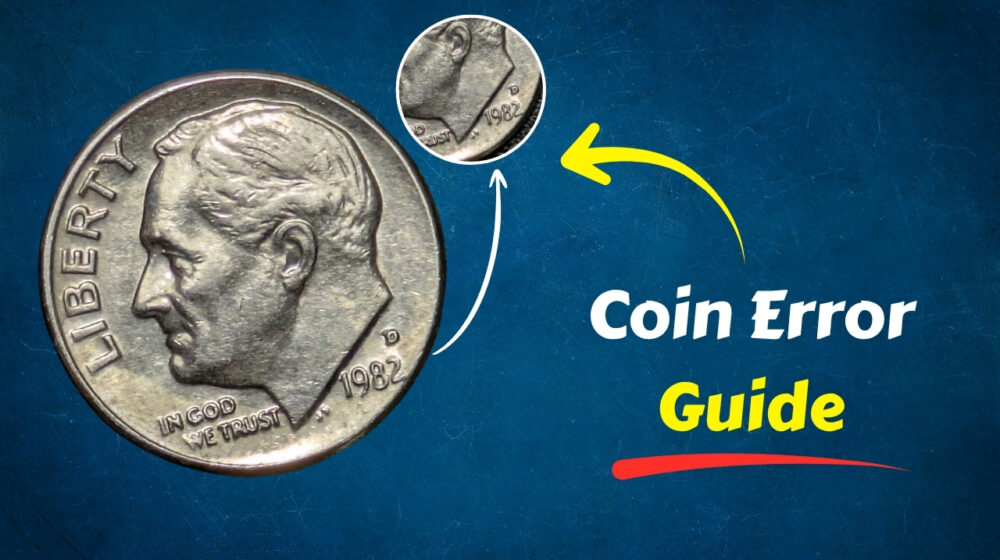
The obverse of the Roosevelt dime carries a left-facing portrait of Franklin D. Roosevelt, rendered by Sinnock with fine detail in the hair, brow, and facial features. “LIBERTY” arcs along the upper left rim, while “IN GOD WE TRUST” sits in small lettering just to the right of the portrait, tucked close to Roosevelt’s neckline. The date appears at the lower right.
On a normal post-1980 Philadelphia dime, a small “P” mintmark would sit just above the date, near the truncation of Roosevelt’s neck. On the 1982 No-P error, that space is entirely blank. Collectors examining a candidate coin should see no outline, no discoloration, and no disturbed metal in that spot; a genuine error shows a clean, unbroken die surface where the mintmark should be, not evidence that something was removed.
Reverse Design
The reverse features a design rich with patriotic symbolism. A lit torch stands at the center, flanked by an olive branch on the left, representing peace, and an oak branch on the right, representing strength and independence. “UNITED STATES OF AMERICA” wraps around the upper rim, “E PLURIBUS UNUM” sits in small letters just above the torch, and “ONE DIME” appears at the bottom.
This reverse composition has remained essentially untouched since 1946, and on the 1982 No-P dime it appears exactly as it does on any other clad-era Roosevelt dime. The reverse plays no role in identifying the error; the entire story is told by the blank space above the date on the obverse.
Strong vs. Weak Strikes
Numismatic references generally divide the 1982 No-P dime into two categories based on strike quality rather than any difference in the missing mintmark itself:
- Strong strikes show crisp, well-defined detail throughout the design, particularly in the lettering and rim, closely resembling a normally struck dime in sharpness.
- Weak strikes show noticeably flattened design elements, with softness or partial loss of detail across large portions of the coin.
Both varieties are legitimate examples of the error and both are collected, but the market consistently places a premium on well-struck Strong examples, since they combine rarity with eye appeal.
Rarity: What We Actually Know
The Mint never tracked or published a count of how many dimes came from the flawed die, and because the coins entered general circulation and were spent like any other dime, an exact population figure will never exist. What collectors do have is decades of submission data from the major grading services. Based on that data, the 1982 No-P dime ranks as the most frequently submitted clad-era Roosevelt dime variety, trailing only the 1996-W dime, a coin that was deliberately produced as a mint-set novelty rather than for circulation.
That distinction matters. The 1996-W was never meant to be found in pocket change; the 1982 No-P was a genuine accident that mixed into ordinary commerce. Collector experience suggests that while thousands of examples likely survive in aggregate, the number thins out quickly in higher Mint State grades, which is why condition, not raw scarcity, tends to drive the price of any individual coin.
How to Identify a Genuine Example
Because altered coins circulate alongside genuine ones, careful identification matters before buying or submitting a coin for grading.
- Confirm the date. The error is specific to 1982; no other date qualifies, regardless of how convincing the coin otherwise looks.
- Inspect the area above the date under magnification. A genuine No-P dime shows a smooth, undisturbed surface with no trace of an outline, shadow, or tool marks. Coins where a mintmark has been physically removed usually show telltale scratching or unnatural metal flow that a loupe or microscope will reveal.
- Check overall die characteristics. Genuine examples match the portrait detail, spacing, and general appearance expected of a 1982 Philadelphia dime in every other respect.
- Rule out simple wear. Natural circulation wear does not erase a mintmark cleanly; a worn-down “P” typically leaves at least a faint trace, unlike the flawless absence seen on a true error.
- When in doubt, get it certified. Third-party grading from PCGS or NGC remains the most reliable way to confirm authenticity, especially for higher-value Mint State or Strong-strike examples.
Buying and Acquiring a 1982 No-P Dime
Unlike a commemorative coin sold directly by the Mint, the 1982 No-P dime was never offered for sale, has no official order window, and carries no purchase limits, since it entered the hobby entirely by accident through general circulation. For today’s collector, acquiring one means buying from the secondary market rather than placing an order. The realistic paths to ownership are:
- Certified coin dealers, both local and online, who regularly stock error coins and can offer PCGS- or NGC-graded examples with an authenticity guarantee.
- Major coin auction houses and online auction platforms, where certified examples in various grades appear regularly, often with detailed photos that allow close inspection before bidding.
- Coin shows, where in-hand examination is possible and dealers specializing in error coins are commonly found.
- Roll searching, the long-shot but still theoretically possible route of examining dimes from circulation, bank-wrapped rolls, or old accumulated change in hopes of finding an unattributed example, exactly how the variety was first discovered in 1982.
Budget expectations should be set by condition rather than by any fixed retail price: a modestly circulated Extra Fine example is realistically priced around $30, while a well-struck Gem Mint State coin can run $300 or considerably more depending on strike strength and certification.
Why This Matters for Collectors
The 1982 No-P dime occupies a unique niche in modern numismatics. It has every quality that makes an error coin desirable: a cause that is easy to explain, a direct link to a documented Mint procedural change, a discovery story rooted in ordinary circulation rather than a warehouse find, and a population that is scarce without being so small that the coin is unattainable.
It also carries a broader message for the hobby. Many newer collectors assume that meaningful errors stopped happening once the Mint modernized its processes, or that real rarities only come from the 19th century and earlier. The 1982 No-P dime proves otherwise. It shows that human steps in an industrial process can still fail in ways that create lasting collectibles, and it keeps alive the appeal of searching ordinary pocket change, since that is exactly how this coin was found in the first place.
Quick-Reference Buying Guide
- Confirm the date is 1982 before considering anything else; no other year applies to this error.
- Examine the area above the date for a completely smooth, undisturbed surface with no mintmark and no signs of alteration.
- Decide between circulated and Mint State based on budget: roughly $30 for a solid Extra Fine example versus $300-plus for Gem Mint State or better.
- Choose Strong or Weak strike based on personal preference, keeping in mind that Strong strikes generally carry a market premium.
- Prioritize certified examples from PCGS or NGC, especially for any purchase above entry-level circulated grades.
- Buy from reputable dealers, established auction platforms, or coin shows, since there is no official Mint source or order window for this coin.
- Keep the coin properly stored in a protective holder immediately after purchase to preserve its grade and value.
- Consider roll searching as a bonus pursuit, not a primary acquisition strategy, since finding an unattributed example today is possible but highly unlikely.