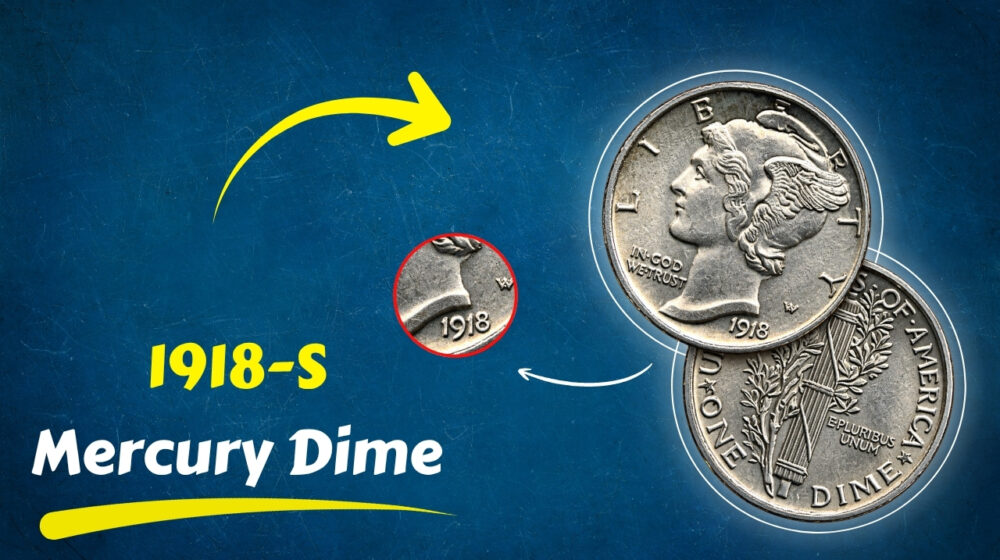
Ask a Mercury dime collector which dates in the series are truly difficult, and the answers come quickly: the 1916-D, the 1921 and 1921-D, perhaps the 1926-S. The 1918-S rarely makes that first list. With a mintage north of 19 million, it seems like a coin that should be easy to find in any grade.

And in lower grades, it is. The problem appears at the top of the scale. Find a 1918-S in Mint State with a sharp strike and fully separated bands on the reverse, and you have found something that most collectors will never own.
This article explains why. We look at how the San Francisco Mint produced the issue, how die wear left most coins soft, what the Full Bands designation demands, and how the market has rewarded the few coins that meet it. Along the way we cover the coin’s specifications, its design, its historical setting, and a practical guide to buying one.
One note on format: the 1918-S is a long-established date, not a new release, so there is no order window or purchase limit to report. In place of a launch-style ordering section, you will find a practical section on how to acquire one.
1918-S Mercury Dime at a Glance
| Detail | Specification |
|---|---|
| Country | United States of America |
| Year | 1918 |
| Denomination | Dime (10 cents) |
| Series | Mercury Dime (Winged Liberty Head) |
| Mint / Mintmark | San Francisco / “S” |
| Mintage | 19,300,000 |
| Composition | 90% silver, 10% copper |
| Weight | 2.5 grams |
| Diameter | 17.9 mm |
| Edge | Reeded |
| Designer | Adolph A. Weinman (obverse and reverse) |
| Strike type | Business strike |
| Dies used (San Francisco, 1918) | 73 obverse and 66 reverse |
| Key challenge | Full Bands (FB) strikes in Mint State |
How to Acquire a 1918-S Mercury Dime
Because this is a collectible coin from over a century ago, you will not find a mint order page, a household limit, or an ordering deadline. You buy it on the secondary market, and the process rewards patience and homework. Here is what that looks like in practice.
Where coins are sold
- Major auction houses. The best Full Bands coins tend to surface in named collection sales. Several of the results listed later in this article came from exactly that kind of event.
- Established dealers. Reputable dealers can search for a specific grade and attribution on your behalf, and many will keep your want list on file.
- Coin shows and online marketplaces. These offer the widest selection, though they also require the most caution about verifying certification.
What to decide before you shop
- Your target grade. Circulated examples are inexpensive and plentiful. Mint State coins cost more, and the price steps up sharply once Full Bands is part of the description.
- Whether Full Bands matters to you. For this date, it is the main value driver. A Mint State coin without the FB designation and a Mint State coin with it can be priced very differently.
- Certification. For anything above modest budgets, buy coins graded by a major third-party service such as PCGS or NGC. CAC stickers add another layer of eye-appeal and quality verification.
How to evaluate a coin
- Check the bands. On the reverse, look at the horizontal bands binding the fasces. Merged or flattened bands mean the coin is not Full Bands, no matter how sharp the rest of the strike looks.
- Check the hair above the ear. Softness here is common on the 1918-S and is a sign of a worn die.
- Look at the surfaces and toning. Original, attractive toning can help a coin. Several high-end examples in the sales record carried it.
- Verify the holder and label. Confirm the certification number with the grading service before you pay.
Budgeting
Prices vary widely by grade and attribution, so the sales results in the market section below are best treated as markers rather than guarantees. Check recent auction records before you bid, and set a ceiling in advance.
Historical Background
The Mercury Dime and its designer
The Mercury dime, formally the Winged Liberty Head dime, was introduced in 1916 and designed by sculptor Adolph A. Weinman. Weinman created both the obverse and reverse, giving the coin a unified look. The popular “Mercury” nickname comes from the winged cap, which resembles the Roman god of that name. The figure on the coin is Liberty, not Mercury.
When the series launched, early coins reportedly gave trouble in vending machines and pay telephones because of their thickness. By 1918 the Mint had made subtle adjustments, and the dime worked well in everyday commerce. That change does not alter how the coin is attributed or collected, but it helps explain why the dimes circulated so widely.
San Francisco in 1918
The 1918-S was struck in the final year of World War I. That year, the San Francisco Mint produced five denominations:
| Denomination | San Francisco mintage, 1918 |
|---|---|
| Lincoln Cents | 34,680,000 |
| Mercury Dimes | 19,300,000 |
| Standing Liberty Quarters | 11,072,000 |
| Walking Liberty Half Dollars | 10,282,000 |
| Buffalo Nickels | 4,882,000 |
The Mercury dime ranked second in output, behind only the cent.
The coins were made in the Old San Francisco Mint, known as “The Granite Lady.” The building became a symbol of endurance after it survived the 1906 earthquake and the fires that followed. This history has no bearing on the coin’s grade or rarity, but it gives any San Francisco coin from the period an extra layer of appeal.
Why a common coin became a challenging one
According to U.S. Mint records, San Francisco used 73 obverse dies and 66 reverse dies to strike all 19,300,000 Mercury dimes in 1918. That works out to more than 277,000 impressions per die on average.
Pushing dies that hard kept production moving, but it came at a cost. As dies wore, the strike lost definition. The result is a typical 1918-S dime with soft details in two places: the hair above Liberty’s ear and, most importantly, the central bands of the fasces on the reverse.
Design Description
Obverse
The obverse shows a left-facing portrait of Liberty wearing a winged cap. The wings are commonly read as a symbol of freedom of thought. Liberty’s hair is shown flowing beneath the cap, and the portrait fills the field with a clean, classical profile. This is the area where die wear first shows up on the 1918-S: the hair above the ear can look flat or indistinct on weaker strikes.
The date and mintmark are small elements placed near the lower portion of the design. On this issue, the mintmark “S” identifies San Francisco.
Reverse
The reverse centers on a fasces, a bundle of rods bound by horizontal bands and topped with an axe blade, an ancient Roman emblem of unity and strength. An olive branch crosses the design as a symbol of peace. Together they pair strength with peace in a single image, a message that carried extra meaning in 1918.
The collecting story of this issue lives here. To earn the Full Bands (FB) designation, the horizontal bands across the center of the fasces must appear fully separated and uninterrupted. On the 1918-S, worn dies and shallow strikes left the bands merged or incomplete on most coins. A fully split-band example is the exception.
A note on symbolism
The imagery was not changed to serve wartime propaganda. Still, a winged cap for liberty and a fasces joined with an olive branch fit the mood of a nation at war that was also hoping for peace.
Market History and Noteworthy Sales
Interest in this date goes back decades. In April 1976, New York dealer Joel D. Coen advertised choice Brilliant Uncirculated examples for $150 in The Numismatist. The price reflects early recognition that quality coins were harder to find than the mintage suggested.
As grading standards tightened and Full Bands attribution became a core part of the market, the premium for sharp strikes grew.
Certified population (as of March 2025)
| Service / Grade | Number reported |
|---|---|
| PCGS MS67+FB | 1 |
| NGC MS66FB | 5 |
| CAC MS67FB | 3 (all stickered) |
Population figures change as coins are submitted, so check the current reports from each grading service before making a decision.
Notable auction results
- NGC MS68FB. This coin sold for $22,000 in January 1996 and brought $35,075 in August 2001. It showed scattered crimson toning and no longer appears in the NGC Census.
- PCGS MS67FB, CAC-approved. This example, which has been certified in multiple holders, sold for $44,850 in 2002 and $63,250 in 2009. It then reached $144,000 in the Charles McNutt Collection sale in January 2019. By then it showed golden-brown toning around the borders of both sides.
- PCGS MS67FB, William Dominick Collection. This coin realized $97,750 in August 2010.
- PCGS MS66FB, Del Loy Hansen Collection. This coin sold for $21,075 in August 2024.
Together, these results show how heavily the market rewards strike quality over mintage.
A Rare Error: The Mirror Brockage
Collectors also know the 1918-S for a dramatic error type called a mirror brockage. This happens when a previously struck coin stays lodged in the press and transfers a reversed, incuse image of its obverse onto the next planchet. The effect is striking, and examples exist for this date. They are better viewed as a separate specialty than as a measure of the regular issue’s market.
Why This Matters for Collectors
1. It teaches the difference between mintage and availability. A date with 19.3 million coins can still be scarce in the grades and strike qualities that matter most. The 1918-S is one of the clearest illustrations of that principle in U.S. numismatics.
2. It is a conditional rarity. The 1918-S is not a traditional key date. Its difficulty comes from a specific combination: high grade plus Full Bands. Collectors who understand that distinction can avoid overpaying for the wrong attributes and spot coins that are better than they look.
3. Strike quality drives value. The sales record shows large price jumps for the best Full Bands coins. The market is paying for sharpness, not simply for survival.
4. It matters for Registry Set builders. Anyone assembling a high-grade Mercury dime set will find the 1918-S one of the more demanding dates to fill with a top-quality coin.
5. It is accessible at the entry level. Because so many were made, collectors on a smaller budget can still enjoy a nice circulated 1918-S and take part in the same history, with the Full Bands chase available later if they want to move up.
6. It carries a story. A coin struck in the last year of World War I, at the Granite Lady, with a design that pairs liberty and peace, gives collectors more than a grade to chase.
As the story of this issue shows, the challenge is not finding a 1918-S. It is finding the right one.
Quick-Reference Buying Guide
- Set your goal. Decide whether you want a circulated example for a date set or a Mint State, Full Bands coin for a high-grade or Registry collection.
- Set a budget range. Review recent auction results for your target grade, then decide your maximum. Full Bands coins can cost many times more than non-FB coins at the same grade.
- Choose certified coins. Buy coins graded by PCGS or NGC. Consider CAC-approved coins for extra confidence in quality.
- Inspect the reverse bands first. Check that the horizontal bands of the fasces are separated and complete. If the label says FB, confirm it by looking at the coin’s images.
- Check the hair above Liberty’s ear. Soft detail here is common. A sharper area suggests a stronger strike.
- Evaluate surfaces and toning. Prefer original, attractive color and clean surfaces. Be careful with coins that look artificially altered.
- Verify the certification number. Confirm the holder details with the grading service’s online lookup before you pay.
- Compare sellers and sale venues. Check dealers, auction houses, and shows. Review return policies and buyer’s fees on auction lots.
- Check the current population report. Numbers change. Review the latest PCGS, NGC and CAC data to see how rare your target coin really is.
- Buy, store, and document. Keep the coin in its holder, store it in a stable environment, and keep your invoice and certification details for insurance and future resale.
Population data and sales results cited above are as reported through the dates given. Verify current figures with the grading services and auction records before buying or selling.