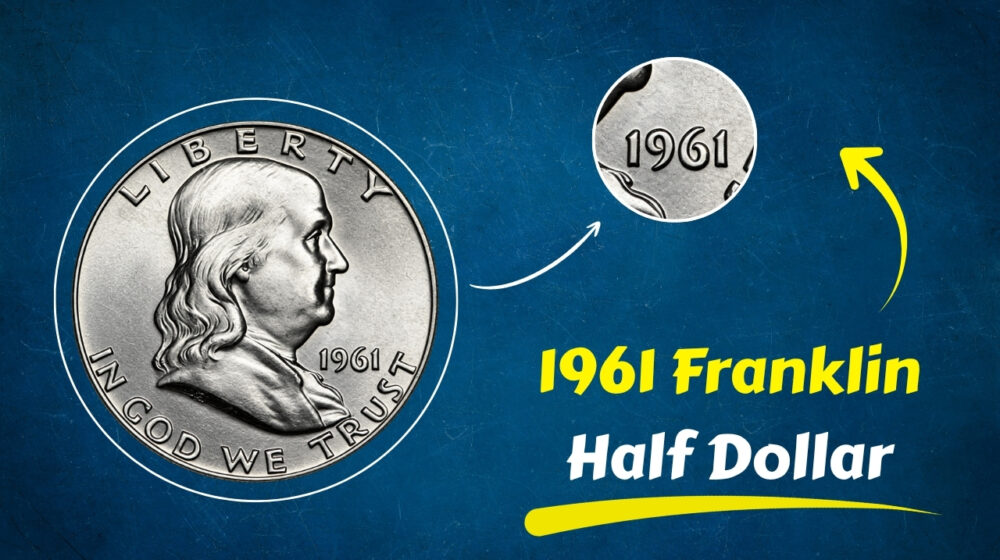
Most 1961 Proof Franklins are inexpensive, easy to find, and rarely worth more than a modest premium over their silver content. One reverse die broke that pattern. The 1961 Proof Franklin Half Dollar Doubled Die Reverse, catalogued as FS-801, shows doubling so bold that collectors can spot it without a loupe. That is rare among die varieties, which usually demand magnification and patience.
Rarity then raises the stakes. PCGS estimates roughly 1,000 FS-801 coins survive in all grades, with about 370 at PR65 or better. True Cameo examples are scarcer still: PCGS puts the Cameo population at only about 20 coins, perhaps 10 of them at PR65 or higher.
The market reflects that scarcity. In April 2021, an NGC Proof-67 Ultra Cameo CAC example sold through GreatCollections for $46,125 after 96 bids. NGC described it as the only Ultra Cameo on either major grading-service census at the time. Meanwhile, an ordinary Proof Franklin from the same year can sell for very little.
This guide covers what makes FS-801 special, how to identify it, what it costs in 2026, and how to buy one with confidence.
1961 FS-801 Doubled Die Reverse: Specifications at a Glance
| Detail | Information |
|---|---|
| Denomination | 50 cents (half dollar) |
| Series | Franklin Half Dollar (1948–1963) |
| Year | 1961 |
| Mint | Philadelphia (no mintmark) |
| Variety | FS-801, Doubled Die Reverse (Fivaz-Stanton number) |
| Finish | Proof |
| Total 1961 Proof mintage | 3,028,244 |
| FS-801 mintage | Unknown; the Mint kept no record |
| Estimated FS-801 coins released | Roughly 1,500 to 2,000 |
| Estimated survivors (PCGS) | About 1,000 in all grades; about 370 at PR65 or better |
| Cameo survivors (PCGS) | About 20, with perhaps 10 at PR65 or better |
| Composition | 90% silver, 10% copper |
| Weight | 12.5 grams |
| Diameter | Approximately 30.6 mm |
| Silver content | Approximately 0.36169 troy ounce |
| Edge | Reeded |
| Designer | John R. Sinnock |
| Key diagnostic | Strong reverse doubling on E PLURIBUS UNUM, UNITED STATES, and HALF DOLLAR |
| Other 1961 doubled dies | FS-802 and FS-803 |
Why FS-801 Stands Out Among Franklin Varieties
Franklin half dollar collectors have plenty of varieties to hunt. The “Bugs Bunny” coins, for instance, draw attention for their nickname and distinctive die clash. FS-801 offers something else: the kind of dramatic doubling that hobbyists usually associate with famous doubled dies from other U.S. series.
Several respected voices have noted this:
- PCGS describes it as one of the most dramatic, exciting, and valuable Franklin half dollars.
- Stack’s Bowers has repeatedly called it the strongest doubled die in the Franklin series.
- Rick Tomaska, author and Franklin specialist, called it the “king” of 20th-century Proof half dollar error varieties.
- Heritage Auctions notes that the fifth edition of the Cherrypickers’ Guide put the coin on its cover because the doubling is visible to the naked eye.
That visibility is a big part of its staying power. Buyers can see what they are paying for.
Historical Background
The Franklin Half Dollar Series (1948–1963)
The Franklin half dollar replaced the Walking Liberty design and ran for just 16 years. It was struck at Philadelphia, Denver, and San Francisco during its early years, and Proof versions for collectors were offered from 1950 through 1963. The series closed in 1963, and the Kennedy half dollar replaced it the following year.
The coin was the work of John R. Sinnock, Chief Engraver of the U.S. Mint. Sinnock died in 1947, so he did not see his design enter circulation. The coin honors Benjamin Franklin, a fitting choice for a series pairing the Founding Father with the Liberty Bell. The series is popular today because it is affordable, offers a manageable date run, and rewards collectors who chase quality, such as fully struck “Full Bell Line” coins and sharp Proofs.
The 1961 Proof Issue
The Philadelphia Mint produced 3,028,244 Proof half dollars in 1961, a large number by the standards of Proof production. Because so many were made, most examples are common and affordable.
The FS-801 variety exists because of a single reverse die. The Mint did not record how many coins it struck from that die. Specialists have long estimated that perhaps 1,500 to 2,000 pieces reached the public before workers pulled the die from production. GreatCollections discussed that estimate in 2017 and suggested about 1,000 might survive. Current PCGS research lands in the same range.
The Three 1961 Doubled Die Reverses
FS-801 is not the only doubled die reverse for the date. PCGS also lists FS-802 and FS-803 among the 1961 Proof major and die varieties. Collectors should know the difference, because FS-801 commands the strongest attention and the strongest prices. Mistaking a lesser doubled die for FS-801 could cost thousands of dollars.
Design Description
Obverse
Sinnock’s obverse shows a right-facing portrait of Benjamin Franklin. The inscription LIBERTY arcs across the top, IN GOD WE TRUST appears to the left of the portrait, and the date sits to the right. Sinnock’s initials, JRS, appear at the truncation of the bust. The portrait is strong and simple, with Franklin shown in a plain, dignified style.
The obverse is not where the FS-801 doubling lives. Treat it as a quality check: examine the fields and Franklin’s portrait for contact marks, hairlines, and the frosted-versus-mirrored contrast that drives Cameo designations.
Reverse
The reverse features the Liberty Bell, with its famous crack, in the center. E PLURIBUS UNUM sits above the bell, UNITED STATES OF AMERICA curves around the upper rim, and HALF DOLLAR runs along the bottom. A small eagle stands to the right of the bell. Collectors also pay attention to the lines on the bell’s lower portion, which are a quality marker in the series.
The reverse is where FS-801 shows itself. Collectors should look closely at three areas:
- E PLURIBUS UNUM
- UNITED STATES
- HALF DOLLAR
On FS-801, the separation through these inscriptions is wide and obvious. The doubling is especially strong along parts of the left and lower edges of the letters. A strong example can often be identified without magnification, and PCGS continues to use these inscriptions as the key diagnostics for the variety.
What Is a 1961 FS-801 Worth in 2026?
Value depends heavily on grade, eye appeal, certification, and above all cameo contrast.
Regular (Non-Cameo) Proof FS-801
As of September 2026, the PCGS Price Guide lists these approximate values:
| Grade | PCGS Price Guide |
|---|---|
| PR65 | $3,150 |
| PR66 | $5,000 |
| PR67 | $5,750 |
| PR68 | $17,500 |
Greysheet continues to show a broad retail market that stretches from the hundreds of dollars into five figures.
Actual auction prices can differ from the guides:
- Heritage sold a PCGS PR65 for $2,562 on July 28, 2026.
- Heritage sold a PCGS PR66 for $2,562 on July 17, 2026.
- A PCGS PR67 realized $4,080 in November 2025.
- Stack’s Bowers sold a PCGS PR68 CAC for $15,000 in November 2020, which PCGS still lists as the auction record for the regular Proof category.
Cameo and Ultra Cameo FS-801
Cameo contrast changes the market entirely. Older references once described Cameo FS-801 coins as almost unobtainable and even said no Deep Cameo examples had surfaced. The market proved otherwise:
- A PCGS PR66+ Cameo CAC brought $14,100 in November 2016.
- An NGC Proof-67 Ultra Cameo CAC sold for $46,125 in April 2021 (96 bids).
- A PCGS PR67 Cameo sold for $22,800 at Stack’s Bowers on June 16, 2023, which PCGS lists as its Cameo category record.
- A PCGS PR66+ Cameo CAC (CMQ) sold for $17,080 at Stack’s Bowers in June 2026. At the time, PCGS listed two coins at PR66+ Cameo and only one finer.
Do not compare a brilliant Proof FS-801 directly with a Cameo or Ultra Cameo coin. They sit at different levels of the market.
Why This Matters for Collectors
1. The doubling is genuinely dramatic. Most die varieties reward the trained eye. FS-801 rewards almost anyone, which makes it a great entry point for collectors who want a variety they can actually see and show off.
2. The population is tiny relative to the issue. Over three million Proofs were made, yet only about 1,000 FS-801 coins are believed to survive. That gap between mintage and survivors is a large part of the coin’s appeal.
3. Registry demand is built in. PCGS includes FS-801 in its Franklin Half Dollars Complete Variety Set, Proof (1950–1963), which now requires 30 coins rather than 29 and incorporates Fivaz/Stanton varieties. It is also part of the shorter Franklin Half Dollars with Major Varieties, Proof (1950–1963) set, which requires 16 coins. Registry competitors treat FS-801 as a required slot, not an optional curiosity, and that adds steady demand for high-grade pieces.
4. Cameo contrast creates a second tier of rarity. With only about 20 Cameo survivors, these coins are the true rarities of the variety, as the 2021 and 2026 results show.
5. Discovery is still possible. An ordinary-looking 1961 Proof Franklin can sit in a collection for decades. Turn it over, look at E PLURIBUS UNUM, and the story can change very quickly. Collectors checking old Proof sets, inherited collections, or raw coins at shows may still find one.
How to Buy a 1961 FS-801: What to Know
Unlike a modern Mint release, FS-801 has no order window, household limit, or issue price. It trades on the secondary market, so the process looks like this:
- Where to buy: Major auction houses (Heritage, Stack’s Bowers, GreatCollections), established dealers, coin shows, and online marketplaces. Auction results change quickly, so check recent sales before bidding.
- What to buy: Certified coins are the safest option. PCGS and NGC both grade the variety, and a CAC sticker adds confirmation of quality.
- What to check: Confirm the attribution on the holder reads FS-801 and not FS-802 or FS-803, then verify the doubling yourself on the reverse inscriptions.
- Budget range: Roughly $3,000 or more for PR65 and up for regular Proofs, well into five figures for top grades, and a different price tier for any Cameo or Ultra Cameo.
This article provides general information, not financial advice. Prices change, so verify current values before you buy.
Quick-Reference Buying Guide
- Set your goal and budget. Decide whether you want a nice example for a variety set, a registry-competitive coin, or a Cameo showpiece. Each sits at a very different price level.
- Learn to spot FS-801. Study high-resolution images of E PLURIBUS UNUM, UNITED STATES, and HALF DOLLAR. Look for wide, obvious separation, especially along the left and lower edges of the letters.
- Know the lookalikes. FS-802 and FS-803 are also 1961 doubled die reverses, but they are weaker and priced lower. Confirm the FS number on the holder.
- Buy certified. Choose a PCGS- or NGC-graded coin with the variety attribution on the label. A CAC sticker is a plus.
- Check contrast. Look for the Cameo or Ultra Cameo designation if you want the premium tier. It makes a major price difference.
- Compare recent sales. Review the PCGS Price Guide, Greysheet, and recent auction results from Heritage, Stack’s Bowers, and GreatCollections. Remember that guide prices and actual sales can differ.
- Inspect the coin and images. Look for hairlines, contact marks, and eye appeal. Two coins with the same grade can carry very different prices.
- Buy from a reputable source. Use established auction houses or dealers with solid return policies.
- Place a firm bid or offer. At auction, set a limit before bidding so competition does not push you past it.
- Store and document it. Keep the coin in its original holder, record the certification number, and insure it appropriately.