There is an obvious puzzle here. Ancient tradition set the Trojan War in the 12th or 13th century BCE, in the Late Bronze Age. Coinage did not appear in western Asia Minor until the seventh century BCE, so centuries separate the supposed age of Odysseus from the first coins. Homer himself came later. Tradition places him around the eighth century BCE, though scholars still argue over when the Iliad and Odyssey took something like their surviving shape, whether one poet or several composed them, and how writing interacted with a long oral tradition.
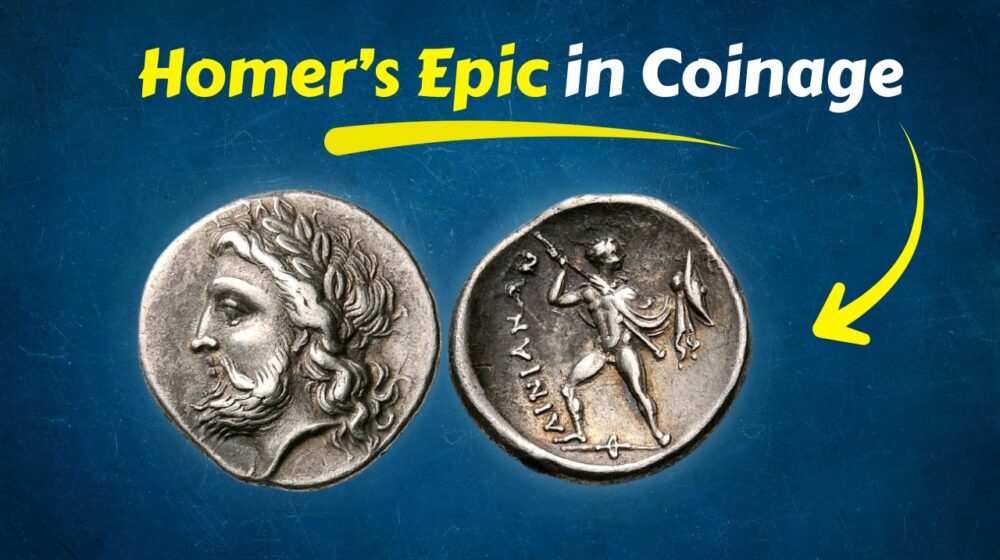
Homer’s Odyssey is back in the public eye, thanks in part to Christopher Nolan’s film adaptation. Coin collectors never needed the reminder. Odysseus, Homer himself, the monster Scylla, the Sirens and even the hero’s faithful hound have been circulating on ancient coins for well over two thousand years.
Whatever the answer, later Greeks and Romans revered the poems, and their coins show it. This article walks through nine coins and coin-like pieces connected to the Odyssey. Together they cover Greek cities squabbling over Homer’s birthplace, a Roman moneyer advertising a mythical ancestor, a Roman admiral turning a sea monster into propaganda, and a small Kyzikene electrum coin whose hero may not be Odysseus at all.
A note on this format: this is a survey of historical coins, not a new release. The sections you asked for have been adapted accordingly. There is no mintage, order window or issue price for any of these pieces, and the prices quoted are past auction results.
The Coins at a Glance
Ancient coins carry no official mintage figures, and the reference material gives none. Where a dimension or weight is missing from the source, it is left out. “Hammer price” is the winning bid before buyer’s premium and other fees.
| # | Coin | Issuer | Date | Metal | Diameter | Weight | Past auction result |
|---|---|---|---|---|---|---|---|
| 1 | Drachm, Homer seated | Smyrna (Ionia) | c. 190/189-180 BCE | Silver | 20 mm | 4.19 g | CHF 26,000 (2023, Leu Numismatik) |
| 2 | Assarion, Homer seated | Cyme (Aeolis) | c. 184-190 CE (Commodus) | Bronze | 20 mm | 5.00 g | Not stated |
| 3 | Didrachm, head of Homer | Ios (Cyclades) | c. 325-300 BCE | Silver | 19 mm | 6.20 g | CHF 360,000 (2022, Nomos) |
| 4 | Serrate denarius, Ulysses and Argus | C. Mamilius Limetanus, Rome | 82 BCE | Silver | 19.5 mm | 3.92 g | Not stated |
| 5 | Restitution denarius, Ulysses and Argus | Emperor Trajan | c. 112-113 CE | Silver | About 19 mm* | 3.08 g* | GBP 2,800 (2020, Roma Numismatics) |
| 6 | Denarius, Scylla | Sextus Pompeius, Sicily | c. 37-36 BCE | Silver | Not stated | 3.91 g | CHF 4,500 (2025, Numismatica Genevensis) |
| 7 | Contorniate, Scylla attacking Odysseus’ ship | Roman | Late 4th century CE | Bronze | 37.5 mm | 23.53 g | $900 (2024, CNG) |
| 8 | Stater, Siren with tunny fish | Kyzikos (Mysia) | c. 550-500 BCE | Electrum | Not stated | Not stated | GBP 3,200 (2017, Roma Numismatics) |
| 9 | Bronze, head of Odysseus | Ithaka | Mid-late 4th century BCE | Bronze | 16 mm | 3.69 g | $4,750 (2024, CNG) |
| 10 | Hekte, kneeling figure with ram | Kyzikos (Mysia) | c. 450-330 BCE | Electrum | 11 mm | 2.64 g | CHF 6,000 (2023, Nomos) |
*Individual examples of the Trajan restitution type vary. The source cites 3.08 g for the coin catalogued as RIC 780 and describes a separate documented example at 19 mm and 2.99 g.
How to Buy Coins Like These
Every price above is a completed sale. None of these pieces is presently on offer according to the reference material, so there is no order deadline, purchase limit or issue price to report. What the results do show is where this material tends to trade: specialist ancient-coin auctions. The houses named in the source are Leu Numismatik, Nomos, Roma Numismatics, Classical Numismatic Group (CNG) and Numismatica Genevensis.

The steps below reflect general practice in the ancient coin market. Terms vary, so confirm them with any house you use.
- Register early. Auction houses generally require an approved account before you can bid, and large lots may need extra verification.
- Learn the bidding options. Most houses allow live online, phone and absentee bids. Some sell through web auctions with fixed closing times.
- Read the catalog entry closely. Look for the reference number (for example Crawford, RIC, BMC, HGC), the description, the metal, the dimensions and the condition grade.
- Budget for fees. The hammer price is not your total cost. Buyer’s premium, taxes, shipping and insurance are usually added.
- Check provenance. Ancient coins from Turkey, Greece and other source countries can be subject to import and export rules. A documented collecting history, such as the BCD Collection pedigree on the Ios didrachm, adds confidence and value.
- Consider the range. As the results show, you can own a piece of the Homeric world for under a thousand dollars (the contorniate) or spend well into six figures for a landmark rarity (the Ios portrait).
- Set a firm limit before the sale. Rare ancient coins can sell well above expectations.
Historical Background and Design Descriptions
Ancient engravers were anonymous, and the reference material identifies no designer for any of these coins, so none is credited. Each entry below covers the issuer, the date and why the design mattered, followed by the obverse and reverse.
1. Smyrna Drachm: Homer Enthroned (c. 190/189-180 BCE)
Background. Many Greek cities claimed Homer as a native son. Ancient tradition connected him with Smyrna, Chios, Cyme, Colophon, Athens and other places, and the island of Ios developed a strong tradition that he died there. The rivalry reached the coinage. Smyrna, today İzmir in Türkiye, put the poet on a silver drachm in the early second century BCE. Leu Numismatik called it one of the finest known examples of an extremely rare coin and praised its Hellenistic style. It sold for CHF 26,000 in 2023, over $28,000 at the time.
Obverse. The laureate head of Apollo, god of poetry and music, faces right, with two locks of hair falling down the neck.
Reverse. The inscription reads ΣΜΥΡΝΑΙΩΝ (“of the Smyrnaeans”). Homer sits facing left and bare-chested, holding a scroll in his right hand and a scepter in his left.
A curious detail. Tradition describes Homer as blind, yet the engraver gave him a scroll. That contradiction reflects a real scholarly debate about how oral performance, dictation and writing produced the poems. The Odyssey itself belongs to a world where oral performance was fundamental.
2. Cyme Assarion: A Rival Claim (c. 184-190 CE)
Background. Cyme, an ancient coastal city near modern Aliağa in Türkiye, made its own claim. One tradition says Homer married Aresiphone, daughter of Gnotor of Cyme. True or not, the story strengthened the city’s link with the poet. This Roman-era bronze was struck in the time of Commodus and is described as extremely rare, apparently the fourth known example.
Obverse. OMHPOC (“Homer”) names the seated poet, who faces right holding a scroll in his left hand and resting his right on his seat.
Reverse. KYMAIΩN (“of the Cymaeans”) is set within an oak wreath.
Significance. Coins traveled in a way monuments could not. Each Homer coin leaving Cyme carried the city’s claim into markets, ports and military camps.
3. Ios Didrachm: The Great Portrait of Homer (c. 325-300 BCE)
Background. Ios, a small Cycladic island, had perhaps the strongest Homeric claim of all: ancient tradition said the poet died there. It issued its own coins from the fourth through the second centuries BCE, and this didrachm is regarded as a masterpiece of Greek portraiture. Nomos described it as the finest and most famous numismatic portrait of Homer. It comes from the BCD Collection, associated with the Greek numismatist Basil C. Demetriadi, and its recorded history reaches back to before World War I. It sold for CHF 360,000 in 2022, roughly $370,000 at the time.
Obverse. The inscription ΟΜΗΡΟΥ (“of Homer”) accompanies an idealized bearded head facing right, wearing a simple headband (taenia).
Reverse. ΙΗΤΩΝ (“of the people of Ios”) sits inside a laurel wreath tied at the bottom.
Significance. Nobody knows what Homer actually looked like. Collectors were bidding for one of antiquity’s most powerful attempts to give the poet a face.
4. C. Mamilius Limetanus Serrate Denarius: Ulysses and Argus (82 BCE)
Background. In the Odyssey, Odysseus returns to Ithaka after 20 years, disguised as a ragged beggar. No one in his household recognizes him. His old hunting dog Argos does. The dog lies neglected and dying, lowers his ears, wags his tail, and soon afterward dies.
In 82 BCE, the Roman moneyer C. Mamilius Limetanus put the scene on a silver denarius struck at Rome. Roman mint magistrates often came from ambitious aristocratic families, and coin designs could advertise ancestors or legendary origins. The Mamilian family claimed descent from Mamilia, daughter of Telegonus, the legendary son of Odysseus and the goddess Circe. Ulysses, the Roman name for Odysseus, was an ideal subject.
Obverse. A draped bust of Mercury (the Greek Hermes, divine messenger and guide in the Odyssey) faces right, wearing a winged petasus. To the left, an S sits above a caduceus.
Reverse. Ulysses walks right, holding a staff and extending a hand toward his dog Argus.
The serrated edge. The blank was deliberately notched around the edge before striking. Why Rome made serrate denarii is uncertain. Some numismatists think the cuts discouraged plated counterfeits by exposing the core metal, but ancient counterfeit serrate denarii also exist, so the measure was no guarantee.
5. Trajan Restitution Denarius: Argus Returns (c. 112-113 CE)
Background. Nearly two centuries later, Emperor Trajan (98-117 CE) reissued the design. Numismatists call such pieces restitution coins because they revive types from Rome’s distant past. It is extremely rare. The source reports that only a tiny number of examples appeared in major auction databases. One sold for GBP 2,800 at Roma Numismatics in 2020.
Obverse. Mercury’s bust faces right, wearing a petasus and holding a caduceus.
Reverse. Ulysses stands right, holding a staff and extending his right hand to Argus. A long legend reads IMP CAES TRAIAN AVG GER DAC P P REST / C MAMIL LIMETAN. In expanded form, it names Emperor Caesar Trajan Augustus, conqueror of the Germans and Dacians, Father of the Country, and credits the restored design to C. Mamilius Limetanus.
What changed. The serrated rim was dropped in favor of a normal round flan. The imagery stayed the same.
6. Sextus Pompeius Denarius: Scylla as Naval Propaganda (c. 37-36 BCE)
Background. In the Odyssey, the passage between Scylla and Charybdis is one of the hero’s worst choices. Charybdis is a whirlpool that can swallow a ship. Scylla is a many-headed monster in a cliffside cave. Later tradition located the story in the Strait of Messina between Sicily and mainland Italy.
That made Scylla a fitting emblem for Sextus Pompey, son of Pompey the Great. During the civil wars after Julius Caesar’s assassination, he held Sicily and used his fleet to challenge Caesar’s heir Octavian. He lost, fled east, and was captured and executed in 35 BCE. Scylla outlived him. One example, catalogued as Crawford 511/4a, sold for CHF 4,500 in November 2025.
Obverse. A galley with an eagle standard (aquila) on the prow. Behind it stands the Pharos of Messana, surmounted by a statue of Neptune. The legend refers to Magnus Pius, Sextus Pompey’s title.
Reverse. Scylla appears with a woman’s upper body, fishlike lower extremities and snarling dogs emerging from her waist. She wields a ship’s rudder like a club with both hands. The legend refers to his command as prefect of the coast and fleet.
Significance. The design evoked Homer, advertised Sicily’s dangerous waters, and recast a sea monster as a symbol of naval power.
7. Contorniate: Scylla Attacks Odysseus’ Ship (Late 4th Century CE)
Background. Contorniates are large bronze Roman medallions made mainly in the fourth and fifth centuries CE, usually with a deep groove around the edge. They were not ordinary money. Their exact function is debated. One suggestion is that they were gifts tied to public spectacles such as chariot races. Many bear portraits of earlier emperors, especially Nero and Trajan, while others show cultural figures such as Homer, Solon, Euclid and Socrates. Piercing and heavy wear on some examples suggest owners handled or even wore them. This piece, pierced and in Good Fine condition with a red-brown patina, sold for $900 at CNG in 2024.
Obverse. A laureate head faces right with slight drapery, with the legend DIVO NERVAE TRAIANO, naming the deified Trajan.
Reverse. Scylla, at left, attacks Odysseus’ ship and crew at right. Three crewmen fight from the prow while two men struggle helplessly in the sea below.
Significance. Unlike a portrait, this is an action scene. More than a thousand years after the supposed age of the Trojan War, the monster still had the power to terrify.
8. Kyzikos Electrum Stater: The Siren (c. 550-500 BCE)
Background. The Sirens make their first surviving literary appearance in the Odyssey, but Homer never says what they look like. Later Greek artists filled the gap, and by the Archaic period they commonly showed Sirens as part woman, part bird. Their weapon was desire: a song that drew sailors toward a deadly shore.
Kyzikos in Mysia struck exceptionally varied electrum coinage, and its civic emblem was the tunny fish, a symbol of the city’s wealth. This stater is described as very rare and among the finest known, with only about half a dozen examples auctioned in 15 years. Roma Numismatics sold it for GBP 3,200 in 2017.
Obverse. A winged Siren stands left, holding a tunny fish.
Reverse. A quadripartite incuse square, the punch-mark typical of early coinage.
Significance. One of Homer’s most seductive monsters holds the commercial symbol of a major trading city.
9. Ithaka Bronze: Odysseus at Home (Mid-Late 4th Century BCE)
Background. Odysseus wants one thing above all: to go home. Home is Ithaka, a rocky island in the Ionian Sea off Greece’s western coast, covering about 37 square miles (97 square kilometers). Its ancient coinage is extremely rare. In the fourth and third centuries BCE it issued several small bronze types, some showing Odysseus in his conical cap, the pilos (or pileus). This example, described by CNG as Near Very Fine and “very rare,” sold for $4,750 in September 2024.
Obverse. The head of Odysseus faces right, wearing the pilos.
Reverse. A thunderbolt, the weapon of Zeus, sits within a wreath.
Significance. Few ancient coins tie a legendary hero so directly to the place that defined his story.
10. Kyzikos Electrum Hekte: Odysseus, or Phrixus?
Background. In the Odyssey, Circe tells Odysseus that only the blind prophet Tiresias, among the dead, can explain how to reach Ithaka. Odysseus digs a pit, sacrifices sheep, and draws the spirits up from the underworld with their blood.
A tiny Kyzikene hekte from circa 450-330 BCE may show that scene. A kneeling male figure pulls back a ram’s head with one hand and holds a dagger in the other, ready to sacrifice it. The figure wears a pilos and a chlamys (cloak). It sold for CHF 6,000 at Nomos in 2023.
Obverse. The kneeling figure sits atop a ram lying to the left.
Reverse. A quadripartite incuse square.
The problem. The man may not be Odysseus. He could be Phrixus, who escaped death on the magical ram whose fleece became the Golden Fleece sought by Jason and the Argonauts. The Nomos cataloguer pointed out that Kyzikos used hundreds of designs with no obvious link to the city apart from the tunny fish, and offered both readings, noting that the pilos would favor Odysseus and that Circe supplied the ram before his descent to Hades. The coin’s identity remains open.
Why This Matters for Collectors
Literature you can hold. Few themes let a collector own the physical trace of a story this famous. A single set can span Archaic electrum, Hellenistic silver, Roman Republican and Imperial silver, and late Roman bronze.
Cities used myth as branding. Smyrna, Cyme and Ios all backed their claims to Homer with coins. Roman aristocrats used Odysseus to advertise legendary ancestry, and Sextus Pompey used Scylla for naval propaganda. These are not decorative choices. They show how ancient states and families used imagery to make an argument.
There is an entry point at every budget. The results quoted here range from $900 for the contorniate to CHF 360,000 for the Ios portrait. The market rewards rarity, quality and provenance, but the theme is accessible at several levels.
Rarity is real. Several of these types are described as extremely rare, with examples turning up in auction databases only occasionally. The Trajan restitution is far scarcer than the Republican original it copies.
Attribution is part of the fun. The Kyzikos hekte shows that some questions never get settled. Hero or not, it is a reminder that the study of ancient coins involves reading images, not just identifying them.
Some designs outlived their moment. Rome revived a Republican design nearly two centuries later. Contorniates showed Homeric scenes a thousand years after the supposed events. The stories kept being worth telling.
Caveat. The prices above are hammer prices from past sales and do not include fees. They show where the market has been, not where it will go.
Quick-Reference Buying Guide
- Choose your Homeric theme. Homer’s portraits, Odysseus and Ithaka, Argus, Scylla, the Sirens or the underworld all offer different price ranges.
- Set a budget. Past results run from about $900 to well over $300,000.
- Pick a specialist auction house. Leu Numismatik, Nomos, Roma Numismatics, CNG and Numismatica Genevensis all appear in this survey.
- Register and get approved. Do this well before the sale date.
- Study the catalog entry. Check the reference number, condition, dimensions and any notes on rarity or finest known status.
- Ask about provenance. A documented history matters, especially for coins from Türkiye, Greece and other source countries.
- Add up the full cost. Include buyer’s premium, taxes, shipping and insurance on top of the hammer price.
- Bid to your limit, not past it. Then arrange secure delivery and insurance for the coin.
This article is based on the supplied reference material. All auction figures are past hammer prices. Confirm current auction terms, fees and import rules with the relevant house before bidding.