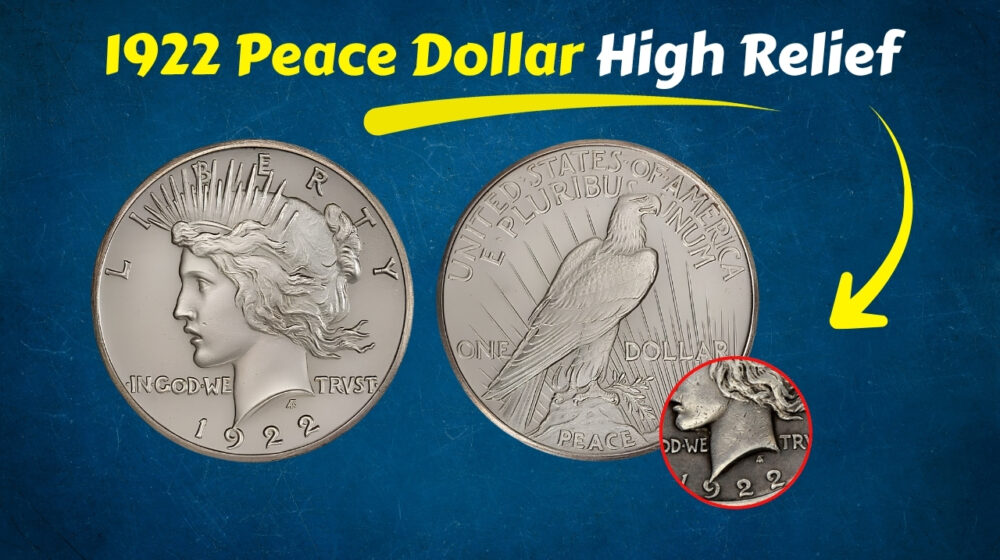
Ask most collectors about the 1922 Peace Dollar and they’ll picture the familiar low-relief workhorse that circulated by the millions. Few realize that before the Mint settled on that practical design, Philadelphia engravers spent a frantic January racing to rescue a much bolder version of the coin one so sculpturally ambitious that ordinary coinage presses couldn’t strike it properly.
That rescue effort produced a small family of experimental pieces, and at the top of that family sits one of the true trophies of 20th-century American numismatics: the Judd-2019 1922 High Relief Matte (Sandblast) Proof Peace Dollar. Recent auction activity has thrust this story back into the spotlight. A PCGS PR63 CAC example brought $192,000 at Heritage in April 2025, and in 2026 two related Judd-2020 experimental pieces cousins to the famous Matte Proof, not the coin itself sold for $252,000 and $213,500. Together, these results have renewed interest in one of the most technically fascinating chapters in American coin manufacturing history: the Mint’s month-long struggle to keep Anthony de Francisci’s original sculptural vision alive before practicality finally won out.
This guide walks through the specifications, the historical background, the design, the different experimental varieties, and what any collector or investor should know before pursuing an example on today’s market.
At a Glance: Specifications
| Attribute | Detail |
|---|---|
| Country | United States |
| Year | 1922 |
| Mint facility | Philadelphia (no mintmark) |
| Denomination | One Dollar |
| Designer | Anthony de Francisci |
| Composition | 90% silver, 10% copper |
| Weight | 26.73 grams |
| Diameter | 38.10 mm |
| Edge | Reeded |
| Silver content | Approx. 0.77346 troy oz |
| Variety designation | Judd-2019 |
| Relief | High Relief |
| Finish | Sandblast / Matte Proof |
| Production quantity | Not precisely documented; estimates vary by source |
| Estimated survivors | Roughly high single digits to about a dozen, depending on the roster consulted |
| Top certified grade | PR67 |
| Standing public auction record | $458,250 (Goldberg Auctioneers, June 2, 2014) |
| Most recent notable sale | $192,000, PCGS PR63 CAC (Heritage, April 30, 2025) |
Because this issue was never released for general circulation and no fixed mintage figure survives in Mint records with certainty, published population estimates differ. PCGS lists the issue (coin number 7383) as “Est. 5-8 known,” while PCGS CoinFacts separately cites a mintage of 10. Heritage has referenced Mint Director-era evidence pointing to roughly 20 pieces struck, with 11 confirmed specimens as of a 2022 offering. Stack’s Bowers has described “a dozen or so” as extant. None of these figures should be forced into agreement differences between recorded mintage, confirmed survivors, and certified population counts are common with rarities this old, and resubmissions can inflate raw certification numbers.
How Collectors Actually Acquire This Coin
Unlike a modern commemorative, the 1922 High Relief Matte Proof was never sold to the public through a Mint order window, subscription period, or household purchase limit. It exists today purely as a secondary-market rarity, meaning acquisition works differently than buying a new release. Here is what the process realistically looks like:
- Source: Major numismatic auction houses (Heritage Auctions, Stack’s Bowers Galleries, Goldberg Auctioneers) handle nearly every public sale of this issue. Private treaty sales through established rare coin dealers also occur, though far less visibly.
- Certification: Virtually every traded example is encapsulated by PCGS or NGC, frequently with a CAC (Certified Acceptance Corporation) sticker or CAC gold label confirming the grade is solid for its assigned numeric level.
- Timing: Because so few pieces exist, availability is unpredictable. Some years pass with no public offering at all; other years bring two or three separate sales, as happened in 2025 and 2026.
- Price range: Recent results span roughly $37,000–$45,000 for the lowest-grade circulated example known (Proof-25) up to $458,250 for the finest certified specimen (PR67). Mid-grade Proof-63/64 examples have traded in the $150,000–$250,000 range in the past decade.
- Budget alternative: Collectors priced out of the Judd-2019 Matte Proof sometimes pursue the related Judd-2018 or Judd-2020 experimental issues instead, which document the same Mint project at different stages and have sold for comparable or, in some cases, even higher prices due to their own extreme rarity.
- Due diligence: Given the coin’s value and the existence of closely related but distinct varieties (Judd-2018, Judd-2019, Judd-2020), buyers should confirm the Judd number, verify the certification number directly on the PCGS or NGC population database, and, where possible, review the auction house’s diagnostic notes before bidding.
Historical Background: Why the Peace Dollar Exists at All
The story begins not with an artistic competition but with an act of Congress. The Pittman Act of 1918 authorized the Treasury to melt down as many as 350 million standard silver dollars into bullion; ultimately 270,232,722 coins were destroyed. The same law obligated the Treasury to replace those coins by purchasing domestic silver at a fixed $1-per-ounce price between May 1920 and June 1923. That purchase requirement forced the Mint back into large-scale silver dollar production after a long hiatus, and Philadelphia initially resumed striking with George T. Morgan’s long-serving dollar design in 1921.
At the same moment, numismatist Farran Zerbe was campaigning for an entirely new dollar to commemorate the peace following World War I, a cause he championed publicly at the 1920 American Numismatic Association convention. The Mint’s practical need for silver dollars and the public’s appetite for a coin symbolizing a new peacetime era converged, and the Peace Dollar was born from that convergence.
Historical Background: The Designer and the Design Competition
On December 13, 1921, the Commission of Fine Arts convened at sculptor James Earle Fraser’s New York studio to judge submissions for the new dollar. The winning design came from Anthony de Francisci, then just 34 years old. De Francisci modeled his allegorical Liberty on his own wife, Teresa, and paired her portrait with a reverse depicting a bald eagle perched above the rays of a rising sun.
The design nearly derailed before it ever reached full production. De Francisci’s original reverse included a broken sword at the eagle’s feet, a detail that provoked public criticism once newspapers described it. Rather than restart the design process, Chief Engraver George T. Morgan physically removed the sword from the reverse hub. Morgan’s willingness to alter the design on the fly would prove important again just weeks later, when the Mint needed him to solve a far more serious problem.
Historical Background: The 1921 High Relief Coin and Its Flaw
The first Peace Dollars 1,006,473 of them were struck in high relief during the closing days of December 1921. Visually, the coin was a triumph. Mechanically, it was nearly unworkable at scale. The design’s high points demanded so much striking pressure that a single blow from the dies often failed to bring up full detail in Liberty’s hair or the eagle’s feathers. Die life collapsed under the pressure required, and uneven metal flow sometimes raised rims high enough to interfere with proper coin stacking.
The Mint could not sustain that failure rate across the millions of dollars Pittman Act obligations required. Yet officials didn’t scrap high relief outright they spent January 1922 trying to save it, and that month of experimentation is the real subject of this article.
The Experimental Varieties: More Than One “High Relief” Coin
Older references often lumped every 1922 experimental piece together under a single “High Relief” label. Modern pattern research separates the month’s work into distinct stages, each with its own Judd catalog number.
Judd-2018: The 35,401-Coin Trial
Mint historian R.W. Julian uncovered records in 1974 documenting a January 1922 trial production run of 35,401 High Relief dollars, struck from four obverse and nine reverse dies on standard production presses rather than a special press. The results were unacceptable die failures under the required pressure were extensive, and most of the run was destroyed. Older accounts claimed every coin was melted; Heritage has since reported at least three surviving Judd-2018 examples, including impaired and special-finish pieces that escaped destruction. Judd-2018 represents the earliest stage of the January 1922 rescue effort.
Judd-2019: The Matte Proof
This is the coin most collectors mean when they say “1922 High Relief Peace Dollar.” Judd-2019 used a reverse die distinct from the Judd-2018 trial coins, and Morgan further refined the portrait for this version sharper hair detail, adjusted lettering, and additional reverse touch-ups. Numismatic researcher Roger W. Burdette has called this the finest realization of the Peace Dollar design the Mint ever produced. Crucially, the known Judd-2019 examples were struck as special Proofs rather than ordinary production pieces, which is what makes them identifiable and traceable individually today.
Judd-2020: The Modified (Medium) High Relief
Even after Judd-2019, the Mint kept trying. Morgan lowered the relief again, producing what collectors call the Modified High Relief or Medium Relief, cataloged as Judd-2020. A trial run of 3,200 coins was struck from these dies and the dies failed again. One surviving example carries the handwritten number “3200” in the obverse field, tied by Mint correspondence and Baker-era provenance to the very end of that test run; Heritage sold that specific coin for $213,500 in April 2026, with six known examples reported from those dies. A separate Judd-2020 Proof-63 PCGS CMQ piece, unseen publicly for more than four decades, brought $252,000 at Stack’s Bowers just weeks earlier in its Spring 2026 Showcase Auction.
After Judd-2020 also proved impractical for mass production, the Mint finally adopted the low-relief design used for the remainder of 1922’s enormous mintage and for the rest of the Peace Dollar series through 1935.
Obverse Design
The obverse presents Liberty in profile, her hair swept back beneath a radiate crown evoking the rays of dawn a deliberate echo of the coin’s “peace” theme. On the Judd-2019 Matte Proof specifically, Morgan’s refinements give the portrait noticeably deeper sculptural modeling than the coin that eventually went into mass production: Liberty’s hair shows greater strand separation and dimensionality, and the lettering rises more sharply from the field. Heritage has published specific diagnostics for identifying genuine Judd-2019 examples: on the obverse, the top of the “E” in “WE” sits above the “W,” and the “S” in “TRVST” has a notably broad base.
Reverse Design
The reverse depicts a bald eagle at rest on a mountain crag, overlooking rays of a rising sun, with the word “PEACE” beneath. The design originally included a broken sword at the eagle’s feet, removed by Morgan directly from the working hub after public objection. On the Judd-2019 Matte Proof, the eagle shows stronger, more defined feather texture and sits in sharper relief against the sun’s rays than on the later mass-produced coin. Heritage’s published diagnostics note four rays visible below the word “ONE” on genuine examples, with the highest ray extending well to the northwest of the “N.”
The Sandblast (Matte) Finish: How These Coins Were Actually Made
The Judd-2019 Proofs were not struck on a standard coinage press. Mint workers used a medal press instead, striking each coin multiple times so repeated blows could force metal into the full depth of the dies something a single high-speed production strike could not achieve. After striking, the coins were sandblasted, producing the finely textured, non-reflective surface collectors typically call a “Matte Proof,” though “Sandblast Proof” is the more technically accurate term (both terms appear in Stack’s Bowers cataloging). The resulting texture softens light reflection and emphasizes sculptural depth, giving the coin more the presence of a small medal than a mass-produced dollar.
The Ernest Lush Coin: A Circulated Rarity That Solved a Mystery
No Judd-2019 has a stranger biography than the specimen discovered by Ernest Lush in the late 1970s, found mixed in with a group of ordinary circulated silver dollars in Lathrup Village, Michigan. For decades this raised a genuine attribution question: was it a lone survivor of the 35,401-coin Judd-2018 trial, or an actual Judd-2019 Proof that had somehow slipped into circulation and been spent unknowingly?
When Heritage first sold the coin in April 2002 graded PCGS Proof-25, realizing $10,637.50 the catalog still treated both possibilities as open questions. Later die study settled the matter: the reverse diagnostics matched the Judd-2019 Proof dies, not the Judd-2018 trial dies. Stack’s Bowers now identifies it definitively as a circulated Judd-2019 Matte Proof, making it the only known example of the issue to have entered general circulation.
Its ownership trail is unusually well documented: a Michigan collection, RARCOA’s Auction ’83, collector Gwyn Houston, a consignment display by dealer Julian Leidman at the 1992 ANA convention, a Bowers and Merena sale in 1995, the 2002 Heritage sale, a 2007 Stack’s offering, and a return to Heritage in August 2022 at $37,200. Before a 2024 Stack’s Bowers sale, the owner had the coin professionally conserved removing dark toning that had obscured its texture for decades and it crossed over into an NGC Matte Proof-25 holder. On November 19, 2024, the freshly conserved coin brought $45,600 in Stack’s Bowers’ Rarities Night sale, a price well below Gem examples but reflecting a combination of history, discovery story, and unmatched provenance that no other Judd-2019 can offer.
Notable Auction Records
- $458,250 — PCGS PR67, Raymond T. Baker specimen, Goldberg Auctioneers, June 2, 2014 (standing public auction record for the issue)
- $329,000 — NGC PR67, Greensboro Collection pedigree, Heritage, January 2014
- $252,000 — Judd-2020 Proof-63 PCGS CMQ, Stack’s Bowers Spring 2026 Showcase
- $213,500 — Judd-2020 “3200” specimen, PCGS MS65 CAC, Heritage, April 2026
- $198,000 — PCGS PR64 CAC, Heritage, January 2021
- $192,000 — PCGS PR63 CAC, Heritage, April 30, 2025
- $161,000 — Joseph C. Thomas Collection, PR66, Heritage, 2009
- $158,625 — PCGS PR64 CAC, Heritage, 2017
- $144,000 — PCGS Proof Uncirculated Details (altered surfaces), Stack’s Bowers, February 2023
- $99,875 — NGC PR61, ex-“Pawn Stars” television coin (originally sold to Rick Harrison for $80,000), Heritage, January 2015
- $45,600 — Ernest Lush discovery coin, NGC Matte Proof-25 (conserved), Stack’s Bowers, November 19, 2024
Why This Matters for Collectors
The Judd-2019 High Relief Matte Proof occupies a unique place in American numismatics because it represents an idea the Mint itself ultimately rejected as impractical. The coin that went into mass production in 1922 succeeded precisely because the Mint scaled back de Francisci’s original sculptural ambition lower relief, easier strikes, longer die life. The Judd-2019 Proof, by contrast, shows what the design could have been without those manufacturing compromises: deeper modeling on Liberty’s hair, crisper lettering, and a more dramatically rendered eagle.
For collectors, that makes the coin significant on several levels at once. It is an extreme rarity, with realistic survivor estimates in the range of five to twenty pieces depending on the source consulted. It is a documented piece of Mint engineering history, part of a traceable, multi-stage experimental sequence (Judd-2018, Judd-2019, Judd-2020) rather than an isolated curiosity. And it carries genuine artistic significance as arguably the finest realized version of one of America’s most admired coin designs. The 2025 and 2026 sales results spanning the flagship Judd-2019 issue and its closely related Judd-2020 cousins confirm that demand for this entire experimental family remains strong and that well-documented, well-certified examples continue to command six-figure prices.
Collectors should also be aware that mintage and survivor figures for this issue are genuinely unsettled in the record, not merely a matter of differing opinions. Treating any single number as definitive risks overstating certainty that the historical record doesn’t support.
Quick-Reference Guide for Collectors
- Confirm the exact variety. Make sure you’re looking at Judd-2019 (the Matte Proof) and not the related but distinct Judd-2018 (early production trial) or Judd-2020 (Modified/Medium Relief) issues all three are sometimes casually grouped together as “1922 High Relief.”
- Verify certification. Look up the PCGS or NGC certification number directly on the grading service’s population database before bidding or buying.
- Check for CAC approval. A CAC sticker or gold label on a high-value rarity like this one adds a layer of third-party confirmation that the grade is solid for its level.
- Cross-check the diagnostics. For genuine Judd-2019 examples, confirm the obverse “E” over “W” alignment in “WE,” the broad-based “S” in “TRVST,” and the four-ray reverse pattern below “ONE” described by Heritage’s published cataloging notes.
- Set a realistic budget range. Recent results span roughly $37,000 (low-grade circulated) to well over $400,000 (top-certified Gem), so decide where your budget realistically fits before shopping.
- Watch major auction calendars. Because so few examples exist, availability is sporadic track upcoming sales at Heritage Auctions, Stack’s Bowers Galleries, and other major numismatic auction houses rather than expecting a fixed release schedule.
- Review provenance when available. Well-documented pedigrees (such as the Baker, Greensboro, or Lush specimens) can add both historical interest and resale confidence.
- Consider related varieties if budget-limited. Judd-2018 and Judd-2020 examples document the same historical episode and, being comparably rare, are sometimes available when no Judd-2019 is on the market.
- Consult a specialist dealer or PCGS/NGC resources before a major purchase. Given the prices involved, independent verification is worth the effort for any five- or six-figure acquisition.