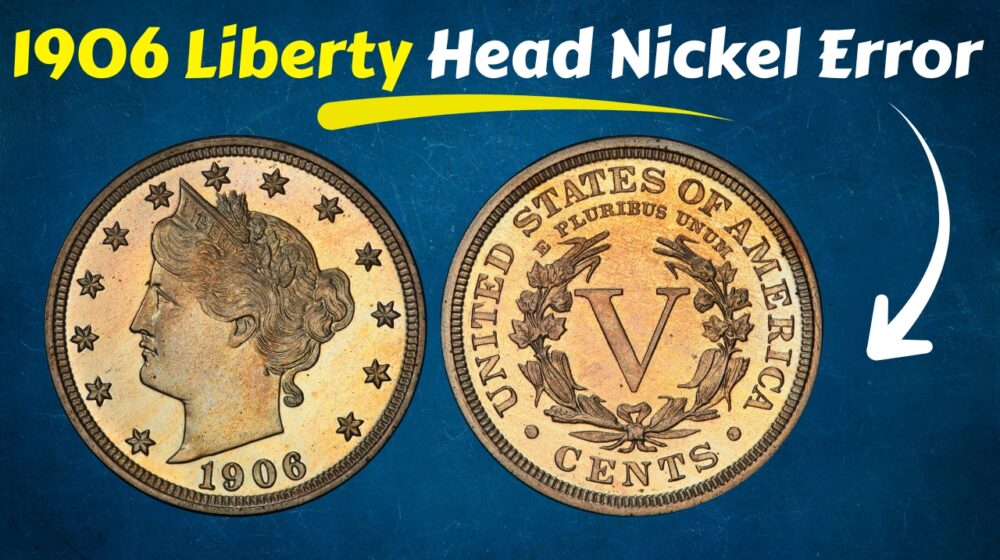
Among the thousands of documented U.S. mint errors, one coin stands entirely alone: a 1906 Liberty Head nickel obverse die cap struck not on a nickel planchet, but on a copper planchet intended for an Indian Head cent. According to veteran mint error dealer Mike Byers who has personally handled more U.S. type coin die caps than any other dealer over a fifty-year career this piece is the only known U.S. type coin die cap ever produced on the wrong metal. It isn’t simply rare within its category; it is, at present, unique.
The coin’s story is as compelling as its physical appearance. A blank copper cent planchet somehow found its way into a press fitted with Liberty Head nickel dies. Instead of being struck once and ejected normally, the planchet lodged onto the obverse die, was struck repeatedly, and gradually wrapped itself around the die face producing the deep, cup-like distortion collectors call a “die cap.” The result is a dramatic, one-of-a-kind mint error with a documented ownership trail running through some of the most respected names in error-coin collecting: Fred Weinberg, Mark Lighterman (current president of the American Numismatic Association), and Mike Byers.
At a Glance: Specifications
| Detail | Description |
|---|---|
| Error type | Obverse die cap (off-metal) |
| Host planchet | Indian Head cent planchet (copper alloy) |
| Dies used | 1906 Liberty Head (“V”) nickel obverse die |
| Planchet weight | 3.1 grams |
| Intended denomination of planchet | 1-cent (Indian Head cent) |
| Denomination struck onto planchet | 5-cent (Liberty Head nickel), obverse only |
| Date on dies | 1906 |
| Population | Unique only known example of its type |
| Grading history | NGC MS 66 BN → PCGS MS 65 BN → NGC (via NCS) MS 65 RB |
| Authenticator | Dave Camire, NGC mint error specialist |
| Notable pedigree | Fred Weinberg → Mark Lighterman → private collector → Mike Byers |
| Published appearances | Cover feature, Mint Error News Magazine, Issue 94 |
| Price | Not publicly disclosed at current writing |
How a Coin Like This Reaches the Market
Because this die cap is unique, there is no order window, mintage limit, or release date in the way a modern commemorative or bullion product would have it was never intended to exist, let alone be sold, and it has changed hands exclusively through private transactions among specialist dealers and advanced collectors rather than through any official channel.
Its documented path illustrates how a rarity of this caliber typically moves through the hobby:
- 2002 — Discovery and first sale. The piece surfaced raw (ungraded) as part of a larger collection purchased by veteran mint error dealer Fred Weinberg.
- Private allocation. Weinberg had already promised first right of purchase to advanced collector Mark Lighterman, who bought the coin directly over the phone before it ever reached open the market.
- Certification. Weinberg submitted the coin to NGC, where mint error specialist Dave Camire authenticated it and NGC certified it MS 66 BN.
- Long-term holding. The coin remained in Lighterman’s collection for an extended period, during which it was cracked out and crossed to PCGS, which certified it MS 65 BN.
- Re-certification. The coin was later sent to NCS/NGC and certified MS 65 RB.
- Change of ownership. The coin eventually passed into another private collection before being sold to Mike Byers, alongside a second unique Liberty Head nickel die cap (a flip-over double strike dated 1896).
For collectors interested in acquiring comparable mint-error rarities, the realistic path mirrors this one: building relationships with dealers who specialize specifically in major mint errors and die caps, watching specialist auctions and dealer inventories (rather than general bullion or type-coin listings), and being prepared to act quickly and discreetly when a unique piece becomes available, since transactions of this kind are frequently negotiated privately rather than announced publicly in advance.
Historical Background: The Two Coins Involved
The Liberty Head (“V”) Nickel
The Liberty Head nickel, often called the “V nickel” for the large Roman numeral V on its reverse, was designed by U.S. Mint Chief Engraver Charles E. Barber and entered production in 1883. It replaced the Shield nickel and was struck continuously through 1912, with a small, famously controversial group of 1913 examples produced outside official channels. The series is best known today for its early 1883 “No CENTS” variety briefly gold-plated and passed off as $5 gold pieces by fraudsters before the Mint added the word “CENTS” to the reverse later that year and for the five specimens dated 1913, among the most valuable coins in American numismatics. By 1906, the design was well into its mature production run, struck in large numbers for general circulation.
The Indian Head Cent
The Indian Head cent was designed by Mint Chief Engraver James B. Longacre and was first struck in 1859, replacing the short-lived Flying Eagle cent. Its obverse depicts Liberty wearing a Native American-style feathered headdress, and its reverse carries a wreath (later modified to include a shield above the wreath starting in 1860). The series was struck in bronze for most of its run and remained in production through 1909, when it was replaced by the Lincoln cent. In this particular error, the Indian Head cent’s design never actually appears on the coin the blank copper planchet was diverted into the coining process before it could be struck with the cent dies, meaning its only connection to the series is its metal composition and weight standard.
Obverse and Reverse: What the Coin Actually Shows
Obverse
The obverse die used to strike this error is the standard 1906 Liberty Head nickel design: a left-facing portrait of Liberty wearing a coronet inscribed “LIBERTY,” surrounded by thirteen stars and the date at the bottom. On a normal nickel, this design strikes crisply onto a nickel-alloy planchet of the correct size and thickness. On this error, however, the softer copper cent planchet was rammed repeatedly against the die face without ever being ejected from the coining chamber. Each successive strike drove the planchet’s metal further around the contours of the die, causing it to stretch, thin, and curl upward at the rim producing the characteristic bowl- or cap-shaped distortion that gives “die caps” their name. The Liberty portrait is still identifiable but appears compressed, doubled in areas, and wrapped around the die’s edges rather than lying flat, a dramatic visual signature of repeated off-planchet striking.
Reverse
Because this piece functioned as an obverse die cap, it has no true reverse design in the conventional sense. The reverse face of the error typically shows a smooth, heavily distorted, and often featureless or minimally detailed surface the result of the planchet’s metal being stretched and displaced as it wrapped around the obverse die rather than being struck normally between two dies. This blank, deformed reverse is itself part of what makes true die caps instantly recognizable to error specialists, since it visually confirms that the planchet lodged onto one die rather than striking normally in the collar.
Why This Matters for Collectors
- True uniqueness. Among all U.S. type coin die caps documented by a dealer with five decades of specialized experience, this is the only one known to exist on the wrong metal (planchet mismatched to the denomination of the dies that struck it).
- A clean, traceable pedigree. Few error coins carry a documented chain of ownership running through such recognized names in the hobby Fred Weinberg, Mark Lighterman, and Mike Byers each a serious specialist in major mint errors.
- Triple certification history. The coin’s path across NGC, PCGS, and back to NGC (via NCS), with grades of MS 66 BN, MS 65 BN, and MS 65 RB, gives collectors an unusually well-documented condition and authentication record for a coin of this type.
- Connection to a world-class collection. Its time in the collection of Mark Lighterman current president of the American Numismatic Association and owner of other landmark off-metal errors adds significant historical weight to the piece.
- Published recognition. The coin’s appearance on the cover of Mint Error News Magazine (Issue 94), alongside a second unique Liberty Head nickel die cap, cements its standing within the specialized mint-error collecting community.
- A benchmark for the category. For collectors and researchers of off-metal errors, this piece effectively defines the top of the category for Liberty Head nickel die caps, and by extension, for U.S. type coin die caps generally.
Quick-Reference Buying Guide
- Understand what makes a “die cap.” Learn to recognize the cup- or bowl-shaped distortion, stretched rim, and compressed design details that result from a planchet sticking to a die and being struck multiple times.
- Confirm the planchet-to-die mismatch. For off-metal die caps specifically, verify that the planchet’s metal, weight, and diameter genuinely correspond to a different denomination than the dies that struck it.
- Insist on third-party certification. Look for grading from NGC or PCGS with an explicit mint-error attribution, ideally reviewed by a recognized mint-error specialist such as NGC’s Dave Camire.
- Research the ownership history. A documented pedigree prior owners, past certifications, and any published appearances adds both credibility and long-term value to a unique error coin.
- Work with specialist error dealers. General coin dealers may not have the expertise to authenticate or accurately price major mint errors; seek out dealers whose primary focus is documented major errors and die caps.
- Compare against known population data. For a piece claimed as unique or extremely rare, confirm with specialist references or dealer archives (such as published sold-coin records) whether any comparable examples are known.
- Review published literature. Check specialist publications such as Mint Error News Magazine or established mint-error catalogs for prior documentation of the specific coin or comparable pieces.
- Move decisively when a unique piece appears. Because coins like this rarely reach public auction and often change hands through private sale, be prepared to act quickly once authenticity and pedigree have been verified.