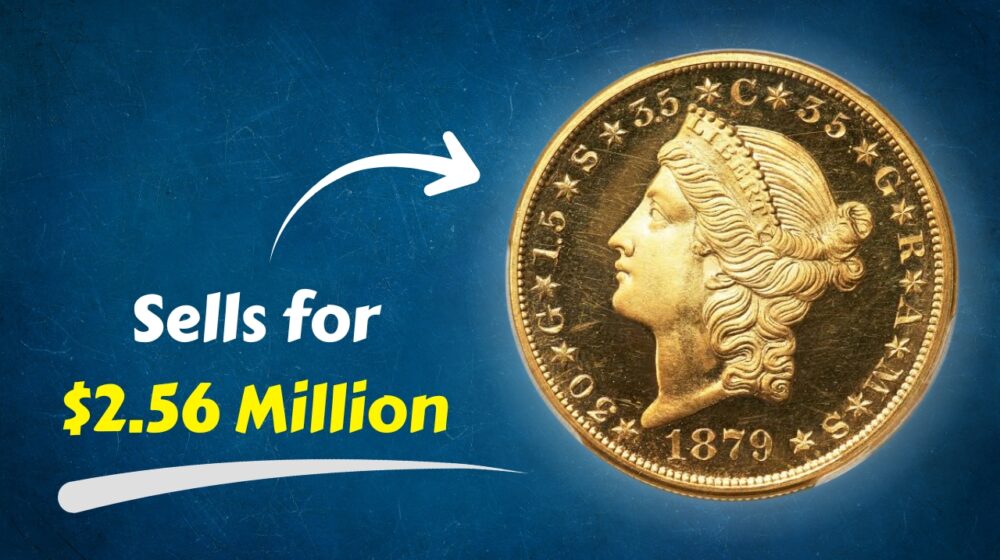
Only five examples of the 1879 $20 Liberty Head “Quintuple Stella” were ever struck in gold, and one of them just rewrote the price history books. On September 2, 2026, Heritage Auctions closed its 2026 ANA U.S. Coins Signature Auction with Lot 3604 the finest-certified Quintuple Stella known to exist realizing an extraordinary $2,562,000.

The coin, formally cataloged as the 1879 $20 Liberty Head Quintuple Stella, Judd-1643, Pollock-1843, is graded PCGS PR64+ Deep Cameo, making it the single highest-graded gold example of the five that survive. Its pedigree reads like a roll call of the greatest names in American numismatics: Virgil Brand, Fred Olsen, Dr. John E. Wilkison, the Southern Collection, and most recently Texas businessman Bob R. Simpson, who kept the coin off the market for 18 years before consigning it to Heritage.
The Quintuple Stella is far more than a rarity born of low mintage. It is a physical artifact of a forgotten chapter in American monetary policy a serious 19th-century attempt to create a U.S. gold coin that could circulate as easily in Vienna or Paris as in New York. Congress ultimately rejected the idea, but the handful of pattern coins struck to test it have become some of the most coveted objects in the pattern-coin collecting world.
Specifications at a Glance
| Detail | Information |
|---|---|
| Date | 1879 |
| Denomination | Pattern $20 (Metric Double Eagle) |
| Popular nickname | Quintuple Stella |
| Judd number | Judd-1643 |
| Pollock number | Pollock-1843 |
| Rarity rating | Low R.7 |
| Mint facility | Philadelphia |
| Strike type | Proof |
| Grade of auction example | PCGS PR64+ Deep Cameo |
| Designer (obverse) | James B. Longacre (Liberty Head motif; “J.B.L.” on truncation) |
| Diameter | Approximately 34 mm |
| Intended total weight | 35 grams |
| Metallic formula | 30 g gold, 1.5 g silver, 3.5 g copper |
| Edge | Reeded |
| Known gold examples in existence | Five |
| Examples in private hands | Four |
| Examples in institutional hands | One (Smithsonian Institution) |
| PCGS number | 537318 |
| Greysheet ID | 373253 |
| Auction house | Heritage Auctions |
| Auction event | 2026 ANA U.S. Coins Signature Auction |
| Lot number | 3604 |
| Sale date | September 2, 2026 |
| Final price realized | $2,562,000 |
| Prior benchmark (different specimen) | $2,160,000 (August 2025, PCGS PR64 Deep Cameo) |
How the Sale Worked: Bidding, Timing, and the Path to Ownership
Unlike a modern Mint product release with a fixed mintage, an order window, and a per-household purchase limit, the Quintuple Stella is a 147-year-old numismatic rarity that changes hands exclusively through the secondary market. There is no “ordering process” in the traditional sense acquiring a coin like this means competing against other advanced collectors and institutions in a live auction environment. Still, prospective bidders and collectors following high-end pattern coins should understand how a sale of this caliber unfolds.
How Heritage structured the sale:
- The coin was cataloged well in advance of the auction date as part of Heritage’s marquee ANA (American Numismatic Association) show sale, timed to coincide with the annual convention where the country’s most serious collectors and dealers gather.
- Interested parties could review high-resolution imagery, PCGS population data, and a full pedigree write-up in the online lot listing before the sale opened for bidding.
- Bidding was open to registered Heritage members through internet, phone, and in-person floor bidding, standard practice for material of this significance.
- As with all Heritage sales, the final hammer price is subject to a buyer’s premium, which is added on top of the reported hammer figure to reach the total cost of acquisition (Heritage’s stated all-in price for this lot was $2,562,000).
- There was no fixed “limit per buyer” because only a single example was offered; by definition only one bidder could win the lot.
For collectors who did not participate in this particular sale, the practical path to owning a Quintuple Stella is to watch for the four remaining privately held examples to reappear at auction, since transactions of this rarity are infrequent the coin sold here had not appeared publicly in 18 years.
Historical Background: The Coin, the Concept, and the People Behind It
The Origins of the Metric Gold Idea
The story begins not with a coin but with a policy problem. In the late 1870s, international trade was complicated by the fact that every major economic power minted gold coinage to its own weight standard. A U.S. gold piece could not simply be handed across a counter in Vienna or Paris and expected to match local value without recalculation or reminting.
John A. Kasson, who had chaired the House Committee on Coinage, Weights, and Measures and later served as U.S. Minister to Austria, pushed for a solution: an American gold coin whose weight would align conveniently with major European denominations, particularly Austria’s eight-florin piece. For decades, Kasson was credited as the driving force behind the resulting pattern coinage.
More recent research by numismatic historian Roger W. Burdette complicates that narrative. Burdette’s research points to inventor Dr. William Wheeler Hubbell as the true engine behind the project. Hubbell had patented a three-metal gold-silver-copper alloy he called “goloid” in 1877 and was a committed advocate of metric-based coinage. His ideas fed directly into the Mint’s pattern experiments of the era, including the $4 Stella and, ultimately, its much larger sibling.
Why It’s Called the “Quintuple Stella”
The nickname derives from arithmetic, not folklore. Hubbell’s original $4 Stella called for a metric composition of six grams of gold, 0.3 gram of silver, and 0.7 gram of copper seven grams in total. Multiply every figure by five, and the result is the formula stamped directly onto the $20 pattern: 30 grams gold, 1.5 grams silver, 3.5 grams copper, for a total of 35 grams. Because the design is essentially a five-times-larger version of the $4 Stella concept, collectors began calling it the “Quintuple Stella,” and the name stuck.
It is worth noting that although Hubbell’s name is closely associated with both the “goloid” alloy patent and the metric-gold proposal, the two concepts used different metal ratios. No published metallurgical analysis has definitively confirmed the exact composition of every surviving example, though one specimen the piece later known as the Trompeter coin was weighed at 35.01 grams by Superior’s catalogers in 1992, closely matching the intended standard.
A Production Run of Just Five Coins
Records uncovered by Burdette show the metric-gold proposal reaching the House of Representatives in January 1879. By early February, Acting Mint Director Robert Preston confirmed that Philadelphia had shipped three Metric Double Eagles to the House Committee on Coinage, with two more believed struck for the Mint Cabinet. A subsequent 1880 letter from Preston closed the door on the matter for good: the Mint had produced only five examples, and the dies used to strike them no longer existed, meaning no further coins could ever be made.
An 1887 inventory of the Mint’s own cabinet still listed two Quintuple Stellas in government hands, but by a 1912 accounting, none remained in the official collection all five had, by one route or another, entered private ownership. Decades later, one of the five was donated back into public trust, becoming part of the Smithsonian’s National Numismatic Collection. Congress, notably, never adopted the metric double eagle concept; it remains, to this day, an unrealized pattern rather than a circulating coin.
The Coin’s Own Journey: Brand to Simpson
The specific specimen sold in this auction traces to the cabinet of Virgil M. Brand, whose overall holdings eventually topped 350,000 pieces. Brand’s acquisition records show he purchased one Quintuple Stella from dealer Charles Steigerwalt in 1894 for $100, then acquired two more from Stephen Nagy in 1907 at $150 apiece though which of these three purchases became the coin sold in 2026 cannot be determined with certainty from surviving records.
The trail becomes clear again in November 1944, when B. Max Mehl offered the coin as part of the Fred Olsen Collection, describing it as a beautiful and exceptionally rare proof; it sold for $3,850, a substantial sum for the period. Ownership then passed to Dr. John E. Wilkison, a noted specialist in U.S. gold pattern coins, whose collection was acquired intact by Paramount International Coin Corporation in 1973. From there the coin moved through A-Mark, surfaced in a 1980 New England Rare Coin Auctions sale, appeared again at Stack’s 65th Anniversary Sale in 2000, and eventually became part of the Southern Collection.
In 2008, Bob R. Simpson the Texas businessman and former co-owner of the Texas Rangers acquired the Southern Collection in a deal reportedly worth around $36 million, bringing this Quintuple Stella into his cabinet along with one of the finest pattern-coin collections ever assembled. Simpson had actually owned a second, lower-graded example of Judd-1643 at the time; once he judged the Plus-graded coin to be the superior of the two, he sold the duplicate and held onto the present coin for 18 years before this sale.
The Other Four Known Examples
- PCGS PR64 Deep Cameo — Also once owned by Simpson, this example sold for $1,880,000 in a 2016 Legend Regency Auction, then returned to the market and set a new record of $2,160,000 at Heritage’s August 2025 ANA sale a benchmark the newly sold PR64+ coin has now surpassed.
- PCGS PR64 Cameo — Carries a pedigree running through the Harlan Page Smith, John Story Jenks, and John H. Clapp collections before reaching Louis E. Eliasberg, Sr., one of the most celebrated collectors in American numismatic history, and later Bowers and Merena sales in 1996 and 2008.
- PCGS PR63 Cameo — Traces back to Hubbell himself before passing through dealer John W. Haseltine’s landmark 1881 “Type Table” sale, later reaching collector Ed Trompeter and, more recently, two separate Heritage FUN auctions.
- Smithsonian specimen (uncertified) — An extraordinary pedigree that reportedly includes King Farouk of Egypt and passed through Sotheby’s 1954 dispersal of the Palace Collections of Egypt before eventually being donated to the National Numismatic Collection.
Design Breakdown: Obverse and Reverse
Obverse
At a glance, the Quintuple Stella resembles a standard Liberty Head double eagle of the era. James B. Longacre’s familiar Liberty Head portrait appears, with his initials, “J.B.L.,” on the truncation of the neck. Interestingly, the die used does not appear to originate from the regular Type Three double eagle hub of the period a subtle diagnostic detail is the absence of a diagonal die line that normally runs from Liberty’s hair toward the letter “Y.”
The most striking departure from a conventional double eagle is the removal of the usual ring of stars. In its place, the coin’s rim carries its own chemical formula, spelled out letter by letter around the portrait:
★ 30 ★ G ★ 1.5 ★ S ★ 3.5 ★ C ★ 35 ★ G ★ R ★ A ★ M ★ S ★
In effect, the coin functions as its own metallurgical label, announcing exactly how much gold, silver, and copper it contains and its total gram weight a design choice with no real precedent in U.S. coinage. The date, 1879, sits below the portrait in the usual position.
Reverse
The reverse hews closely to the standard double eagle design of the period: a shield-bearing eagle, a scroll reading E PLURIBUS UNUM, and UNITED STATES OF AMERICA encircling the design with TWENTY DOLLARS identifying the denomination.
The notable departure comes in the motto. The familiar IN GOD WE TRUST is absent. Instead, surrounded by stars and rays, the coin carries the Latin phrase DEO EST GLORIA — “To God is the glory.”
Physically, the coin measures roughly 34 mm across, identical to a standard double eagle, but its intended 35-gram weight is significantly heavier than the 33.436 grams of a regular double eagle, a direct consequence of its experimental metric formula. The Mint also produced the same design in copper (cataloged separately as Judd-1644), with an estimated dozen or so examples surviving today, including several gilt pieces.
Why This Matters for Collectors
For advanced collectors of U.S. pattern coinage, this sale is significant on several levels:
- A census of just five gold coins. Unlike many “rare” coins where population figures run into the hundreds or thousands, the entire universe of gold Quintuple Stellas is fixed and known: five pieces, four in private hands, one in the Smithsonian. That ceiling will never move the original dies no longer exist.
- A finest-known designation. As of the June 2026 PCGS population report cited by Heritage, only two examples have received a PR64 Deep Cameo grade or better, and this coin is the sole PR64+ among them meaning it now stands alone at the top of the condition census for the issue.
- A price trajectory worth watching. The prior record for a Deep Cameo Quintuple Stella stood at $2,160,000, set only a year earlier by the second-finest example. The new $2,562,000 result confirms that top-tier pattern coinage with elite pedigrees continues to command a real premium over “merely fine” examples of the same issue.
- A pedigree collectors can’t replicate. Ownership history running through Virgil Brand, Fred Olsen, Dr. John E. Wilkison, the Southern Collection, and Bob Simpson gives this specific coin a depth of documented provenance that few pattern coins can match, adding value beyond grade and rarity alone.
- A story larger than the coin itself. The Quintuple Stella represents a genuine “what if” moment in American monetary history — a serious, government-backed attempt at an internationally compatible gold coin that predates the euro by well over a century. Collectors are not just buying a rare gold pattern; they are buying a physical argument for a monetary system the United States ultimately chose not to adopt.
Quick-Reference Guide: Pursuing a Coin Like the Quintuple Stella
Since patterns of this caliber cannot be “ordered” from the Mint, here is a practical step-by-step guide for collectors interested in acquiring elite U.S. pattern coinage at auction:
- Identify the target issue and its known population. Confirm the total number of surviving examples (in this case, five gold pieces) and where each currently resides, using resources such as USPatterns.com and standard pattern references.
- Monitor major auction houses. Watch marquee sales from firms like Heritage Auctions, Stack’s Bowers, and Legend Auctions, particularly events timed around large shows such as the ANA World’s Fair of Money, where the finest material tends to surface.
- Review certified population reports. Check current PCGS or NGC population data before bidding, since grading population figures can shift over time due to resubmissions always compare against the coin’s documented physical census.
- Study the pedigree. For coins with well-documented ownership histories, verify the chain of custody through catalog records, prior auction results, and published pedigree research; a strong, well-documented pedigree can meaningfully affect both desirability and price.
- Register in advance. High-value lots typically require bidder registration, and sometimes financial pre-qualification, well before the sale date — don’t wait until the day of the auction.
- Set a firm bidding limit. Factor in the buyer’s premium on top of any hammer price target, and set a ceiling based on recent comparable sales (such as the $2,160,000 and $2,562,000 results for this issue).
- Consider condition versus rarity trade-offs. With only a handful of examples in existence, decide whether a lower-graded, more affordable specimen might better suit a collection than waiting indefinitely for a finest-known example to reappear.
- Plan for long holding periods. As this sale demonstrates, top pattern coins can disappear from the market for close to two decades between appearances — be prepared to hold, and be patient before a comparable opportunity returns.
This article is intended for informational purposes for numismatic collectors and enthusiasts. Auction results, pedigree details, and population data are subject to updates as new research and grading submissions occur.