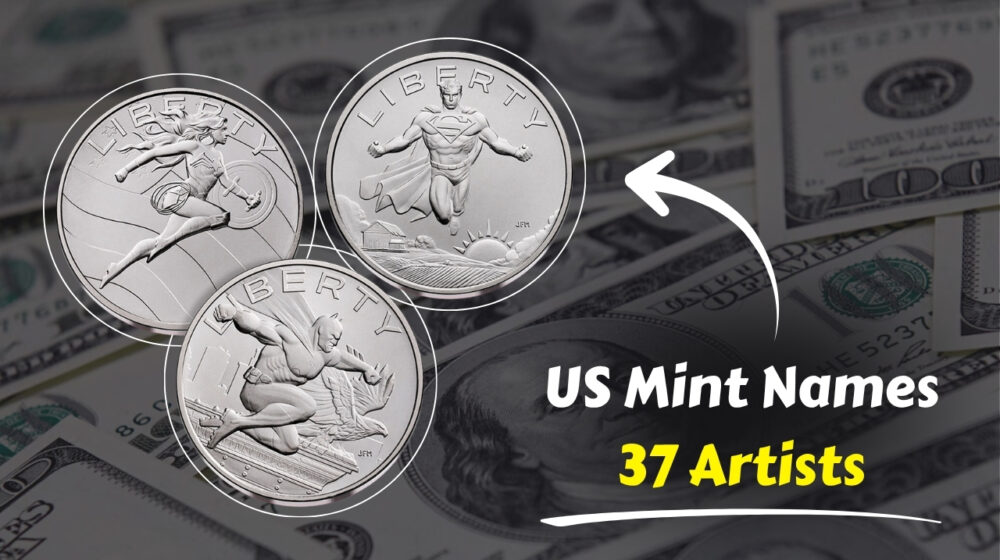
The United States Mint has refreshed the roster of artists eligible to shape the look of America’s future coins and medals. On August 31, the Mint announced 37 artists selected for its Artistic Infusion Program (AIP), the roster that supplies candidate designs alongside artwork produced by the Mint’s own in-house engraving staff. Four of the 37 Kristine Campbell, Donovan Corcoran, Gian Galang, and James Martin are joining the program for the first time, while the remaining 33 are returning participants with prior AIP experience.
The announcement caps a nationwide search that began earlier this year, when the Mint opened applications to professional artists interested in contributing coin and medal designs. This is not the debut of a new coin or medal no specific design, denomination, price, or mintage has been announced. Instead, it’s the moment that determines which artists will have the opportunity to submit candidate artwork for future U.S. coin and medal programs, some of which may not reach circulation or release for years. For collectors who follow the design side of numismatics as closely as the coins themselves, this roster is where many future favorites begin.
Artistic Infusion Program: Key Facts at a Glance
Because this story concerns an artist roster rather than a coin release, the table below summarizes the program’s structure and terms rather than coin specifications there is no mintage, composition, or retail price to report at this stage.
| Detail | Information |
|---|---|
| Program Name | Artistic Infusion Program (AIP) |
| Administered By | United States Mint |
| Program Established | 2003 |
| 2026 Application Window | January 8 – February 9, 2026 |
| Initial Submission Requirement | 5 to 10 portfolio images |
| Second-Phase Materials (if advanced) | Resume/CV, online portfolio, demonstration design |
| Second-Phase Compensation | $1,500 |
| Total Artists Named (2026 Roster) | 37 |
| New Artists Added | 4 (Kristine Campbell, Donovan Corcoran, Gian Galang, James Martin) |
| Returning Artists | 33 |
| Payment Per Design Assignment | $3,000 |
| Additional Payment If Design Is Selected | $5,000 |
| Design Attribution | Designer’s initials typically appear on the finished coin or medal, alongside those of the Mint medallic artist who sculpted it |
| Announcement Date | August 31, 2026 |
The Selection Process: How Artists Are Chosen
Unlike a coin or medal, which collectors can order during a defined sales window, admission to the Artistic Infusion Program follows an application and review process rather than a purchase process. Here is how the 2026 cycle unfolded:
Application window: The Mint accepted applications from professional artists between January 8 and February 9, 2026, following a nationwide call for submissions publicized at the start of the year.
Initial submission: Applicants were required to submit a portfolio of 5 to 10 images demonstrating their artistic range and technical ability.
Advancement to a second phase: A subset of applicants advanced to further evaluation, which could include submitting a resume or CV, an expanded online portfolio, and a demonstration design intended to show how their artistic style might translate to a coin or medal surface. Artists who reached this phase were paid $1,500 for their participation.
Final selection: The Mint stated that the four newcomers Campbell, Corcoran, Galang, and Martin were chosen based on the artistic merit of their applications. The remaining 33 spots went to artists who had already participated in the program previously.
What happens next: Being named to the AIP roster does not guarantee an artist will design a specific coin or medal. Instead, AIP participants become eligible to receive assignments tied to particular coin and medal programs as they arise. When assigned, an artist develops candidate artwork that is considered alongside designs produced by the Mint’s own engraving staff. If a Mint official body selects an AIP artist’s design, that artist receives the additional $5,000 selection payment, and the design proceeds toward sculptural development.
There is no public “order window” for coins associated with this announcement because no coin or medal program has been tied to a specific artist or design at this stage. Collectors interested in tracking the outcome should watch for future Citizens Coinage Advisory Committee (CCAC) and Commission of Fine Arts (CFA) design review announcements, which are the venues where candidate AIP designs are typically reviewed before a final design is chosen.
Historical Background: The Artistic Infusion Program
Origins and Purpose
The Artistic Infusion Program was established in 2003 to give the U.S. Mint access to a wider pool of professional artistic talent than its permanent engraving staff alone could offer. Rather than relying solely on Mint-employed engravers to originate every design, the AIP allows outside artists working independently from their own studios to submit candidate artwork for consideration on U.S. coins and medals.
How Designs Move From Sketch to Coin
When an AIP artist receives a design assignment, they work independently to produce candidate artwork reflecting the theme or subject specified for that particular coin or medal program. That artwork is then considered alongside any designs generated internally by Mint staff. If an AIP-originated design is ultimately selected typically after review by bodies such as the CCAC and CFA, with final approval resting with the Secretary of the Treasury a Mint medallic artist takes on the task of sculpting the two-dimensional drawing into the three-dimensional relief needed for coining dies. This handoff from illustrator to sculptor is a defining feature of the AIP process: the AIP artist creates the concept, and a separate Mint sculptor-engraver executes the physical adaptation.
Recognition on Finished Coins
When an AIP design reaches production, the finished coin or medal typically carries two sets of initials: those of the AIP artist who created the original design, and those of the Mint medallic artist who sculpted it. This dual attribution has become a familiar feature for collectors who study design credits on modern U.S. coinage, from commemorative half dollars to circulating coin reverses.
A Track Record Across Modern Coinage
Many of the 33 returning artists named to the 2026 roster have prior design credits spanning circulating coinage, commemorative coin programs, numismatic collector issues, and medals. Since the program’s 2003 launch, AIP artists have contributed to a wide range of U.S. Mint products, making the program a significant, if often under-recognized, force behind the visual identity of modern American coinage.
Obverse and Reverse Designs: Nothing to Report Yet
Because this announcement names artists eligible for future design assignments rather than unveiling a finished coin or medal, there is no obverse or reverse artwork to describe at this time. No theme, denomination, or program has been publicly linked to any of the 37 named artists as of this announcement. When the Mint assigns these artists to specific coin or medal programs and when the CCAC, CFA, and Treasury Department review and approve resulting designs obverse and reverse artwork will be unveiled through the Mint’s standard design-review process. Collectors should watch for future CCAC and CFA meeting agendas, which typically preview candidate designs months before a coin or medal officially releases.
Why This Matters for Collectors
Even without a coin to buy, this announcement carries real significance for the collecting community:
- It signals who will shape tomorrow’s coinage. The artists named to the AIP roster are the same pool from which candidate designs for future commemorative coins, circulating coin reverses, and medals will be drawn. Knowing who is in the program offers an early window into the creative talent behind coins that may not appear for years.
- New talent brings new perspectives. The addition of four first-time artists Kristine Campbell, Donovan Corcoran, Gian Galang, and James Martin introduces fresh artistic voices into a program responsible for some of the most widely circulated American art.
- Continuity matters too. With 33 returning artists, the program maintains experienced contributors who have already demonstrated their ability to translate assigned themes into designs the Mint, CCAC, and CFA have approved in the past.
- It highlights an often-overlooked part of the coin-making process. Collectors frequently focus on mintages, grades, and finishes, but the AIP program is a reminder that every design starts with an individual artist working from a specific creative brief — a process worth understanding for anyone who wants a fuller picture of how U.S. coins come to be.
- It’s an early signal for future releases. Design assignments and CCAC/CFA reviews tied to these artists may offer collectors advance notice of upcoming coin and medal themes well before official release announcements.
Quick-Reference Guide: What Collectors Should Watch For Next
- Note the four new artists. Kristine Campbell, Donovan Corcoran, Gian Galang, and James Martin are newly eligible for AIP design assignments — watch for their names on future candidate designs.
- Understand there is no coin to order yet. This announcement covers artist eligibility, not a product release; there is no price, mintage, or purchase window to act on at this stage.
- Follow CCAC meeting announcements. The Citizens Coinage Advisory Committee reviews candidate designs, often including AIP submissions, well before coins are finalized.
- Follow CFA design reviews. The Commission of Fine Arts also weighs in on candidate coin and medal artwork before final approval.
- Watch official U.S. Mint announcements. New coin and medal programs, along with their design credits, are announced through the Mint’s official news channels and product pages.
- Check design credits on new releases. Once a coin or medal reaches production, compare the AIP artist’s initials and the Mint medallic artist’s initials against this year’s roster to see which program members’ work made it to market.
- Set alerts for future commemorative and circulating coin programs. As new coin programs are authorized by Congress or announced by the Mint, some of the 37 AIP artists named here are likely to be assigned to develop candidate designs.
This article is based on the U.S. Mint’s August 31 announcement regarding its Artistic Infusion Program. No coin or medal designs have been released in connection with this announcement; collectors should follow official U.S. Mint, CCAC, and CFA channels for updates on future design assignments and coin programs.