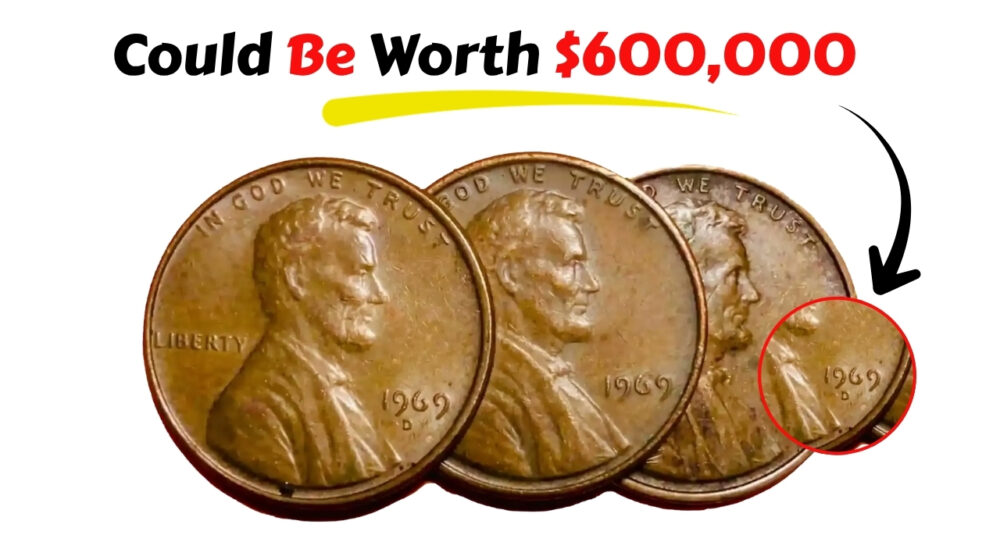
Somewhere out there, tucked inside a coffee can of loose change, a forgotten coin jar, or an unsearched roll of pennies from a bank, a handful of ordinary-looking 1969 cents are anything but ordinary. The coin in question is the 1969-S Lincoln Memorial Cent with a Doubled Die Obverse (DDO) a dramatic minting error struck at the San Francisco Mint that has become one of the most famous and valuable error coins in modern American numismatics.
Fewer than 100 examples are believed to have ever left the Mint, and most experts now put the surviving population at somewhere between 30 and 60 pieces across all grades. That extreme scarcity, combined with the doubling being bold enough to see with the naked eye, has driven prices into six-figure territory for decades and in January 2023, the finest known example shattered records entirely, selling at auction for $601,875, including the buyer’s premium. That single sale is the basis for headlines describing the coin as being “worth up to $600,000.”
The coin has resurfaced in the news cycle again recently, in part because of the U.S. Mint’s decision, announced in late 2025, to end production of the penny after more than 230 years a move that has pushed ordinary people to take a second look at the loose change piling up in their homes.
Coin Specifications
| Detail | Information |
|---|---|
| Coin | Lincoln Memorial Cent |
| Date / Mint Mark | 1969-S (San Francisco) |
| Variety | Doubled Die Obverse (FS-101) |
| Estimated Surviving Population | Roughly 30–60 pieces (estimates vary by source; historically believed no more than ~100 were struck) |
| Composition | 95% copper, 5% zinc |
| Weight | 3.11 grams |
| Diameter | 19.05 mm |
| Edge | Plain |
| Strike Type | Business (circulation) strike |
| Obverse Designer | Victor David Brenner |
| Reverse Designer | Frank Gasparro |
| Auction Record | $601,875 (PCGS MS-66 Red, sold January 2023) |
| Typical Circulated Value | $10,000 and up |
| Typical Mint State Value | $35,000–$50,000+, with top-grade examples reaching six figures |
Because grading, surface color designation (brown, red-brown, or full red), and eye appeal swing the value so widely, no two examples are priced the same condition is everything with this variety.
How to Get Yours Verified and Sold (There’s No “Order Window”)
Unlike a modern commemorative coin, the 1969-S doubled die cent was never sold by the Mint and cannot be purchased new, reserved, or “ordered” through any official channel. It exists only within the pool of genuine 1969-S pennies already in circulation or sitting in old collections. If you believe you have one, here is the realistic path collectors and dealers actually use:
Step 1: Confirm the mint mark and doubling. A genuine 1969-S DDO must carry a small “S” mint mark below the date, and the doubling should appear clearly in “LIBERTY,” “IN GOD WE TRUST,” and the date itself visible without magnification. If the doubling only shows up on the mint mark, or the coin lacks an “S,” it is not this variety.
Step 2: Rule out common look-alikes. Machine doubling (a flat, shelf-like smearing caused by a loose die, not a true hub doubling) is far more common and worth little. A jeweler’s loupe or macro photo comparison against verified images from PCGS or NGC can help you tell the difference before spending money on grading.
Step 3: Submit to a major grading service. Because counterfeits and altered coins exist for this variety (it was even briefly investigated by the U.S. Secret Service in the 1970s due to an unrelated counterfeiting scheme), reputable dealers and auction houses will not handle an example unless it has been authenticated and graded by PCGS, NGC, or a similar third-party service.
Step 4: Consult or consign through a specialist. Firms with a track record in this variety such as Heritage Auctions, Stack’s Bowers Galleries, and GreatCollections — regularly handle 1969-S DDO sales and can advise on realistic value based on current condition and market comparables.
Step 5: Find a dealer near you if you want a local opinion first. The American Numismatic Association maintains a free online dealer directory to help you locate a reputable coin dealer for an initial evaluation.
There is no deadline, quantity limit, or purchase price tied to this coin only the ongoing, decades-long hunt by collectors searching rolls, jars, and inherited collections for a genuine survivor.
Historical Background of the Design
The Obverse: Victor David Brenner’s Lincoln Portrait (1909)
The bust of Abraham Lincoln on the obverse dates back to 1909, when sculptor and medalist Victor David Brenner was commissioned to design a new one-cent coin to mark the 100th anniversary of Lincoln’s birth. It was the first U.S. coin to feature the portrait of an actual president rather than an allegorical figure, breaking with more than a century of American coinage tradition. Brenner’s design proved so enduring that the same Lincoln portrait, essentially unchanged, has appeared on the cent for well over a hundred years.
The Reverse: Frank Gasparro’s Lincoln Memorial (1959)
The Lincoln Memorial reverse was introduced in 1959 to mark the 150th anniversary of Lincoln’s birth, replacing the wheat-ears design that had been used since 1909. It was created by Frank Gasparro, who later became the ninth Chief Engraver of the United States Mint. His design depicts the Lincoln Memorial in Washington, D.C., rendered in fine detail a tiny, seated statue of Lincoln is even discernible between the columns on well-struck, well-preserved examples.
The 1969-S Doubled Die Error
The error itself originated not at the San Francisco Mint but at the Philadelphia Mint, which was responsible for producing coinage dies for all U.S. branch mints until 1996. During die production, a working die received a misaligned secondary impression from the hub the master tool used to imprint the design most likely because the die shifted slightly during the annealing (heat-treatment) process between hubbings. The result was a die that stamped every coin it struck with a doubled image across the date and lettering.
The error went undetected for years. The first confirmed example didn’t surface publicly until the mid-1970s, when a California woman discovered one in her change and eventually sold it to dealer Jack Beymer for $3,500 a substantial sum at the time that helped ignite interest in the variety. Adding to its unusual history, the coin was briefly entangled in a real Secret Service counterfeiting investigation targeting a separate, fraudulent “1969 doubled die” scheme unrelated to the authentic San Francisco error — a mix-up that only deepened the coin’s mystique among collectors.
Obverse and Reverse Design Details
Obverse: The obverse features Lincoln’s bust in profile, facing right, occupying most of the coin’s field. “IN GOD WE TRUST” arcs along the top rim, “LIBERTY” sits to the left of the portrait, and the date appears to the right. On the doubled die variety, this is where the error is most visible the letters in “LIBERTY” and “IN GOD WE TRUST,” along with the numerals in “1969,” show pronounced, separated doubling, sometimes described by specialists as having visible “open space” between the doubled strokes. Notably, the small “S” mint mark below the date does not show doubling, because mint marks were punched into the die separately, after the doubled hubbing had already occurred.
Reverse: The reverse depicts the Lincoln Memorial building, rendered with fine architectural detail including its columns and steps. “UNITED STATES OF AMERICA” arcs along the top, “E PLURIBUS UNUM” appears just beneath it, and “ONE CENT” is centered along the bottom. The reverse die was not affected by the doubling error, so reverse designs on 1969-S DDO cents are entirely normal the entire premium comes from the obverse alone.
Why This Matters for Collectors
The 1969-S doubled die cent occupies a unique place in the hobby for several reasons:
- Extreme, well-documented rarity. With a surviving population estimated at only a few dozen pieces, it is rarer than many pre-1933 gold coins that command similar or lower prices.
- Dramatic, eye-visible doubling. Unlike many die varieties that require magnification to appreciate, this error is bold enough to spot with the naked eye, making it instantly satisfying to collectors and a favorite “trophy” coin.
- A genuine treasure-hunt story. Because it can only be found in circulation or old accumulations never purchased new every confirmed discovery carries a real “found in change” narrative, which keeps public interest in checking pocket change alive.
- A benchmark for the modern error-coin market. Its climb from a $3,500 sale in the 1970s to a $601,875 record in 2023 illustrates just how much the modern die-variety market has matured, and it’s often cited alongside icons like the 1955 and 1972 doubled die cents as proof that 20th-century “common” coins can rival classic rarities in value.
- Renewed relevance amid the penny’s discontinuation. With the U.S. Mint having ended penny production, public attention has turned toward the coins already in circulation, and collectors expect increased interest in searching remaining cents including any lingering 1969-S rolls before they fully disappear from daily use.
Quick-Reference Buying Guide
- Grab your loose change. Check coin jars, drawers, inherited collections, and especially any old, unsearched rolls of pennies dated 1969.
- Look for the “S” mint mark. It must appear below the date; Philadelphia (no mint mark) and Denver (“D”) 1969 cents are not the rare variety.
- Check for bold doubling. Focus on “LIBERTY,” “IN GOD WE TRUST,” and the date doubling should be clearly separated, not a flat smear.
- Compare against verified images. Cross-reference your coin with authenticated photos from PCGS CoinFacts or NGC’s coin explorer before assuming a match.
- Don’t clean the coin. Cleaning a potentially valuable coin can destroy its surface and significantly reduce its value handle it only by the edges.
- Get it authenticated. Submit the coin to PCGS or NGC for official grading and variety attribution.
- Consult a specialist dealer or auction house. Reach out to firms experienced with this variety, such as Heritage Auctions, Stack’s Bowers Galleries, or GreatCollections, or use the ANA’s dealer directory to find local expertise.
- Decide: sell or hold. Once authenticated, you can consign the coin to a major auction, sell it privately through a reputable dealer, or hold it as a long-term collectible, depending on your goals.
Sources referenced for this article include Stack’s Bowers Galleries, PCGS CoinFacts, Coin World, Numismatic News, GreatCollections, Greysheet, and the American Numismatic Association.