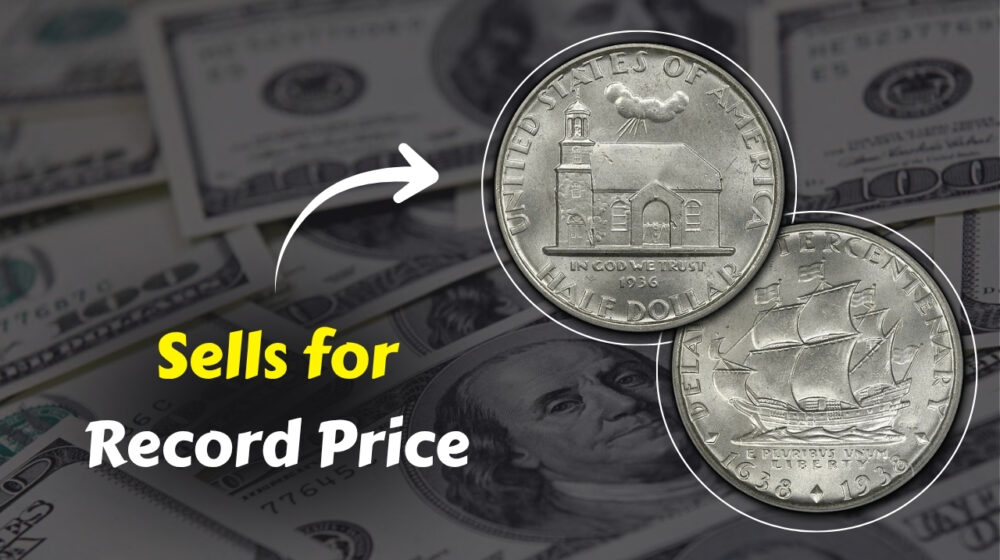
A single silver half dollar can hold more history than most museum exhibits, and the 1936 Delaware Tercentenary Half Dollar proves the point. The coin wears a 1936 date, but the Philadelphia Mint didn’t actually strike it until 1937, and the anniversary its reverse celebrates didn’t happen until 1938. That three-year mismatch alone makes it one of the more curious entries in the American commemorative series and in August 2025, a single coin turned that curiosity into headline news.
Heritage Auctions sold a PCGS-graded MS68 example from the Gregg Bingham Collection for $19,200, a price that now stands as the recognized auction record for the issue. The lot closed on August 28 as part of Heritage’s August 26–31 ANA U.S. Coins auction (PCGS logs the sale under the event’s August 31 closing date). For a coin that collectors could originally buy for $1.75, the result is a striking reminder of how far a well-preserved commemorative can travel.
But the price is only the most recent chapter. Behind the coin sits a story that stretches from a 1638 transatlantic voyage to a Wilmington church still standing after more than 300 years, a Depression-era design contest, and a companion coin struck an ocean away in Sweden.
Coin Specifications at a Glance
| Detail | Information |
|---|---|
| Denomination | Half Dollar (50 cents face value) |
| Date shown on coin | 1936 |
| Year actually struck | 1937 |
| Anniversary dates on reverse | 1638–1938 |
| Mint facility | Philadelphia (no mintmark) |
| Designer | Carl L. Schmitz |
| Composition | 90% silver, 10% copper |
| Weight | 12.50 grams |
| Diameter | 30.60 mm |
| Actual silver weight | Approximately 0.3617 troy oz |
| Edge | Reeded |
| Total struck | 25,015 (including 15 assay pieces) |
| Coins melted (unsold, returned to Mint) | 4,022 |
| Coins distributed to collectors | 20,978 |
| Standard reference net mintage | 20,993 |
| Original issue price | $1.75 per coin |
| PCGS number | 9301 |
| Obverse design | Old Swedes Church (Holy Trinity Church), Wilmington |
| Reverse design | The sailing ship Kalmar Nyckel |
| Estimated surviving population | Roughly 17,000 pieces, all grades |
| Estimated population at MS65 or better | About 6,500 |
| Auction record | $19,200 – PCGS MS68, Heritage Auctions, August 2025 |
| Prior auction benchmark | $18,400 – PCGS MS67 (CAC), Heritage, January 2012 |
How Collectors Originally Obtained the Coin
The Delaware Half Dollar didn’t reach the public through a mint-run subscription program the way modern commemoratives do. Instead, distribution ran through a single organization tied directly to the state.
The sponsoring body. The Delaware Swedish Tercentenary Commission oversaw the coin’s production and sale, working under the authority Congress granted in Public Resolution No. 91, approved May 15, 1936.
The legislative framework. Congress had grown wary of earlier commemorative programs that spread mintages across multiple mints and dates to force collectors into buying duplicate varieties. For Delaware, lawmakers required a single design produced at a single mint, with every coin dated 1936 regardless of the year it was actually struck. The commission also had only one year from the law’s passage to request coins from the Mint.
The order minimum. A frequently repeated claim holds that Congress capped the mintage at 25,000 coins. In fact, the resolution set 25,000 as a minimum order, requested in batches of at least that size not a ceiling.
The distributor. Rather than selling coins directly, the commission worked through the Equitable Trust Company of Wilmington, which handled sales and mailed the coins to buyers. Contemporary congressional records put the price at $1.75 per coin, postage included.
What happened to the unsold coins. The Philadelphia Mint struck 25,015 half dollars in March 1937 (15 of them reserved for assay testing). Demand fell short of the full run: collectors ultimately purchased 20,978 coins, and the commission returned the remaining 4,022 to the Mint, which melted them. That’s why reference sources cite two different figures 20,978 for coins actually sold, and 20,993 for the “net mintage,” which adds back the 15 assay pieces that survived.
Buying one today. Because no subscription window remains open, today’s collectors acquire the Delaware Half Dollar exclusively on the secondary market through major auction houses such as Heritage Auctions, established coin dealers, and certified-coin marketplaces. Prices vary enormously by grade, from a few hundred dollars for a solid Mint State example up to five figures for a top-tier PCGS or NGC-certified specimen.
Historical Background of the Design Elements
Old Swedes Church – The Obverse Subject
The building at the center of the obverse is Holy Trinity Church in Wilmington, better known as Old Swedes Church. Swedish and Finnish settlers built it between 1698 and 1699, and the Reverend Eric Björk consecrated the finished building on June 4, 1699.
What makes the church remarkable is that the original structure is still standing and still in use. The National Park Service lists it among the oldest church buildings in the country that continues to serve an active congregation a claim sometimes stated even more strongly in older numismatic writing, which called it the oldest Protestant church building in continuous worship in the United States. Either way, its survival across more than three centuries gave designer Carl L. Schmitz a genuinely historic structure to render on the coin, complete with the broad, simple roofline that later became a grading challenge, since its flat surfaces show even minor contact marks.
The Kalmar Nyckel – The Reverse Subject
The reverse turns to the ship rather than the settlement it produced. In late 1637, the New Sweden Company dispatched two vessels across the Atlantic the Kalmar Nyckel and the Fogel Grip under the leadership of Peter Minuit. The expedition reached the Christina River in March 1638, and the Swedish and Finnish settlers aboard established Fort Christina near modern Wilmington, the first permanent European settlement in what is now Delaware and the anchor of the New Sweden colony.
The Kalmar Nyckel’s name translates roughly as “Key of Kalmar,” referencing the Swedish city of Kalmar. Schmitz depicted the ship under full sail, with the dates 1638–1938 beneath it marking the 300-year span between the voyage and the tercentenary celebration the coin honors. Three small diamonds accompany the design, a nod to Delaware’s “Diamond State” nickname and its three counties New Castle, Kent, and Sussex.
The Designer: Carl L. Schmitz
The Delaware Swedish Tercentenary Commission chose its design through an open competition rather than a direct commission, and 40 artists reportedly submitted entries for a $500 prize. Mint Chief Engraver John R. Sinnock and sculptor Dr. R. Tait McKenzie served on the review panel, and the commission ultimately selected French-born, German-American sculptor Carl L. Schmitz. The Delaware Half Dollar became the best-known numismatic work of his career.
McKenzie’s presence on the judging panel is itself a footnote worth knowing: the Canadian-born physician was a pioneer in physical education and rehabilitation medicine who built a parallel career as a sculptor, credited with roughly 200 works, including the well-known statue of a young Benjamin Franklin at the University of Pennsylvania, where he taught.
One organizational quirk survives in early commission materials, which treated the ship side as the coin’s obverse. The Mint ultimately designated the church side as the obverse, and that is the convention collectors follow today.
Sweden’s Companion Coin
The United States wasn’t alone in marking the anniversary. In 1938, Sweden’s Royal Mint struck its own commemorative a silver 2 Kronor piece designed, modeled, and engraved by Erik Lindberg, featuring King Gustaf V on the obverse and the Kalmar Nyckel sailing beneath a royal crown between the dates 1638 and 1938 on the reverse. Notably, the inscriptions appear in Latin, a detail Sweden’s Riksbank has pointed out as unusual since Swedish coinage hadn’t used Latin lettering since the reign of Gustav III. The Stockholm mint produced 508,815 of these 15-gram, 31mm coins in .800 fine silver, giving the American Delaware issue a genuine international counterpart struck for the same historical milestone.
Obverse and Reverse Design Details
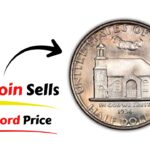
Obverse. The design is dominated by Old Swedes Church rendered with a broad roof and restrained architectural lines, set above the 1936 date. The composition is deliberately simple, letting the historic building carry the visual weight of the coin though that same simplicity means the large flat roof surface shows handling marks more readily than busier designs, something collectors should watch for when evaluating grade and eye appeal.
Reverse. The Kalmar Nyckel appears under full sail, rendered with enough detail that the rigging and canvas become a natural focal point and, for the same reason, a common location for light contact marks. Below the ship are the flanking dates 1638 and 1938, marking the 300 years between the voyage and the tercentenary. The three small diamonds referencing Delaware’s nickname and counties round out the design, giving the reverse a quieter narrative than the obverse but one packed with just as much symbolism.
Surface and finish notes. Because most surviving coins were purchased as souvenirs and rarely circulated, the majority remain in Mint State. Quality within that range varies significantly: some examples show attractive semi-Prooflike luster, others a softer frosted finish, and toning ranges from appealing champagne, amber, and plum hues to uneven, blotchy coloration that can noticeably hurt eye appeal. There has also been long-standing speculation, raised by commemorative-coin specialist Anthony Swiatek, that a small number of Matte Proof Delaware halves might exist but no confirmed Proof population has ever been established, and PCGS continues to catalog the issue as a standard strike.
Why This Matters for Collectors
The Delaware Half Dollar’s appeal doesn’t rest on an ultra-low mintage the way some commemoratives do a net mintage near 21,000 is not exceptionally scarce by classic commemorative standards. Instead, its value to collectors comes from several other angles working together:
- A layered historical narrative. Few 30.6mm coins connect a 1638 transatlantic voyage, a still-standing 1699 church, a 1936 congressional resolution, a coin actually struck in 1937, and a 1938 anniversary celebration all on one piece of silver.
- An international companion piece. Pairing the U.S. half dollar with Sweden’s 1938 2 Kronor creates a natural two-coin exhibit telling the same story from two national perspectives.
- Condition sensitivity. The broad, open fields on both sides make well-preserved, cleanly toned examples genuinely harder to find than raw population numbers suggest, which is part of why top-graded pieces command outsized premiums.
- A moving census at the top end. Population figures at the MS67+ and MS68 level have shifted over time as more coins are submitted and resubmitted for grading, meaning older published census data and price levels (such as figures cited in older market coverage) shouldn’t be treated as current benchmarks.
- Demonstrated market strength. The move from an $18,400 record in 2012 to $19,200 in 2025 shows sustained collector demand for top-condition examples of this issue, even though prices for mid-range grades have historically remained modest.
Quick-Reference Buying Guide
- Decide on your target grade. Mid-range Mint State coins (MS64–MS65) remain relatively affordable and represent the bulk of the surviving population; MS67 and above are where prices accelerate sharply.
- Buy certified whenever possible. Look for coins graded by PCGS or NGC, since third-party certification protects against cleaning, doctoring, or mis-grading — issues that are easy to miss on a coin with large open fields like this one.
- Inspect the church roof and ship’s sails closely. These are the design’s most mark-prone areas; use magnification or high-resolution auction photos to check for scratches or nicks before bidding.
- Evaluate toning carefully. Favor coins with even, attractive coloration (champagne, amber, plum, or soft gold tones) over pieces with blotchy or uneven color, which typically sell at a discount.
- Check recent auction records, not old price guides. Because population data and pricing shift as more coins are graded, confirm current values through recent sales results (e.g., PCGS CoinFacts auction history) rather than relying on figures from years-old articles.
- Buy from reputable auction houses or established dealers. Given the coin’s market activity at the high end, provenance and seller reputation matter, especially for coins graded MS67 and above.
- Consider the Swedish companion piece. Collectors building a thematic set may want to pair the Delaware Half Dollar with Sweden’s 1938 2 Kronor for a fuller telling of the New Sweden tercentenary story.
- Verify certification numbers. For higher-value purchases, cross-check the PCGS or NGC certification number against the grading service’s online population and pedigree records before completing a purchase.
Disclaimer: This article was compiled from secondary source material. Prices, mintage figures, dates, and other details should be independently verified against primary references (e.g., PCGS CoinFacts, official auction records) before publication.