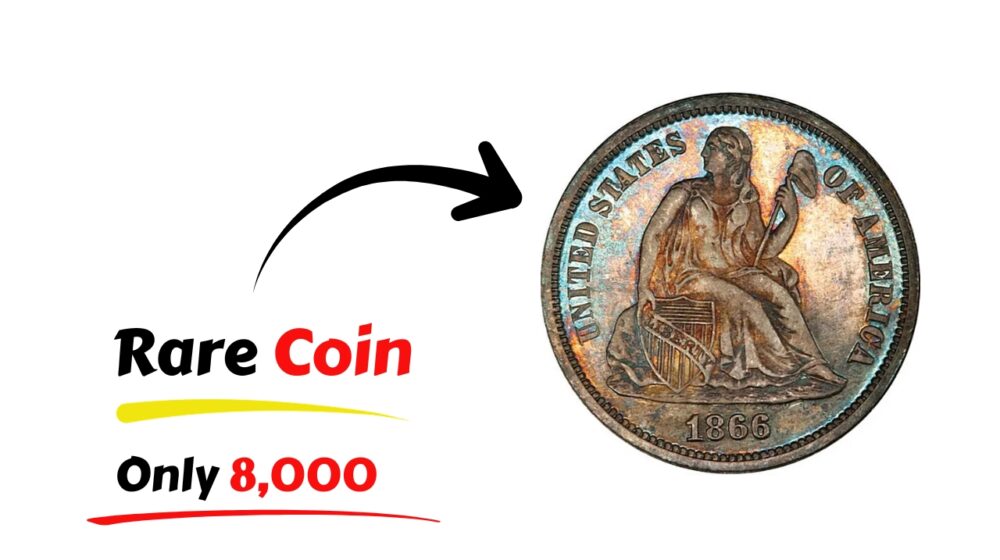
Few coins in the Liberty Seated Dime series pack as much history into so small a package as the 1866 issue. The Philadelphia Mint struck a mere 8,000 business-strike examples of this coin and, remarkably, it did so in a single day, January 31, 1866. That extraordinarily low output alone would make the date a standout among nineteenth-century dimes, but the coin’s backstory gives it even greater weight.
The 1866 dime was born into a nation still reeling from the Civil War. The economy was in upheaval, precious-metal coinage had all but vanished from everyday transactions, and the federal government was contending with hundreds of millions of dollars in paper currency circulating below face value. Against that turbulent backdrop, the Mint devoted only token resources to dime production, leaving collectors today with one of the scarcest Philadelphia issues of the entire Seated Liberty series — particularly in higher Mint State grades, where a small cluster of beautifully toned condition-census coins has become the stuff of specialist legend.
This article walks through the coin’s specifications, its historical context, its design elements, and what collectors should know if they’re hoping to add an example to their own holdings.

Specifications at a Glance
| Attribute | Detail |
|---|---|
| Country | United States of America |
| Denomination | One Dime (10 cents) |
| Year | 1866 |
| Mint Facility | Philadelphia |
| Mintmark | None |
| Business-Strike Mintage | 8,000 |
| Proof Mintage | 725 |
| Composition | 90% silver, 10% copper |
| Weight | 2.48 grams (PCGS); some period references list 2.49 g |
| Diameter | 17.90 mm |
| Edge | Reeded |
| Designer | James B. Longacre (1860-type Legend Obverse) |
| Design Type | Liberty Seated, Legend Obverse |
| Motto | None (“IN GOD WE TRUST” was not added to the dime) |
| Known Die Marriage (business strikes) | F-102 (Fortin attribution), in two die states: F-102a (Perfect Reverse) and F-102b (Clashed Reverse) |
| PCGS Estimated Survivors | ~400 in all grades; ~50 in MS60 or better; only about 8 in MS65 or better |
Because this is a nineteenth-century collector coin rather than a modern government-issued product, there was no public “order” process, subscription window, or household purchase limit when it was struck it entered circulation like any other dime of its era. Today, acquiring one means working through the resale and auction market rather than a mint order form, which is addressed in the buying guide below.
Historical Background
A Nation Rebuilding
By the time the 1866 dime left the presses, the Civil War had been over for less than a year. General Robert E. Lee’s surrender at Appomattox Court House in April 1865 effectively ended major hostilities, though scattered Confederate resistance continued briefly afterward. Days later, the assassination of President Abraham Lincoln removed the leader who had already begun steering the country toward reunification, leaving Reconstruction to proceed without him.
The human and economic toll was staggering. Older demographic estimates placed Civil War deaths near 750,000, with a range extending from roughly 650,000 to 850,000. More recent scholarship a 2024 study in the Proceedings of the National Academy of Sciences that relied on complete census data rather than a small sample narrowed that estimate to around 698,000, with a likely range of about 647,000 to 749,000. The South’s economy fared just as badly: assessments show that roughly two-thirds of the region’s wealth vanished during the war, a decline driven both by physical destruction and by the end of slavery, which erased enslaved people from prewar property valuations.
Paper Money and a Starved Coin Supply
The war had also transformed the nation’s money. Congress had authorized Legal Tender Notes greenbacks that did not convert to gold or silver on demand, so their market value floated against hard coin. By 1866, more than $400 million in greenbacks remained in circulation (one Treasury report placed the figure above $423 million as of March of that year). Because Americans generally valued gold and silver coin more highly than paper, precious-metal coinage largely disappeared from day-to-day commerce, even as Treasury Secretary Hugh McCulloch worked toward an eventual return to specie payments.
This environment shaped what the Philadelphia Mint chose to strike. Base-metal coins were produced in bulk for ordinary domestic use, while gold coinage — especially the Double Eagle, with nearly 700,000 pieces struck for roughly $14 million in face value — served banks, government needs, and international trade. Silver denominations, by contrast, received only limited attention. Of Philadelphia’s sixteen circulating coin denominations struck in 1866, nine had mintages below 25,000 pieces. The half dollar was the only silver denomination that year with a substantial business-strike output (744,900 pieces); the dime’s production, at just 8,000, was minuscule by comparison.
1866 also brought a major design change across the coinage system: the motto IN GOD WE TRUST was added to gold and silver coins beginning January 1 of that year. The dime, however, was left out Mint officials judged the denomination too small to accommodate the additional lettering making the 1866 Liberty Seated Dime a notable exception among its silver contemporaries.
The Dime Series’ Downward Spiral
The 1866 dime’s tiny mintage was not an isolated event. Philadelphia dime production fell sharply starting in 1863 and continued to decline through 1867, when the mint struck only 6,000 business strikes even fewer than 1866. All five issues from 1863 through 1867 are considered difficult dates for collectors, but 1866 stands out for the exceptional detail that its entire circulation-strike run was completed in a single day.
The Mint also struck 725 Proof dimes in 1866 for collectors. Some have speculated that renewed postwar interest in collecting boosted Proof demand that year, though no documentary evidence confirms the theory — and Philadelphia had already produced 1,000 Proof dimes back in 1860, which weakens the idea that the war’s end alone explains 1866’s Proof output.
Design Lineage
The Liberty Seated Dime’s Legend Obverse design was introduced in 1860 by Chief Engraver James B. Longacre, who reworked the original Seated Liberty motif. That earlier concept traced back to Christian Gobrecht, with contributions associated with Robert Ball Hughes, Thomas Sully, and Titian Peale. Engraver Anthony C. Paquet has also been linked to work on the coin’s cereal-wreath reverse. By 1866, the Legend Obverse type had been in continuous production for six years, giving the coin a design pedigree that stretched back to the earliest days of the Seated Liberty series in the 1830s.
Design Details
Obverse
Liberty is shown seated upon a rock, her head turned toward her right shoulder, draped in flowing robes. In her left hand she holds a pole topped by a Phrygian cap a traditional symbol of liberty and emancipation. Her right hand braces a Union shield, across which a curved ribbon bears the word LIBERTY. The legend UNITED STATES OF AMERICA arcs along the upper rim, and the date 1866 sits beneath the seated figure. A ring of denticles frames the coin’s edge.
Reverse
The denomination ONE DIME is lettered across the center of the coin, encircled by a cereal wreath composed of corn, wheat, maple leaves, and oak leaves, tied together at the bottom by a ribbon. Denticles again border the rim. (This wreath is sometimes loosely described elsewhere as simply a “wheat wreath,” but it actually incorporates several distinct plant motifs.)
Edge
The coin has a reeded edge, standard for silver dimes of the period.
Why the 1866 Liberty Seated Dime Matters for Collectors
Several factors combine to make this date a genuine key issue within the Liberty Seated Dime series:
- Extreme scarcity at the source. With only 8,000 business strikes and 725 Proofs, the 1866 dime had one of the smallest mintages of any Philadelphia silver coin that year.
- A single-day production run. All circulation strikes came from one day’s work at the Mint, an unusually well-documented and tightly compressed production event for a nineteenth-century coin.
- Collector habits reduced the surviving population further. Nineteenth-century collectors tended to favor Proofs over business strikes when both were available, so relatively few Mint State 1866 dimes were deliberately saved. Most entered commerce and suffered ordinary wear, which is why top-grade survivors are so hard to find today. PCGS estimates only around 400 survivors across all grades, with roughly 50 in Mint State and just about 8 grading MS65 or better.
- A single die marriage tells the whole story. According to Liberty Seated specialist Gerry Fortin, every known 1866 business strike traces to one die marriage, F-102, which exists in two distinct states — F-102a (Perfect Reverse) and F-102b (Clashed Reverse), the product of the obverse and reverse dies striking each other without a coin between them at some point during production. F-102a is generally considered a touch more available, yet F-102b examples currently dominate the top of the condition census.
- Exceptional toning among top-tier survivors. Many of the finest known 1866 dimes carry striking blue, green, violet, gold, or russet patina, a hallmark of the date’s upper condition census. A small number of coins, such as the bright, frosty Dell Loy Hansen specimen, stand out precisely because they lack this typical toning.
- A missing motto with historical meaning. Because the Mint considered the dime too small to carry the new IN GOD WE TRUST motto introduced in 1866, this date offers a tangible link to a pivotal moment in the design history of U.S. coinage — one shared by no other denomination that year.
- Notable pedigrees. Distinguished collections including those of Millholland, Hansen, Gardner, Simpson, and the New England Museum have all included high-grade 1866 dimes, tying the date to some of the most respected numismatic collections ever assembled.
Population data continues to evolve as collectors submit and resubmit coins for grading. As of an August 2026 PCGS update, the service reported 111 grading events for the date, including three at MS67 with none higher. NGC’s census from mid-2026 showed 58 grading events, topped by a single coin at MS68. Because these are grading events rather than a strict count of unique coins, the true surviving population is somewhat smaller than the raw totals suggest reinforcing just how limited genuine high-grade material remains.
Buying Guide: How to Acquire an 1866 Liberty Seated Dime
Because this is a historic circulation-era coin rather than a modern mint product, there is no original “order window,” household purchase limit, or issue price to reference it was struck for commerce in 1866 and has circulated through the collector market ever since. Today, acquiring an example means navigating the secondary market rather than placing a mint order. Here’s a practical approach:
- Set a grade and budget target first. Because of the enormous jump in price between circulated and Mint State examples, decide early whether you’re pursuing a collectible representative coin or a condition-census-level rarity, since the cost difference can be dramatic.
- Prioritize certified coins. Look for examples graded by PCGS or NGC, and check whether a CAC sticker or CAC Grading designation has been applied, since third-party grading and CAC verification both add confidence in a coin of this rarity and value.
- Identify the die state if it matters to you. Specialists distinguish between the F-102a (Perfect Reverse) and F-102b (Clashed Reverse) die states; some collectors specifically pursue one or the other, so ask dealers or auction houses to confirm which state a given coin represents.
- Check current population reports before bidding. PCGS and NGC population and census figures change as coins are submitted, resubmitted, or crossed over between services, so pull the latest figures before finalizing a purchase decision, especially near the top of the grading scale.
- Research recent auction results. Major auction houses that regularly handle Liberty Seated material including Heritage Auctions and Stack’s Bowers Galleries publish searchable archives of past sales, which are useful for gauging fair market value at a given grade.
- Watch for major collection dispersals. Notable pedigreed coins have periodically entered the market through the breakup of important collections (such as the Millholland, Hansen, Gardner, and Simpson holdings), and these events can be a good opportunity to acquire a well-documented example.
- Inspect toning carefully. Because vivid original toning defines much of the upper end of this date’s market, learn to distinguish attractive, market-accepted natural toning from artificial or unstable coloration before committing to a high-grade purchase.
- Work with a specialist dealer when possible. Given the coin’s rarity and the technical nuances involved (die states, toning, population data), a dealer experienced with Liberty Seated coinage can help evaluate a specific example against the broader condition census.
This article is intended for general numismatic reference. Collectors considering a significant purchase should consult current population reports, recent auction records, and a qualified coin dealer or grading service before finalizing any transaction.