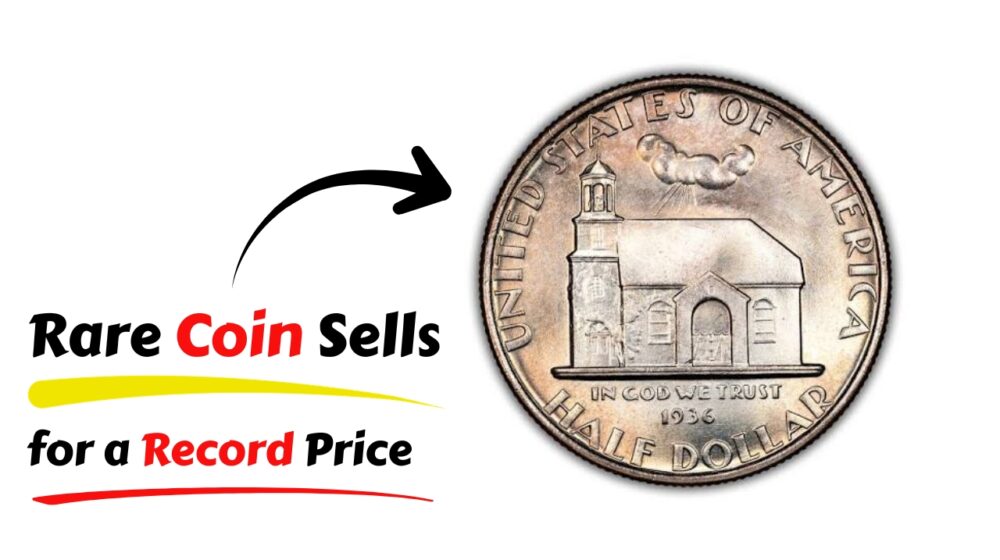
Most commemorative coins wear their history plainly: a portrait, a battlefield, a monument. The 1936 Delaware Tercentenary Half Dollar takes a stranger path. Its face bears the date 1936, but the Philadelphia Mint didn’t actually strike the coin until 1937 and the anniversary its reverse honors didn’t occur until 1938. A single coin, three different years, all equally essential to its story.
That quirky timeline would be enough to make the Delaware half dollar a favorite among commemorative specialists. But the coin’s appeal runs deeper, weaving together a 17th-century Swedish sailing expedition, one of America’s oldest surviving church buildings, a Depression-era design contest, and the peak of the United States’ classic commemorative coin boom.
Then, in August 2025, the coin added a new headline. Heritage Auctions sold a PCGS-graded MS68 example from the Gregg Bingham Collection for $19,200 during its August 26–31 ANA U.S. Coins auction, a price that now stands as the recognized auction record for the series. For a coin that originally sold to collectors for $1.75, it’s a remarkable rise and a good excuse to revisit everything that makes this small silver half dollar such a rich numismatic subject.
Specifications at a Glance
| Detail | Information |
|---|---|
| Denomination | Half Dollar |
| Face Value | 50 cents |
| Date Shown on Coin | 1936 |
| Year Actually Struck | 1937 |
| Anniversary Dates on Reverse | 1638–1938 |
| Minting Facility | Philadelphia (no mint mark) |
| Designer | Carl L. Schmitz |
| Composition | 90% silver, 10% copper |
| Weight | 12.50 grams |
| Diameter | 30.60 mm |
| Actual Silver Content | Approximately 0.3617 troy ounce |
| Edge | Reeded |
| Total Struck | 25,015 (including 15 assay pieces) |
| Coins Melted (Unsold, Returned) | 4,022 |
| Coins Distributed to Collectors | 20,978 |
| Standard Net Mintage (Reference Figure) | 20,993 |
| Original Issue Price | $1.75 |
| PCGS Number | 9301 |
| Obverse Design | Old Swedes Church (Holy Trinity Church), Wilmington |
| Reverse Design | The sailing ship Kalmar Nyckel |
| Estimated Surviving Population | Roughly 17,000 pieces across all grades |
| Auction Record | $19,200, PCGS MS68, Heritage Auctions, August 2025 |
How Collectors Originally Acquired the Coin – and How to Buy One Today
The Original 1937 Distribution
The Delaware Swedish Tercentenary Commission handled sales through the Equitable Trust Company of Wilmington rather than through the Mint directly. Interested buyers paid $1.75 per coin, a price that covered postage. Congress had authorized the program through a resolution passed on May 15, 1936, but the legislation carried some unusual conditions worth understanding, since they explain the coin’s odd numbers.
Rather than setting a maximum mintage, the authorizing resolution set a floor: it called for “not less than twenty-five thousand” coins and required any orders to come in batches of at least 25,000 pieces. In other words, 25,000 was a minimum commitment, not a ceiling a detail that’s often misreported. The law also fixed the design date at 1936 regardless of when the coins were actually struck, and it gave the commission just one year from enactment to place its order.
The Philadelphia Mint ultimately struck 25,015 coins in March 1937, a figure that included 15 pieces set aside for assay testing. Demand, however, fell short of the full production run. Collectors bought 20,978 coins, and the commission returned the remaining 4,022 to the Mint, where they were melted down. That’s why modern references cite two different mintage figures: 20,978 reflects coins that actually reached collectors, while the commonly quoted “net mintage” of 20,993 adds back the 15 assay coins that survived the melting.
Buying a Delaware Half Dollar Today
Since the original sales window closed nearly nine decades ago, the coin is no longer available from any mint or original issuing body. Today’s collectors acquire examples exclusively on the secondary market, primarily through:
- Major auction houses such as Heritage Auctions, which regularly handle high-grade examples, including the record $19,200 Gregg Bingham Collection specimen sold in August 2025.
- Established coin dealers, many of whom specialize in classic U.S. commemoratives and can source PCGS- or NGC-graded examples across a range of grades.
- Coin shows and conventions, including major national events like the American Numismatic Association’s annual convention, where the coin frequently appears in dealer inventories and auction sessions.
Because survival rates are relatively healthy for a coin of this age PCGS estimates roughly 17,000 pieces remain across all grades, with about 13,500 in Mint State condition lower and mid-range grades remain reasonably accessible. It’s the extreme high end of the grading scale, MS67 and above, where prices climb sharply and available inventory thins out.
Historical Background
Old Swedes Church: A 17th-Century Congregation That Still Stands
The obverse design centers on Holy Trinity Church in Wilmington, Delaware, more commonly known as Old Swedes Church. Swedish and Finnish settlers built the church in 1698–1699, and Reverend Eric Björk consecrated the finished building on June 4, 1699. Remarkably, the original structure has survived to the present day. The National Park Service recognizes it as one of the oldest church buildings in the United States still actively used for worship a claim sometimes stated even more emphatically in older numismatic writing as the nation’s oldest surviving Protestant church building still holding services, though the NPS’s more measured phrasing is the safer historical description.
The church’s connection to Delaware’s founding runs deep. It stands near the site of Fort Christina, the settlement established by Swedish and Finnish colonists after their 1638 arrival the very voyage depicted on the coin’s reverse.
The Kalmar Nyckel and the Founding of New Sweden
In late 1637, the New Sweden Company dispatched two ships across the Atlantic: the Kalmar Nyckel and the Fogel Grip. Led by Peter Minuit, the expedition reached the Christina River in March 1638, where Swedish and Finnish colonists founded Fort Christina near modern Wilmington the first permanent European settlement in what is now Delaware, and the anchor of the New Sweden colony.
The ship’s name, Kalmar Nyckel, translates to “Key of Kalmar,” referencing the Swedish city of Kalmar. Its return voyages to the Delaware Valley over the following years helped sustain the fledgling colony, cementing its place in Delaware’s founding story.
Delaware’s colonial history didn’t stay Swedish for long, however. Dutch forces conquered New Sweden in 1655, after Swedish colonists had seized the Dutch outpost of Fort Casimir the year before. England took control of the region in 1664, and the territory eventually passed to William Penn before developing its own colonial assembly while remaining politically tied to Pennsylvania for much of the era. That layered history Swedish, Dutch, and English gave designer Carl L. Schmitz rich material to work with when the tercentenary commission came calling.
Carl L. Schmitz and the Design Competition
Rather than commissioning a famous sculptor outright, the Delaware Swedish Tercentenary Commission ran an open design competition. Congressional records from 1938 note that 40 different designs were submitted, with the winner receiving a $500 prize. The judging panel included Mint Chief Engraver John R. Sinnock and sculptor Dr. R. Tait McKenzie, and their selection went to Carl L. Schmitz, a French-born artist of German-American background.
McKenzie’s presence on the judging panel is itself a notable footnote. The Canadian-born physician built one career as a pioneer of physical education and rehabilitation medicine, and a second as a sculptor credited with roughly 200 works, including a well-known statue of a young Benjamin Franklin at the University of Pennsylvania, where he also taught.
Interestingly, early commission documents treated the ship side of the coin as the obverse. The U.S. Mint ultimately designated the church side as the obverse instead, and that’s the convention collectors and grading services follow today.
The Obverse and Reverse Designs in Detail
Obverse: Old Swedes Church
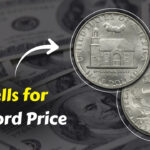
Schmitz placed Holy Trinity Church at the center of the obverse, rendering it with a broad roof and simple, restrained architectural lines. The date 1936 appears below the building the date Congress specified in the authorizing legislation, even though the coin wasn’t actually struck until the following year.
Those large, flat surfaces on the church’s roof give the design a clean, dignified look, but they also create a practical challenge for collectors: even minor contact marks show up easily against such open space, making eye appeal highly dependent on how carefully a given coin was handled and stored.
Reverse: The Kalmar Nyckel Under Full Sail
The reverse depicts the Kalmar Nyckel with its sails fully unfurled, commemorating the ship that carried the original 1638 expedition to the Delaware Valley. Below the vessel, Schmitz inscribed the dates “1638–1938,” pointing toward the tercentenary celebration that would take place two years after the coin’s minting.
Three small diamonds also appear within the design, a nod to Delaware’s nickname as “The Diamond State” and to its three counties: New Castle, Kent, and Sussex. The sails, like the church roof on the obverse, present large open surfaces that are prone to showing contact marks, making well-preserved examples with clean, undisturbed sails especially desirable to collectors.
Why This Matters for Collectors
The Delaware Tercentenary Half Dollar doesn’t rely on a dramatically low mintage to earn its place among the most interesting classic commemoratives its value as a collectible comes from the layers of history and quirky production details packed into a coin barely over an inch across.
A genuinely unusual production story. Few U.S. coins ask a collector to track three separate years the date on the coin, the year it was struck, and the anniversary it commemorates just to understand its own timeline. That triple-date puzzle gives the Delaware half dollar a built-in conversation piece that other commemoratives simply don’t have.
Real scarcity at the top of the grading scale, despite a decent overall survival rate. With roughly 17,000 pieces estimated to survive across all grades, the coin is far from difficult to find in circulated or lower Mint State condition. But population data cited by Heritage around the time of the 2025 sale showed only a handful of coins graded MS68 or finer, meaning the true top tier of quality remains genuinely elusive a dynamic reflected directly in the jump from the previous $18,400 record (set in 2012) to the new $19,200 benchmark.
An international companion piece. Sweden issued its own commemorative 2 Kronor coin in 1938 for the same New Sweden tercentenary, featuring King Gustaf V on the obverse and the Kalmar Nyckel on the reverse, struck in Latin-inscribed .800 fine silver a rare linguistic choice for Swedish coinage of that era. Collectors interested in the full story of New Sweden’s 300th anniversary often pursue both coins as a matched pair representing how two nations marked the same shared history.
A lingering unsolved question. Numismatic researcher Anthony Swiatek has floated the possibility that a small number of Proof (likely Matte Proof) Delaware half dollars may exist, though no confirmed population has ever been established. PCGS continues to catalog the issue only as a standard strike, leaving an intriguing, unresolved mystery for specialists to ponder.
Quick-Reference Buying Guide
- Understand what you’re buying. The Delaware Half Dollar is a vintage 1936-dated, 1937-struck commemorative not a current U.S. Mint product. It can only be purchased on the secondary market through dealers and auction houses.
- Decide on your target grade. Circulated and lower Mint State (MS60–MS64) examples remain relatively affordable and available; grades of MS67 and above are scarce and command premium prices.
- Buy certified whenever possible. Look for coins graded by PCGS or NGC, and check for CAC approval if you want an extra layer of quality verification, especially at higher grade levels.
- Inspect the obverse and reverse carefully. Because the church roof and ship’s sails present large open fields, examine both sides closely for contact marks, and check for even, attractive toning rather than blotchy or uneven color.
- Research recent sale prices before bidding or buying. Auction records including the current $19,200 high set in August 2025 provide useful benchmarks, but keep in mind that prices for common grades can differ dramatically from record-setting top-population coins.
- Consider the Swedish companion coin. If you’re building a New Sweden tercentenary collection, look into pairing the U.S. Delaware Half Dollar with Sweden’s 1938 2 Kronor commemorative for a fuller picture of the shared anniversary.
- Buy from reputable sources. Established auction houses, PCGS/NGC-affiliated dealers, and major coin shows offer the best assurance of authenticity and fair market pricing.
- Keep an eye on population reports. Grading populations can shift over time as more coins are submitted or resubmitted, so check current PCGS or NGC population data before assuming a given grade is as rare today as older references suggest.
Historical and market details in this article are drawn from publicly available auction records, congressional records, and numismatic references current as of August 2025. Prices and population data for graded coins can change as new examples are submitted for grading or come to market; collectors should verify current figures with PCGS, NGC, or a trusted dealer before making a purchase.