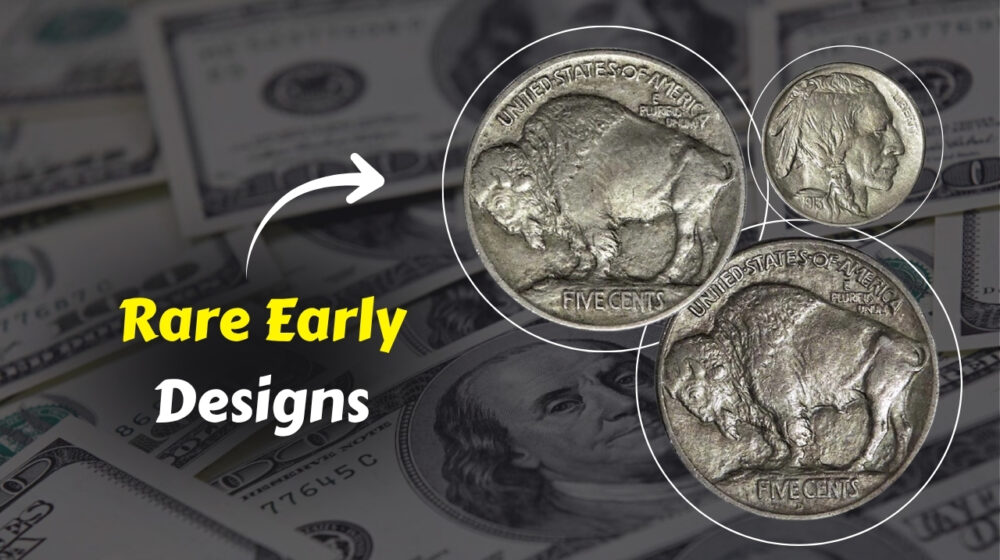
Long before the Buffalo nickel ever left a Mint press, it existed as an idea that had to be sold. In 1912, sculptor James Earle Fraser faced the task of convincing Treasury officials to abandon Charles E. Barber’s classical Liberty Head design in favor of something entirely new: a Native American portrait paired with an American bison. Rather than wait on the Mint’s slow process of preparing hubs, dies, and struck patterns, Fraser turned to the Medallic Art Company, which reduced his preliminary sculptural models into thin, coin-sized electroformed shells known as electrotypes.
Two of those shells one obverse, one reverse have now resurfaced as a matched pair with an extraordinary pedigree. Descended directly from the estate of James Earle Fraser and his wife, the accomplished sculptor Laura Gardin Fraser, the two-piece set is scheduled to cross the auction block as Lot 2048 in Stack’s Bowers Galleries’ Summer 2026 Global Showcase Auction, during the Rarities Night session on September 1. For collectors who specialize in the Buffalo nickel series, this is a rare chance to own physical evidence of the design’s creation, not merely a finished example of it.
Specifications at a Glance
| Detail | Obverse Electrotrial | Reverse Electrotrial |
|---|---|---|
| Designer | James Earle Fraser | James Earle Fraser |
| Manufacturer | Medallic Art Company | Medallic Art Company |
| Date of creation | 1912 | 1912 |
| Judd reference number | Judd-1912-1 | Judd-1912-2 |
| Weight | 4.0 grams (61.74 grains) | 4.096 grams (63.21 grains) |
| Format | Uniface (single-sided) electrotrial | Uniface (single-sided) electrotrial |
| Surface treatment | Plated/colored to simulate nickel coinage; deep pewter-gray | Plated/colored to simulate nickel coinage; deep pewter-gray |
| Grade | MS-64 (PCGS) | MS-64 (PCGS) |
| Holder | Housed together in a single double-size PCGS holder | Housed together in a single double-size PCGS holder |
| Auction lot | Lot 2048 (offered as a two-piece set) | Lot 2048 (offered as a two-piece set) |
| Auction house | Stack’s Bowers Galleries | Stack’s Bowers Galleries |
| Sale | Summer 2026 Global Showcase Auction, Rarities Night | Summer 2026 Global Showcase Auction, Rarities Night |
| Sale date | September 1, 2026 | September 1, 2026 |
A note on “mintage”: because these pieces were experimental studio artifacts made outside the U.S. Mint’s normal production process, they were never issued in any quantity comparable to a coin’s mintage figure. They exist as essentially unique developmental objects tied directly to Fraser’s design process, which is a major part of what makes the pair so significant.
For comparison, here is how the eventual production coin measured up once the Buffalo nickel design was finalized and struck:
| Detail | 1913 Buffalo Nickel (Type I, as issued) |
|---|---|
| Composition | 75% copper, 25% nickel |
| Weight | 5.0 grams |
| Diameter | Approximately 21.2 mm |
| Edge | Plain |
| First production | Philadelphia Mint, February 17, 1913 |
| Years of issue | 1913–1938 |
How to Bid: The Auction Process
Because this pair is being sold as an auction lot rather than issued directly by a mint, there is no fixed “mintage” or per-customer purchase limit in the traditional retail sense. Instead, interested collectors should keep the following auction logistics in mind:
- Sale venue and session: The electrotrials will be offered by Stack’s Bowers Galleries as part of its Summer 2026 Global Showcase Auction, specifically within the Rarities Night session, which is reserved for the auction house’s most significant and high-value lots.
- Sale date: The lot is scheduled to be sold on September 1, 2026.
- Lot number: Prospective bidders should reference Lot 2048 when researching or registering interest, since the two electrotrials are being sold together as a single set rather than individually.
- Registration: As with any Stack’s Bowers auction, participation typically requires bidder registration in advance, whether bidding live, by phone, by absentee bid, or online through the auction house’s bidding platform.
- Condition and authentication: Both pieces have already been independently graded and encapsulated by PCGS at MS-64, housed together in a double-size holder, which should give bidders confidence in authenticity and condition heading into the sale.
- Estimates and pricing: As with most rarities of this caliber, final hammer prices are determined by competitive bidding rather than a fixed retail price, so collectors should watch the auction house’s catalog listing for any pre-sale estimate as the date approaches.
- Provenance review: Given the strength of the pedigree, bidders serious about the lot will want to review the documented chain of ownership before the sale (detailed below), since provenance of this quality is a major driver of value for pattern and pre-production material.
Historical Background
The Buffalo Nickel: A Design Born from Necessity
By 1912, the Liberty Head nickel featuring Charles E. Barber’s classical Liberty portrait had been in circulation since 1883. Treasury Secretary Franklin MacVeagh wanted something different, and he found it in James Earle Fraser’s proposal to replace Liberty with a Native American portrait on the obverse and an American bison on the reverse. Mint Director George E. Roberts was also involved in shepherding the project forward. By January 1912, MacVeagh had formally settled on Fraser and his Native American-and-bison concept for the new five-cent piece.
The challenge Fraser then faced was practical rather than artistic: how to keep Treasury officials engaged and confident in the design while he continued refining his sculptural models. According to numismatic researcher Roger W. Burdette, who documented the episode in his 2007 book Renaissance of American Coinage: 1909–1915, Fraser and the Medallic Art Company solved this by producing electrotypes reduced, coin-sized electroformed shells based on Fraser’s preliminary models. Workers reinforced these thin shells with tin or type metal and finished the surfaces to resemble the intended coinage metal. The result let officials examine something tangible without requiring the Mint to cut hubs and dies for formal pattern coins at every stage of the design’s evolution.
The strategy worked. The Buffalo nickel entered production at the Philadelphia Mint on February 17, 1913, and remained the design of the five-cent piece through 1938 becoming one of the most celebrated coin designs in American history. Along the way, the design faced one more obstacle: the Hobbs Manufacturing Company, which made anti-counterfeiting devices for coin-operated machines, objected to elements of the new nickel, leading to months of friction with Treasury officials. Fraser pushed back against changes he felt would compromise the design’s artistic integrity, and the Mint ultimately proceeded largely on his terms. The Mint did, however, revise the reverse during the coin’s first year of production, lowering and recessing the FIVE CENTS denomination (creating the Type II reverse) after the original Type I design placed the bison on a raised mound.
James Earle Fraser: The Sculptor Behind the Design
James Earle Fraser was already an accomplished sculptor by the time he took on the Buffalo nickel commission, having studied and worked with the renowned Augustus Saint-Gaudens. Fraser would go on to create End of the Trail, one of the most recognizable sculptural images associated with the American West. His wife, Laura Gardin Fraser, was herself a distinguished sculptor and medalist. The electrotrials offered in this sale descended directly through the couple’s estate, which is the foundation of the set’s exceptional provenance.
Medallic Art Company’s Role
Medallic Art Company was the firm Fraser turned to for the electrotyping process itself. Rather than functioning as a mint or coin manufacturer, the company specialized in producing medallic and sculptural reproductions, which made it well suited to translate Fraser’s preliminary models into small, coin-format objects quickly and without the bureaucratic overhead of formal Mint pattern production. This made the company an essential, if often overlooked, partner in the Buffalo nickel’s development.
The Obverse Design
The obverse electrotrial, cataloged as Judd-1912-1, carries Fraser’s Native American portrait design and weighs 4.0 grams (61.74 grains). At first glance, the composition looks remarkably close to the finished portrait that would appear on circulating Buffalo nickels beginning in 1913. Look closer, though, and the piece reveals its developmental status:
- The date numerals are noticeably smaller than those used on the adopted, finalized design.
- Fraser’s designer initial, which appears on the finished coin, is absent from this early version.
- The modeling is softer and less sharply defined than a struck Mint product, since the electrotype was produced from sketch models rather than finished coinage-ready models.
That relative softness is not a flaw in the eyes of specialists it is precisely what makes the piece valuable as a historical document. It captures the Native American portrait at a moment when Fraser was still working out its final details.
The Reverse Design
The companion reverse electrotrial, designated Judd-1912-2, weighs 4.096 grams (63.21 grains) and depicts an early rendering of the American bison that would come to define the Buffalo nickel’s reverse. As with the obverse, the overall composition is immediately recognizable as an early version of the Type I reverse that debuted in 1913, but several differences set it apart:
- The words FIVE CENTS are rendered in smaller lettering than on the finalized design.
- Hyphens, rather than periods, separate the words in UNITED STATES OF AMERICA.
- The motto E PLURIBUS UNUM appears in unusually small lettering.
- The bison itself differs in a number of minor sculptural details from the animal ultimately used on regular-issue Buffalo nickels.
These variations give collectors a genuine window into Fraser’s decision-making process not just where the design ended up, but the intermediate choices he considered and later revised along the way.
Provenance: From Fraser’s Studio to the Auction Block
Provenance is arguably the single most compelling aspect of this offering. The documented chain of ownership is as follows:
- Origin: Commissioned by James Earle Fraser and produced by Medallic Art Company in 1912 during the development of the Buffalo nickel.
- Fraser Estate: The two pieces descended through the estate of James Earle Fraser and his wife, Laura Gardin Fraser.
- 1981 Sale: The obverse and reverse were sold separately by Bowers and Ruddy Galleries in the July 1981 sale of the William R. Sieck Collection, appearing as Lots 2421 and 2422.
- 1988 Sale: The pieces returned to the market via Stack’s in October 1988, listed as Lots 2610 and 2611.
- Certification: PCGS has since certified both pieces MS-64 and encapsulated them together in a single double-size holder.
- 2026 Sale: The pair is now being offered together as Lot 2048 in Stack’s Bowers Galleries’ Summer 2026 Global Showcase Auction, Rarities Night session.
This unbroken, well-documented lineage tracing directly back to the designer’s own estate is unusual for pattern or pre-production material and adds substantially to the historical weight of the set.
Why This Matters for Collectors
For most collectors, the story of the Buffalo nickel begins and ends with the finished coin. This two-piece set tells a different, earlier chapter of that story:
- A design caught mid-formation. The electrotrials show Fraser experimenting with letter size, punctuation, portrait detailing, and the bison’s form before any of it was locked in for coinage.
- Evidence of persuasion, not just artistry. These pieces were tools Fraser used to keep Treasury Secretary MacVeagh engaged with a design that broke sharply from the classical Liberty Head tradition. They document the political and institutional side of getting a radical coin design approved, not just the artistic side.
- A direct line to the designer. Because the set comes from the Fraser estate itself, it carries an authenticity of origin that few pattern pieces can match — there is no ambiguity about who made these or why.
- Rarity within an already scarce category. Pattern and electrotrial material from major 20th-century American coin designs rarely surfaces with this level of documentation, let alone as a matched obverse-and-reverse pair housed together in a single certified holder.
- Cross-collecting appeal. The set is likely to draw interest not only from Buffalo nickel specialists, but from collectors of pattern coinage generally, students of American sculptural history, and anyone building a collection around James Earle Fraser’s broader body of work.
In short, calling these pieces mere “patterns” undersells them. They are physical artifacts from the birth of one of the most iconic coin designs in American history.
Quick-Reference Buying Guide
- Identify the lot. Look for Lot 2048 in Stack’s Bowers Galleries’ Summer 2026 Global Showcase Auction.
- Confirm the session. The lot is part of the Rarities Night session, reserved for top-tier material.
- Mark the date. The sale is scheduled for September 1, 2026.
- Register as a bidder. Set up bidder registration with Stack’s Bowers in advance of the sale date, whether you plan to bid live, by phone, absentee, or online.
- Review the certification. Confirm the PCGS MS-64 grading and double-size holder housing both pieces together.
- Study the provenance. Familiarize yourself with the documented ownership chain Fraser estate, 1981 Sieck Collection sale, 1988 Stack’s sale, and current PCGS certification as this is central to the lot’s value.
- Watch for the estimate. Check the official auction catalog listing as the sale date approaches for any pre-sale price estimate.
- Place your bid. Participate through your chosen bidding method (live, phone, absentee, or online) once the Rarities Night session opens.
This article is based on publicly available auction information regarding Lot 2048 in Stack’s Bowers Galleries’ Summer 2026 Global Showcase Auction. Collectors are encouraged to consult the official auction catalog and Stack’s Bowers Galleries directly for the most current details, estimates, and bidding procedures.